Knowing Is Half the Battle: States Lack Data to Make Good Transpo Decisions

As attention turns to performance measures as a way to squeeze every last drop of value out of scarce transportation dollars, states are going to need to do a better job proving the efficiency and effectiveness of their programs. Trouble is, most states don’t even bother to collect the information they need to show what actually works.
Is this why so many states make questionable decisions, prioritizing highway expansion over transit, walkable streets, and bicycle facilities when trying to fight congestion? Not exclusively, but the lack of good data leaves a bigger opening for purely political considerations to dictate transportation policy. A December GAO report that found that 30 states’ transportation planning officials said that political support was of great or very great importance in selecting projects; just 11 states said the same about economic analysis.
The Pew Center on States and the Rockefeller Foundation just issued “Measuring Transportation Investments: The Road to Results,” a thorough examination of states’ transportation data-gathering capabilities. They found that many states simply don’t have the information they need to accurately evaluate and report on their own performance in the areas of safety, jobs and commerce, mobility, access, environmental stewardship and infrastructure preservation.
Bob Zahradnik, Pew’s research director, told reporters that these days, with money so hard to come by, it’s critically important that every dollar spent deliver a strong return on taxpayers’ investment and advance states’ economic growth.
Many states are spending tax dollars without the data and information to ensure that those dollars are being spent efficiently and effectively. Many, including some policymakers in Washington who are working on reauthorization of the federal surface transportation law, are proposing to move to a performance-based approach that more closely ties dollars to outcomes.
But too often, policymakers don’t know or can’t answer critical questions about results these investments are generating, especially in key areas such as jobs. Without the tools to guide smart decision-making, it’s difficult for policymakers to prioritize transportation investments, target scarce resources, and help foster growth.
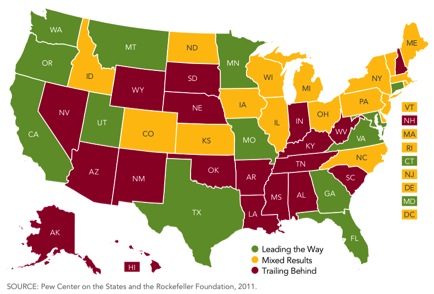
The report found that there’s no easy way to categorize the states that are “leading the way” or “trailing behind” in information-gathering – each group has urban and rural states, large and small states, rich and poor states.
Every state and the District of Columbia scored well on safety information, mostly because the federal government requires collection of data on fatalities. (Information on injuries, however, is harder to come by.) But states fared dramatically worse in their collection of information on environmental stewardship and job creation.
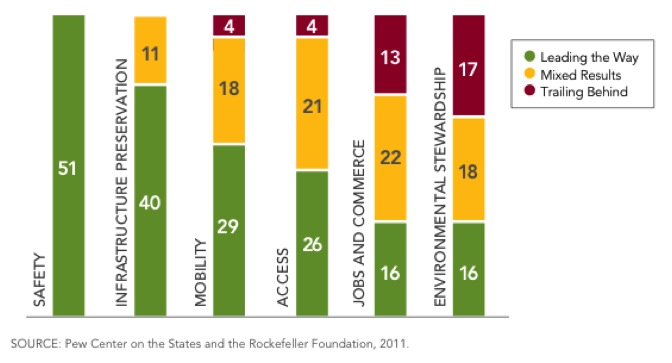
The collection of solid data and the ability to use that data to justify the benefit of transportation expenditures helps the public gain confidence in state transportation agencies. In Washington, once the state started scoring projects based on a cost-benefit analysis, the legislature was persuaded to sell bond issues and increase the gas tax to bring in more revenue. Georgia has begun assessing potential projects in terms of their ability to improve mobility and create economic development. Oregon measures the number and rate of crashes in which large trucks were at fault, using this information to increase safety precautions.
The report spotlights TIGER as heralding a sea change in how transportation dollars are allocated. “[TIGER] requires state and local governments to demonstrate that their proposals fit general criteria set forth by the federal government—including relatively new ones such as environmental stewardship and the capacity to promote economic development,” the authors wrote. “What is more, state and local governments are required to carefully measure the benefits of these expenditures to ensure they are meeting expectations.”
Many have hailed TIGER as setting a higher standard for ensuring that limited transportation dollars are spent wisely. “The expectation around the country is that the government can no longer use the public’s money without knowing what benefits and results we’re getting with the investment of those dollars,” said Paula Hammond, head of the Washington State Department of Transportation, quoted in the report.
If discretionary programs like TIGER grow, and more public funding is distributed based on performance metrics, data-gathering would then become increasingly critical to a state’s ability to get funding. Pew and Rockefeller suggest that, to compete, states should improve their information collection capabilities, set performance measures at the state level, take performance into account when making appropriations, use cost-benefit analyses and citizen feedback to make decisions, and improve coordination among agencies.
The states that showed the best data-gathering and performance measures were California, Connecticut, Florida, Georgia, Maryland, Minnesota, Missouri, Montana, Oregon, Texas, Utah, Virginia and Washington. The authors report that Colorado, Michigan, and Pennsylvania “just missed” making it into this category.
The states with the farthest to go: Alabama, Alaska, Arizona, Arkansas, Hawaii, Indiana, Kentucky, Louisiana, Mississippi, Nebraska, Nevada, New Hampshire, New Mexico, Oklahoma, South Carolina, South Dakota, Tennessee, West Virginia and Wyoming.

Read More:
Streetsblog has migrated to a new comment system. New commenters can register directly in the comments section of any article. Returning commenters: your previous comments and display name have been preserved, but you'll need to reclaim your account by clicking "Forgot your password?" on the sign-in form, entering your email, and following the verification link to set a new password — this is required because passwords could not be carried over during the migration. For questions, contact tips@streetsblog.org.