Buttigieg’s New Emissions Standards Fail to Close ‘Light Truck Loophole’
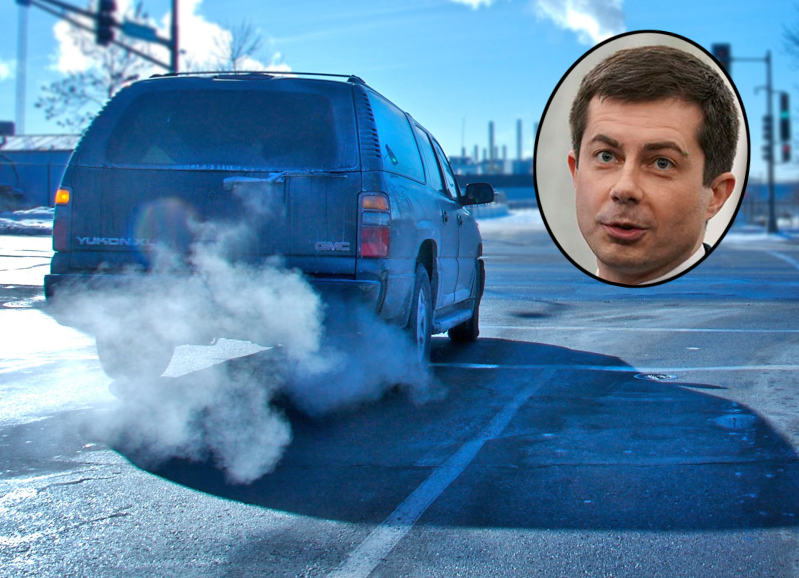
Transportation Secretary Pete Buttigieg announced strong new emissions rules last week — but, once again, the strictest standards won’t apply to the biggest, dirtiest cars that constitute three-quarters of the new vehicle market today.
On March 31, the National Highway Traffic Safety Administration won applause from some sustainability advocates when it announced new Corporate Average Fuel Economy standards (also known as the “CAFE standards”) that will require U.S. automakers to achieve, by 2026, a rough average of about 49 miles per hour per gallon across all the models they make.
But that’s a very rough average, in part because there are actually two sets of standards governing allowable U.S. tailpipe emissions: one for the small-format automobiles that the feds call “passenger cars” — which will have to get 59 miles per gallon by the time the new rule is in full effect — and a much lower one for “light trucks,” a confusingly named umbrella category that includes most sport utility vehicles, pick-up trucks, and vans.
Four years from now, the average megacar will need to be able to travel about 42 miles per gallon of gas, or the equivalent number of kilowatt hours for electric trucks and SUVs, though both will be significantly less fuel-efficient in real-world road conditions. And thanks to the byzantine way that NHTSA does its caculations for this stuff, light truck standards tend to be even more lax when an automaker primarily makes big cars — which at this point, virtually all of them do, because SUVs and pick-ups are significantly more profitable than sedans.
Put another way: the emissions impact of megacars, on average, is graded on such a steep curve that such cars are essentially allowed to pollute about 40 percent more than small ones — and in 2020, a whopping 74.8 percent of new cars sold in the U.S. were megacars, because automakers basically refuse to make anything else.
Here’s the thing: at one time, the light truck loophole actually made a kind of sense.
When the category was first created in 1975, megacars constituted just 21 percent of new vehicle sales, and were largely used as work vehicles in the agricultural and heavy industry sectors — or, as Vice’s Aaron Gordon aptly put it, “Nobody in their right mind would have wanted to drive such a massive, expensive, gas-guzzling vehicle just for the hell of it.”
Today, though, most megacars spend most of their time on the road performing exactly the same function as so-called “passenger” cars — namely, carrying passengers, rather than beds full of construction equipment or bales of hay. Today, only about 25 percent of light truck drivers use their cars’ astonishing bulk to tow something more than once a year — experts believe most of them never hook anything to the hitch — and despite what mountain-climbing stunts in car commercials might suggest, a staggering 70 percent say they pretty much never take their vehicles off of a paved road. Moreover, 35 percent of pick-up drivers admit they use the bed of their truck once a year or less; and once again, experts think most of that group never hauls anything at all.
Even if they never carry anything heavier than a load of groceries, though, megacars still have one big advantage over smaller models: they tend to keep their occupants alive in the event of a crash. One Insurance Institute of Highway Safety study found that “small cars and minicars accounted for 15 of the 20 models with the highest death rates for model year 2017, while nearly half of the 20 models with the lowest death rates were luxury SUVs.” (Pick-up trucks, on the aggregate, actually have an even a lower death rate per mile, though researchers note they’re driven a lot more, which could skew the stats.)
Unfortunately, those same design features that tend to save megacar occupants’ lives — think high front ends, sturdy structural supports, and effectively armored walls — also tend to make their drivers less likely to be able to see other road users in their path, and more likely to kill them when an impact occurs. A recent study found that SUV and pickup truck drivers are three to four times more likely to strike a walker when they’re making a turn, compared to motorists with smaller vehicles — and when that happens, the pedestrian is two to three times more likely to die.
Advocates had hoped that if Buttigieg wouldn’t use the New Car Assessment Program to acknowledge the risks that megacars pose to pedestrians and the drivers of smaller cars, he might at least address the risks they pose to the planet by closing the light truck loophole. Now that he hasn’t, it’s more important than ever that policymakers seize every other possible opportunity to reduce Americans’ dependence on automobiles — because if they don’t, America’s ever-growing appetite for ever-growing trucks and SUVs could all too easily cannibalize smaller cars’ climate gains.

Read More:
Streetsblog has migrated to a new comment system. New commenters can register directly in the comments section of any article. Returning commenters: your previous comments and display name have been preserved, but you'll need to reclaim your account by clicking "Forgot your password?" on the sign-in form, entering your email, and following the verification link to set a new password — this is required because passwords could not be carried over during the migration. For questions, contact tips@streetsblog.org.