Study: Americans Already Doubt the Myth that ‘Driving is Freedom’

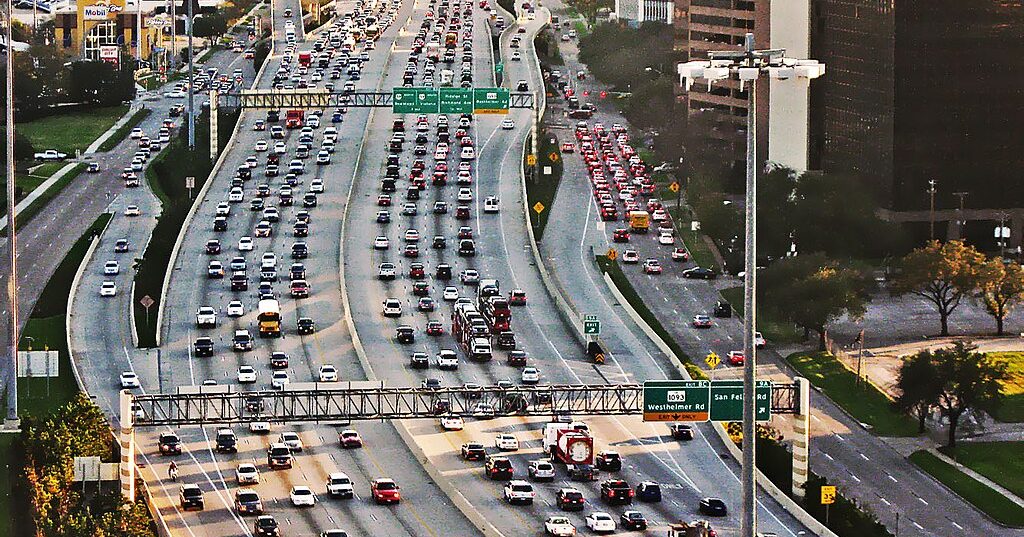
An overwhelming majority of US motorists say they feel they have zero choice in how much they get behind the wheel — and most of them explicitly want to flee a system that forces them to drive almost everywhere they go, a new study finds.
A stunning 73 percent of self-identified drivers in a recent survey by the Climate and Community Institute said they “have no choice but to drive as much as they do,” with another 53 percent reporting that they “would like to have more transportation options” beyond endlessly reaching for the keys.
That second number may be an undercount — both because CCI conducted the poll before the war in Iran sent gas prices soaring, and because many Americans simply cannot imagine a future where their own cities make driving optional and offer attractive alternatives.
For the one in three US residents who can’t drive or lack reliable access to a car, though, those auto-centric cities are just a difficult fact of life — and they need more motorists to join them in the fight for more and better travel options.
“Whether you get around mostly by car or you don’t drive at all, most people in the U.S. are united by feeling unhappy with their daily transportation options,” said Emmett Hopkins, the transportation policy manager at the Institute and co-author of the study. “Broadly speaking, they want the same thing: more good transportation options that don’t [leave] a car as the only choice — or basically, the forced choice.”

Unfortunately, most US policymakers haven’t exactly gotten the memo about how many of their constituents feel trapped by car dependency — never mind how many of them long to escape it.
Co-author and researcher Kira McDonald points out that the federal government routinely guarantees 80 percent of federal funds to automotive uses alone, while making much of the funding for shared and active transportation all too easy to claw back. As those ratios propagate across state and local transportation policies, highways, parking lots, and other car-centric infrastructure have come to dominate our physical environment.
Worse, car dominance has created the impression that America is a “nation of drivers” rather than a nation of people who drive because they have no other choice — and quite often, despite the fact that they can’t really afford to.
Two in five adults surveyed said they struggled to afford an unexpected transportation cost like a car repair, and the same share said they sometimes have to make significant adjustments to their budget just to stay on the road.
“A ludicrous percentage of adults use cars to get to work — [but that’s] because we are under-investing in other modes,” McDonald added. “The novel contribution of this report was to supplement those [mode share statistics] with survey data, and ask people what they actually want.“

To get even further beyond the statistics, co-author Ruth Rojas led an effort to gather stories from non-drivers about how car dependency impacts their lives — and help explain why so many US residents are hesitant to join their ranks.
Again and again, she found that non-drivers struggled with unreliable transportation, navigating transit-poor neighborhoods, and lengthy commutes across sprawling regions. She cites the example of immigrant communities, where she says those challenges can fuel a belief that life would be easier on four wheels — until they actually get a car, and find themselves trapped in it for much of the day.
“[I personally came from] an immigrant family who didn’t have access to cars in a small town that was very spread out and didn’t have public transit,” added Rojas. “My family really bought into that idea that cars meant freedom, cars meant getting a job, cars meant more economic growth. … The narrative ends up being that cars give us a perceived freedom… What gets left out is everybody who doesn’t — or maybe can’t — [drive them].”

Rojas and her co-authors acknowledged that it’s not enough to simply make policymakers aware of how poorly the transportation system is serving is non-drivers and compulsory motorists alike — or even what a sheer majority of Americans belong to their ranks.
Hopkins stressed that much of US transportation policy is the product of “profit-seeking forces” that have successfully influenced lawmakers to privilege automotive interests over the needs of everyday people — and it will take organizing among those people to change the tide.
“This call to offer more people more choices is really a call to stand up for working people against corporate power determining what options they have in their lives,” he adds.
Still, the report says change is possible, starting with “an overhaul of Departments of Transportation (DOTs) at the federal and state levels, as well as massive investment in diverse transportation options to help people have choice in how they get around.” The executive branch, meanwhile, must overhaul auto-centric “rules, guidelines, and culture,” while Congress must use its power of the purse to robustly fund that shift.
Needless to say, local governments must work fast to implement those changes on the ground, in ways that actually engage with the majority of residents who are clamoring for other options. And they have an even more critical role to play among residents who would embrace a different transportation landscape, if they just got a taste of how good life with a broader menu of mobility options can be, even if the transition feels temporarily uncomfortable.
“I think there’s a kind of induced demand [among] people who want to live outside of car dependency, but they don’t know it yet, because they haven’t experienced it,” added McDonald. “These policies always see their popularity improve after implementation.”

Read More:
Streetsblog has migrated to a new comment system. New commenters can register directly in the comments section of any article. Returning commenters: your previous comments and display name have been preserved, but you'll need to reclaim your account by clicking "Forgot your password?" on the sign-in form, entering your email, and following the verification link to set a new password — this is required because passwords could not be carried over during the migration. For questions, contact tips@streetsblog.org.