Progressives Don’t Necessarily Deliver on Transportation at the State Level, Either


A version of this article is the first in a short series that was originally appeared on the author’s Substack. It is republished with permission; read part one in the series here.
Let’s look at some states’ transportation performance, starting with climate. Democrats support reducing climate emissions and Republicans don’t — right?
Not necessarily. Former Washington State Gov. Jay Inslee was often called the climate governor. But he didn’t apply his climate leadership to the state’s transportation program. He liked to build new highways too much. See our report, Fueling the Crisis, on how states spent their federal transportation funding under the Biden era Infrastructure Investment and Jobs Act (IIJA).
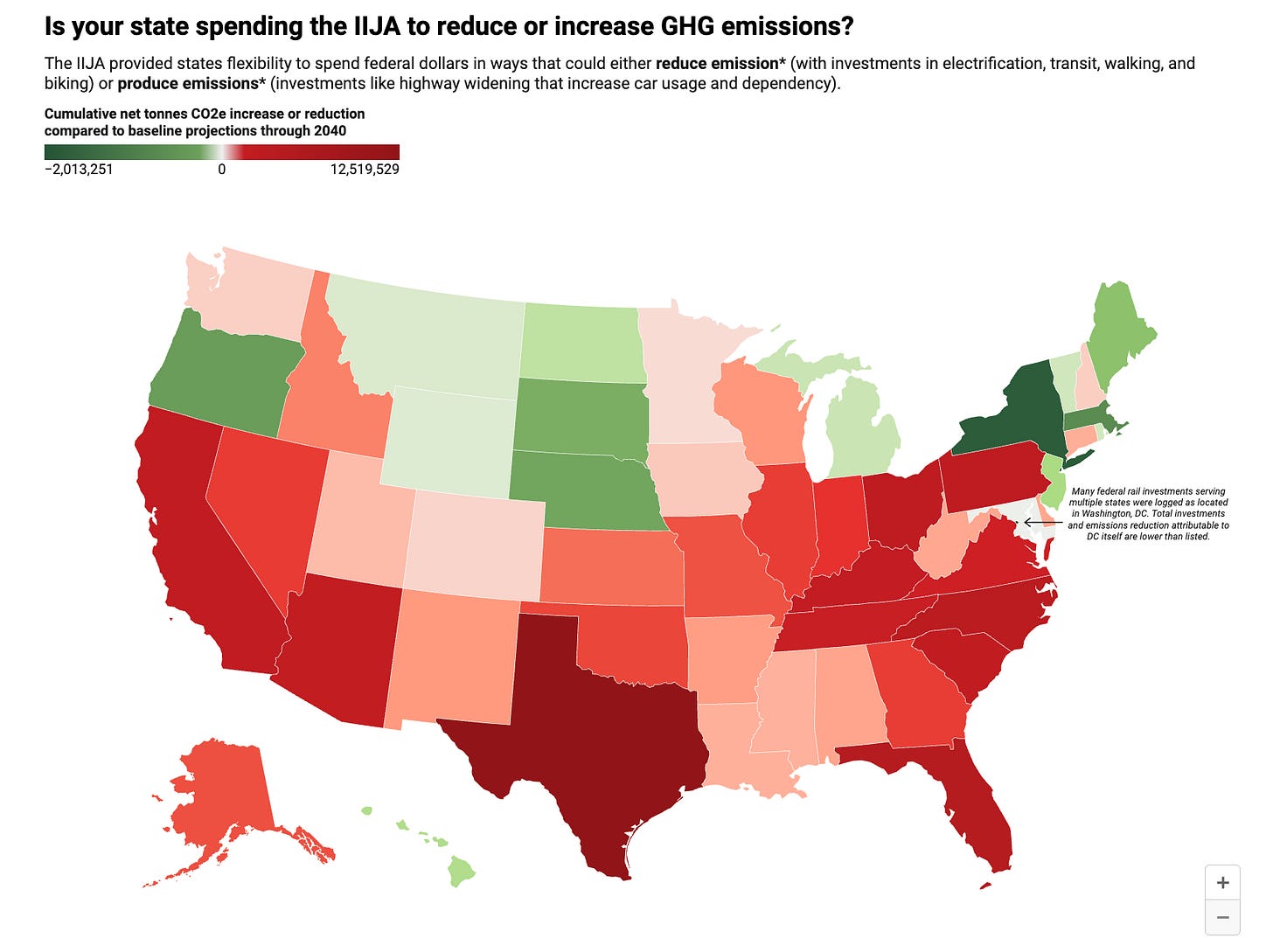
Why did North Dakota, South Dakota, Nebraska, Wyoming, and Montana perform so much better at reducing emissions than California, Washington, and Connecticut?
It wasn’t because they promised climate action and delivered. It’s because they are less likely to build highways they can’t afford to maintain. In other words: fiscal responsibility might be better for the climate than a climate champion.
Most people believe that Democrats care about more than just reducing traffic congestion. They want to provide ways to move around outside of a car. But do they?
North Carolina likes to brag about putting some money into rail and bike/ped projects, but that amount is very small compared to their highway building budget. That is no surprise when you look at the five scoring criteria North Carolina uses to prioritize statewide projects for funding:
- 30 percent travel time benefits v cost, which is how much vehicle speeds increase vs cost (safety is not part of their economic case);
- 30 percent congestion, which scores the problem of congestion, not how an investment will affect it;
- 10 percent economic competitiveness, which estimates how speeding up vehicles affects the economy according to the TREDIS model;
- 20 percent multimodal, which is just existing congestion on military and truck routes plus truck volumes; and
- 10 percent safety, which is the existence of a safety problem rather than how a project might improve it.
In other words, it’s 90 percent the existence of congestion and/or how an inaccurate transportation model claims a project will improve it … and 10 percent safety.
Oregon is often held up as a leader on transit — but it has a constitutional restriction on using the gas tax or vehicle taxes for transit and spends a fraction of what they spend on highways for transit.
The state has lost a lot of goodwill due to its roughly $1 billion budget gap that caught lawmakers and the public by surprise. Oregon’s truck taxation system has generated years of controversy over whether heavy trucks were paying too much, followed by calculations indicating they were paying too little.
And while the state pleads poverty about transportation maintenance and staffing, it commits billions in borrowing and matching funds to megaprojects, like the I-5 Rose Quarter expansion that will induce traffic and likely cost way more than whatever ODOT is saying it will cost now. Further, ODOT struggles to deliver the Columbia River Crossing project after decades of talking about it; I worked on this project when I worked for Rep. Brian Baird in the late 1990s.
The governor is looking for a new ODOT leader now. The fear is that she will pick someone who is an expert in how ODOT has run in the past rather than someone who understands how ODOT needs to modernize to deliver the results it has consistently promised to the Oregon taxpayers.
In fact, this is a challenge that many new governors — at least the 18 of them who will face after the election in November. Stay tuned, because we will have a memo for those newly elected leaders calling for and explaining how to connect their transportation priorities to their transportation spending.
Some states have made progress but it isn’t always clear whether a new governor will maintain it.
The State of Minnesota will have a new governor, likely Sen. Amy Klobuchar, who has a voting record in the Senate of supporting a status quo transportation policy. But many of the exciting updates in Minnesota’s transportation policies were legislated, and the legislative champions, such as Sen. Scott Dibble, are likely to still be in office to protect them.
Under Gov. Jared Polis, Colorado has funded some pretty massive highway expansions that will do little-to-nothing to address congestion or spur the economy. But his administration also established a rule that requires the Colorado Department of Transportation and the state’s five metropolitan planning organizations to show that their transportation plans cut greenhouse gas emissions. If they can’t, they must offset those emissions or remove the projects that cause emissions increases.
The progressive Democrat that is likely to be the next governor of Colorado, state Attorney General Phil Weiser, was rumored earlier in the campaign to be squishy on this important policy. But recently, supporters sound more hopeful.
This is not a comprehensive write-up of where progressive state DOTs land on transportation policy. There are blue states doing very interesting things, like Virginia and Smart Scale and Minnesota on transit funding and climate. There are red states that are being ridiculous, like Florida which has made some safety projects illegal even though it is the most deadly state for cyclists and third most deadly for pedestrians. I can’t cover everything here.
But which states are willing to try new things and innovate does not always track with their partisan leaning. For example, my organization has had success working on quick build safety demonstration projects on state roads in Alabama, Kentucky, and Tennessee — while being told by Pennsylvania and North Carolina that they simply couldn’t do the same. We have also worked with California, Connecticut, and Maryland on some awesome quick-build safety projects. Just don’t assume.
The point is this: just because leaders claim to share your priorities does not mean they will do anything meaningful to move those priorities forward. And sometimes those who claim to oppose one of your goals (like reducing emissions) support other goals (like fiscal responsibility) that will get to the same outcomes.
Conservatives might sometimes produce better progressive outcomes than progressives, even if it is unintentional.If you support transit or more walkable communities or climate or reconnecting communities or fix-it-first or whatever, do not assume that a Democrat will be your champion or that a Republican will block your priorities.
No matter who is in charge, figure out what they care about and where your priorities might overlap or lead to similar outcomes. Demand leadership that is fresh and expert in where you want to go, not where you have been. And then demand that the transportation agency be held accountable for the results it achieves — whether that means criticizing your supposed allies or praising your supposed opposition.

Streetsblog has migrated to a new comment system. New commenters can register directly in the comments section of any article. Returning commenters: your previous comments and display name have been preserved, but you'll need to reclaim your account by clicking "Forgot your password?" on the sign-in form, entering your email, and following the verification link to set a new password — this is required because passwords could not be carried over during the migration. For questions, contact tips@streetsblog.org.