Why Progressives Don’t Deliver on Federal Transportation Policy

A version of this article is the first in a short series that was originally appeared on the author’s Substack. It is republished with permission; check back tomorrow for part 2.
I work at a nonpartisan 501(c)(3) organization, but that doesn’t mean I can’t talk about my experience working with each party. And a poor understanding of what is partisan and what is bipartisan in transportation leads to poor advocacy and bad outcomes.
I pick more on the Democrats because they make loads of speeches and promises about how much they share my organization’s transportation priorities, but they don’t show it in their legislating or administration of programs. Republicans are more honest about their trepidation or even opposition.
And while it surprises people to hear this, when Republicans agree with us, they are much more likely to champion those changes. For example the creation of the intercity passenger rail program in the 2015 surface transportation bill wouldn’t have happened without Sen. Roger Wicker (R-MS).
Let’s dig into this, starting with Democrats.
Democrats tend to claim that funding transit, rail, and walking and biking infrastructure is a priority. They talk about creating good-paying jobs and building a system that does not hurt the environment, public health, or the neighborhoods around it. But they tend to support the exact same projects and programs as those who do not champion these things.
Republicans talk about transportation investments that support a strong economy. They want the states to have control over federal funds and to support rural areas, improve freight movement, and to ensure that the user pays and that the user who pays reaps the benefits of the investments they fund. For the most part, they don’t actually end up funding projects that accomplish those outcomes.
Both parties do so much to undercut what they claim to care about.
Democrats often focus on supporting spending that creates good construction jobs, but they are less concerned with whether the projects those jobs build accomplish anything or even cause harm. Republicans say they want to prioritize rural needs but then pour money into “fixing” urban congestion with highway expansions that create more congestion or they push highways through rural villages that hollow them out.
While both parties are foolish, they are not the same. Republicans would rather have nothing than something they don’t like. Democrats need something and make it clear they will take anything over nothing. So Republicans have a stronger negotiating position.
Republicans are also willing to use their administrative power to push their priorities, while Democrats prefer to write plans about what someone should do someday.
Some examples: I worked at the U.S. Department of Transportation during the Obama Administration. During those eight years, Congress passed and the President signed two transportation authorization bills. Both of them maintained the basic structure of the program that has existed since 1991:
- 80 percent of funding for highways (all guaranteed) and 20 percent for transit (not all guaranteed);
- no reward for improvements in priorities like safety or repairing crumbling infrastructure, and no accountability for doing worse;
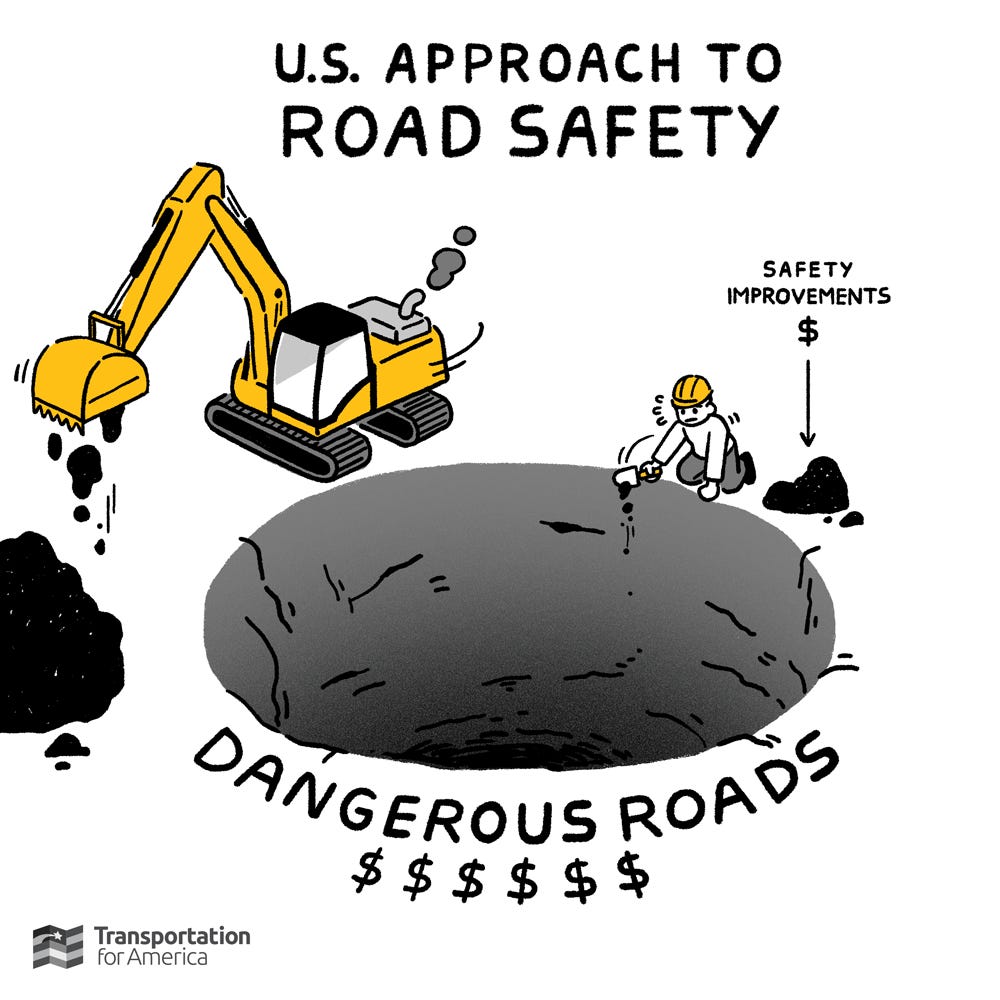
- small programs (e.g., Transportation Alternatives, the Highway Safety Improvement, and Congestion Mitigation and Air Quality Improvement programs) to fix the ongoing damage caused by all of the rest of the much bigger programs; and
- continued support for tools that made it hard to do what we claimed we wanted, like a benefit-cost analysis that quantified mostly congestion benefits, travel demand modeling that was consistently wrong, and design standards that produced unsafe results, etc.
Democrats don’t take their progressive stances into transportation.
For example, when Democrats talk about addressing climate change, they mean that they want the auto companies to produce more efficient cars, not that they want to produce a more efficient transportation system.
There is a bipartisan version of this too. Such as when members of both parties say they want safer roads, they mean they want people to behave better on the roads, and maybe that auto manufacturers should build safer cars, when pushed. They do not mean that they would require roads to be designed in ways that produce safer results.
The first Trump Administration did not move a transportation bill. The Biden Administration did, with some fanfare.
Biden’s bill included a lot more money, but for the most part, the same structural problems bulleted above continued — though credit to them for funding rail investment and electric vehicle charging infrastructure. Unfortunately, they made both programs cumbersome, and most of the money was still sitting unused when the second Trump Administration took over, allowing them to rescind those grants and repeal or change those programs.
Last summer, the House Transportation and Infrastructure Committee passed a bill, almost unanimously, that cuts transit and rail, ends the climate and EV charging programs, and includes almost none of the smaller programs that fix the damage caused by the big programs, except for a couple safety programs that the Trump Administration has already said they will not to be used as the law intends.
Committee Democrats — especially the progressives — praised the bill publicly, but privately said that this was “the best they could do” in the current political environment. However, most have also made clear that, if the political environment changes in the next Congress, they will feel pressure to support the same bill, because they voted for it already.
One has to wonder who is actually supporting the progressives’ supposed priorities.
Progressive leadership does not tend to result in progressive transportation policy. If groups that want the outcomes that progressives claim to care about, then they need to dial up the pressure for real actions.
Speeches don’t create change. And decades of saying that they wish they could do more started sounding hollow years ago.
Tomorrow I will focus on the so-called progressives and champions of multimodal transportation at the state level. Spoiler alert: it is the same as at the federal level.

Streetsblog has migrated to a new comment system. New commenters can register directly in the comments section of any article. Returning commenters: your previous comments and display name have been preserved, but you'll need to reclaim your account by clicking "Forgot your password?" on the sign-in form, entering your email, and following the verification link to set a new password — this is required because passwords could not be carried over during the migration. For questions, contact tips@streetsblog.org.