We Don’t Need to Ban Pick Up Trucks to Take Action on Vehicle Safety
A version of this article recently appeared on Love of Place. It is republished with permission.
The New York Times recently ran a big expose about how big trucks and SUVs are killing Americans. According to their analysis, these large cars lead to between 200 and 400 extra deaths a year, although they said it was a conservative estimate. Even Trump commented about it, along with GM CEO Mary Barra.
This did not surprise me. Federal agencies, like the National Highway Traffic Safety Administration, have known about the increased risk since at least 2015, when they published a research review (though their estimate was higher than the Times.) The Detroit Free Press also found the same thing when they conducted a similar study about a decade ago.
I wrote a book about all this that was published a good six years ago and have traveled quite extensively speaking about it since. Along the way, other credible agencies, like the Insurance Institute for Highway Safety and Consumer Reports, have done studies and come to similar conclusions. I don’t think there’s any debate that larger vehicles are killing people on the roads. This finding has been replicated so many times.
This has been an open secret for a long time. And in fact, when I was working on my book, I found experts that had warned about SUVs and pickups killing pedestrians as far back as the 1990s. But then everyone forgot.
The only reason the New York Times was able to do the kind of study they did, is because a few years back, Consumer Reports took it upon themselves to gather all the data about hood heights for consumer cars and trucks. Prior to that, no one had that data. It just wasn’t tracked because it wasn’t considered a consumer feature.
When I wrote my book, I went around with a tape measure to see how tall grilles of cars were. The Detroit Free Press did the same thing in their analysis and actually theirs was a lot more rigorous than mine. They went to dealerships to do the measurements, in order to assure tire pressure etc. wouldn’t interfere with the results.
One thing that is annoying about this discussion, though, is that whenever I try to bring this up, reactionary people freak out because they think I want to BAN PICKUP TRUCKS.
I basically agree that an idea that extreme is a political nonstarter. However, there are about 1 million intermediary steps we could address short of that could help minimize the risks large consumer vehicles pose to innocent people, without making it impossible for plumbers and landscapers to do their jobs.
The good news is, just last week for the first time NHTSA unveiled its first ever pedestrian safety rankings for cars. I like to think my work helped contribute to this ridiculously modest reform.
While it’s good that there is finally an acknowledgment of these risks, the new rating is a half measure at best. Instead of making pedestrian impacts part of the well known “five-star” rating system, they way they do in Europe and parts of Asia, NHTSA created this dumb little side measure — a separate category — for pedestrian safety that won’t appear on the hood of cars in the dealership. They’ll just be displayed on NHTSA’s website.
I assume they added a pedestrian safety rating but then hid it away to capitulate to some American auto companies that are heavily invested in pickup trucks, like General Motors. Still, at least they finally did something.
Nobody’s asking me. I’m just a person with a blog and middling following. But if I were president of the universe, here are the additional half-measures (short of banning pickup trucks I would take:
1. Ban after-market vehicle modifications — or at least regulate them more
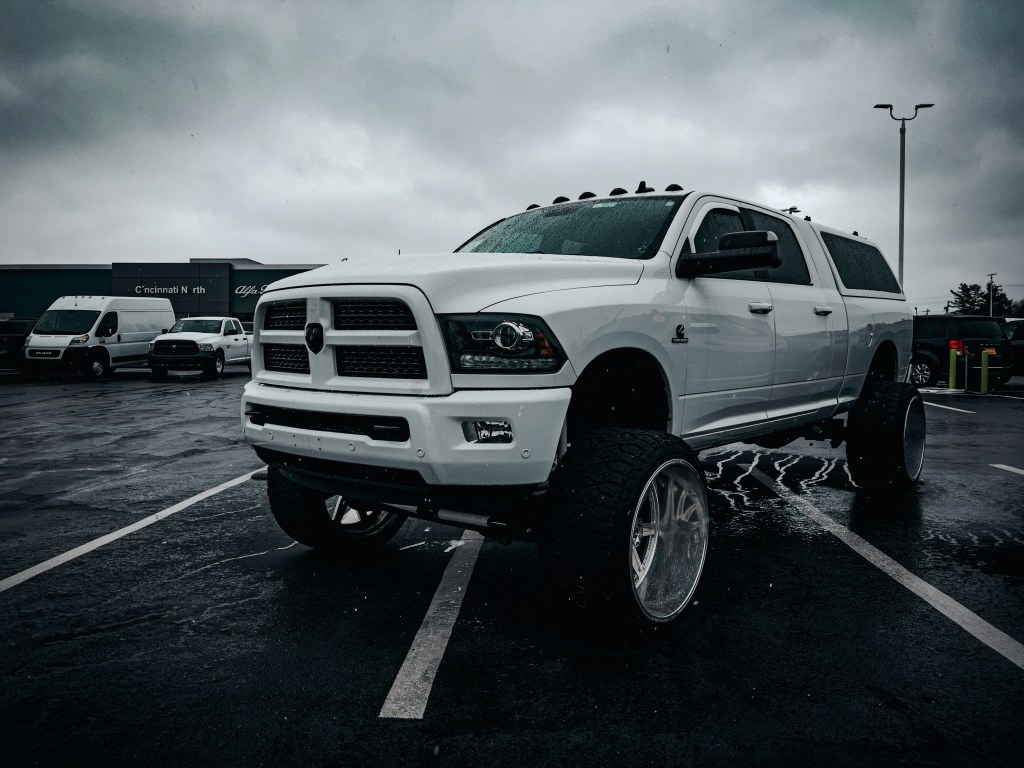
It’s one thing that pickup trucks roll off the factory floor with 55-inch grilles; that’s a bad thing. But we allow any rando to buy an after-market lift kit and jack it up even more — enough so that entire standing adults will be invisible at close range.
Not only is lifting a pickup dangerous to everyone, it’s more dangerous to the drivers themselves, because it becomes really top heavy and is more likely to roll over, which is likely to cause a fatality. There’s a reason racing cars have a very low center of gravity.
Some states do regulate after market vehicle modifications like this, or like “bull bars” which eliminate the crumple zone on cars — no bueno. They also pose additional risks to pedestrians, which is why they are banned in other countries, like the UK. Even the states that do regulate this kinda stuff are very hands off, which I can sort of understand, to be honest.
Rather than making police responsible for this kind of thing, we should just not allow third parties to sell after-market products the threaten public safety. We regulate vehicles for safety and crash impacts; you shouldn’t be able to just undo that with some dumb $150 kit you bought online. It’s dangerous to you and to others.
Short of that, we should at least stop purchasing these kind of after-market kits for public fleets. I saw bull bars on Portland police cars the last time I was there, which is disappointing because they’re a “Vision Zero” city, which means they ostensibly care about traffic safety.
Taxpayers shouldn’t be asked to pay extra for vehicle features that make public cars less safe, and which also could put them on the hook for extra damage if someone is struck and the agency is sued — something that happens to police departments a lot.
Some will claim they need them to move a car off the road or something; if so, they could just have them on one vehicle they use for that purpose. Not every vehicle needs them. In my opinion, though, police just use bull bars to make their cars more military/intimidating looking, which is bad for public relations anyway.
2. Regulate grille heights — or at least require front cameras if not
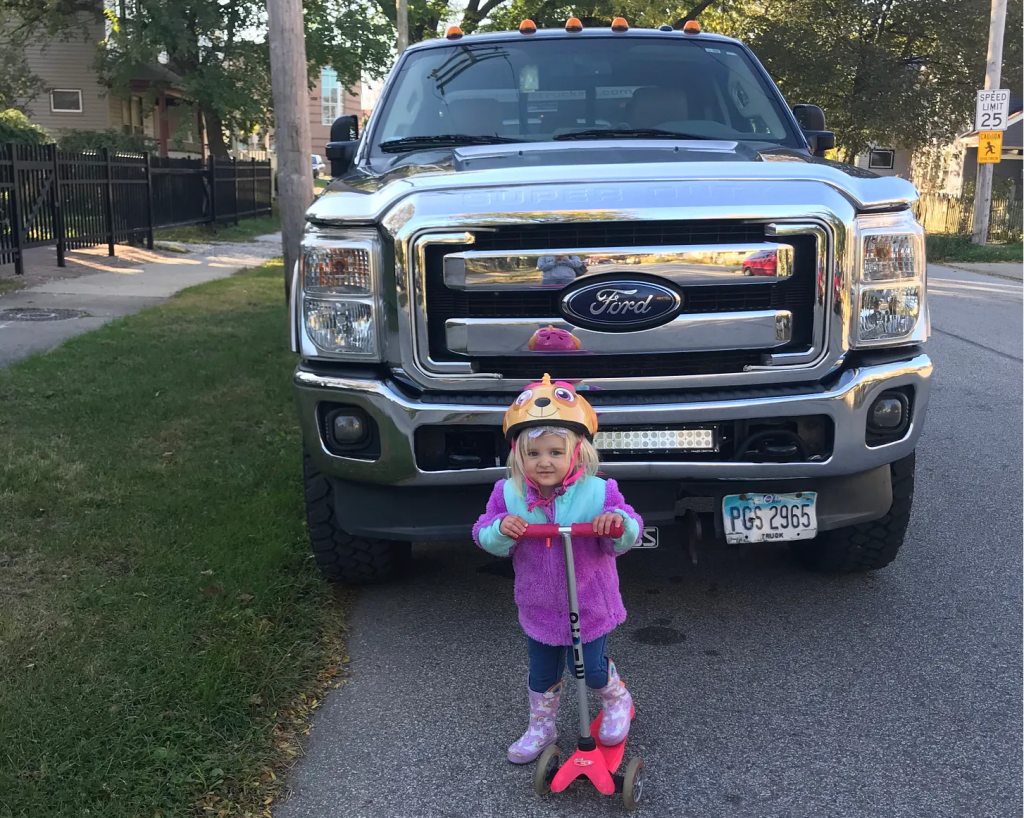
Many of the best selling pickup trucks in America now have 55-inch grilles. That’s tall enough to obscure the average standing 4th grader, not to mention anyone in a wheelchair. This might not be the hugest deal in the world in like a rural setting or on a highway, but it becomes a big deal in parking lots and cities, and these things are everywhere.
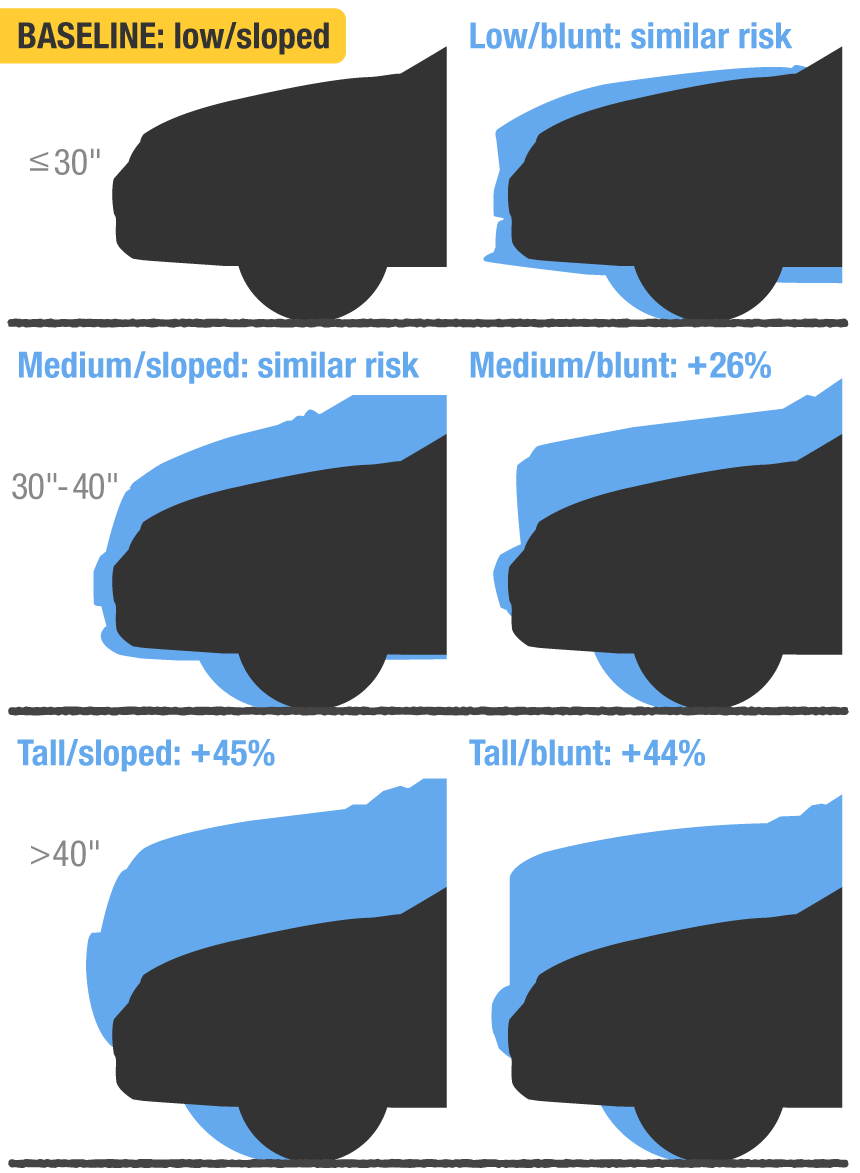
One option is that we could just require car companies to lower hood heights and make them more sloping, and car like which would be way safer. The shape of the hood alone has a surprisingly large impact on survival. IIHS finds box-y grilles are 45 percent more deadline.
Car companies are resistant to changing that, though, because it messes with the appearances of the trucks — the “face.”
The National Association of City Transportation Officials, for example, says there should be a “direct vision” requirement, meaning you should be able to see what’s right in front of your car. Unfortunately, our regulatory agencies are loaded with a bunch of auto industry veterans and political hacks, so that may be too much to ask.
Failing that, we should at least require front cameras instead of having all these people just flying blind with the huge front blind zone.
Some places in Europe are doing more to try to counteract the growth of monster SUVs and pickups. They’ve proposed things like higher license fees for large cars, higher parking prices. I think a few places in the U.S. have discussed this, but I don’t know how far we will get with that.
3. Don’t buy pick-ups for public fleets (unless they’re seriously needed)
I was driving through Parma, Ohio last week and I noticed a police car that was actually a pickup truck. All I could think was “why?!” The boring answer is that public agencies get “upsold” by car dealers the same way average Joes and Janes do. I swear: every time I see a police department with SUVs or pickup trucks, I make a mental note not to vote for their next levy.
And police departments are just one agency. Parks departments etc, should scrutinize these purchases a little more, too. If they legitimately need an F-250 because they’re hauling logs or something, fine. But if they’re not, maybe it’s overkill, and a golf cart could do the job just as well — or a Kei car.
One thing you might notice about these proposals is they’re all very modest. And still, we don’t seem to be able to muster the political will to do any of it.
I wish people would quit yelling at me and acting like I have the power to Ban Pickup Trucks just because I have been trying to raise attention to this overall issue. But that doesn’t mean we don’t have any power to improve the situation short of a full-on ban. In fact, the low hanging fruit is practically on the ground — and we still seem to lack the will to act.
At least the Infrastructure Investment and Jobs Bill included a provision that will make Automatic Emergency Braking and Automatic Pedestrian Detection standard on new vehicles. This is not nothing. What people who don’t follow this stuff closely don’t understand is that we actually have a lot of power to shape safety outcomes. It just takes a lot of pretty boring and reasonable little reforms — if we could just muster the courage and interest to do them.

Read More:
Streetsblog has migrated to a new comment system. New commenters can register directly in the comments section of any article. Returning commenters: your previous comments and display name have been preserved, but you'll need to reclaim your account by clicking "Forgot your password?" on the sign-in form, entering your email, and following the verification link to set a new password — this is required because passwords could not be carried over during the migration. For questions, contact tips@streetsblog.org.