Is It Time for the Era of the ‘Bike-Car’?
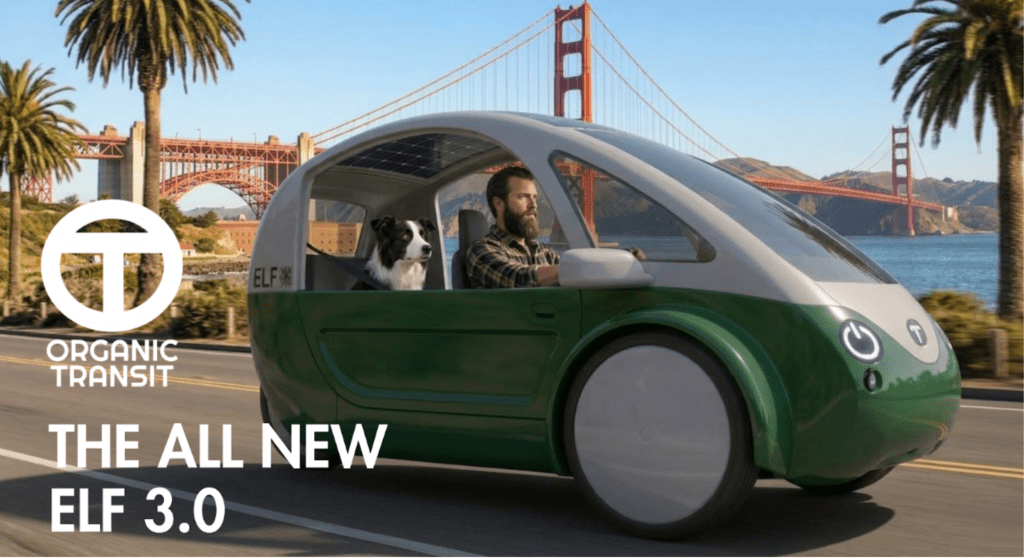
A solar-powered vehicle that straddles the line between an e-bike and a car is plotting a comeback — and sparking questions about the rise of micromobility options that don’t fit neatly into existing vehicle categories.
A crowdfunding campaign to relaunch the “ELF” has racked up more than $380,000 on the strength of a big promise to deliver “the world’s safest bike” and “the next generation of transportation.”
Originally launched in 2012 based on the acronym “electric, light, and fun,” the ELF quickly became a curiosity among many cycling advocates, who puzzled over its quirky blend of recumbent trike features — pedals, three wheels, a battery that powers a motor to get up to 28 miles per hour — and design elements more reminiscent of an automobile, like a windshield and a roof.
With an array of solar panels on top and up to 200 miles of range, though, its inventors argued that their quirky “velomobile” was actually a brand new, cutting-edge mobility solution rather than something out of the The Busy World of Richard Scarry. And with enough momentum, they claim it could have the power to get a whole new segment of Americans out of their automobiles.
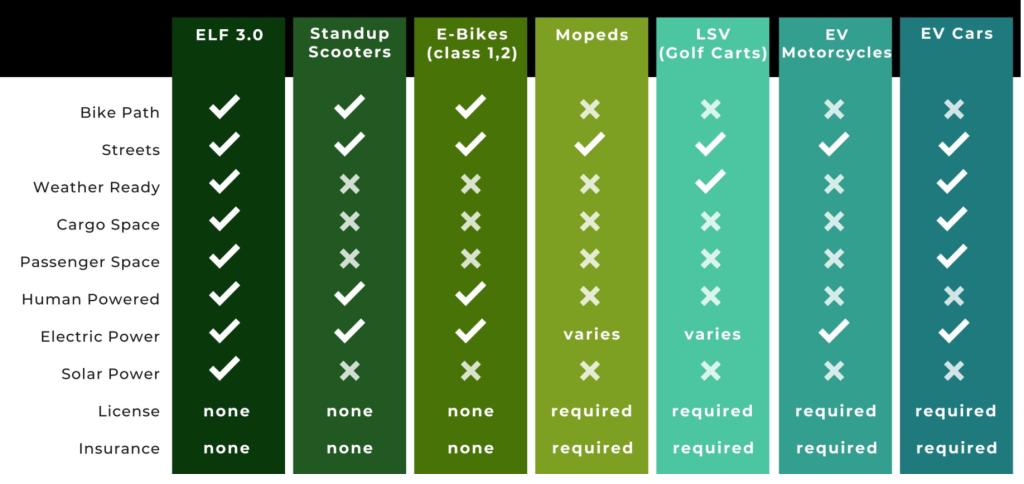
The original-recipe ELF never took off at broad scale on US roads; fewer than 850 were ever produced, compared to the roughly 2.2 million e-bikes that were imported in 2025 alone. But founder Rob Cotter argues that with gas prices on the rise and the e-bike landscape rapidly shifting, light electric vehicles like his are ready for takeoff – and maybe, the ELF 3.0 can lead the surge.
“We wanted something that was sort of the Honda Civic of comfortable, safe, weather-protected bicycles,” said Cotter. “We’re not talking about pulling anybody off of their existing bicycle; it’s quite the opposite. We’re trying to pull people out of their cars. So how do we replicate a car-like experience with bicycle technology?”
How the ELF was born …
A veteran of the automobile industry, Cotter’s enthusiasm for creating a “car-like” bicycles actually began with cars themselves — before he realized how auto-centric transportation infrastructure was impoverishing American families and endangering our climate future.
As his passion for transportation reform grew, so did Cotter’s appetite for innovation — and it led him to the science-fictional fringes of the cycling universe, in addition to his local bike shop. As a member of the International Human Powered Vehicle Association, he helped launch “recumbent streamliners” capable of achieving over 80 miles per hour on flat ground without a motor, in addition to watercrafts, submersibles, and flying machines right out of a DaVinci codex.
Cotter saw creating a human-powered vehicle for the everyday commute as a similarly heroic challenge — especially when it came to tapping the vast market of people who would never think of getting on a traditional bike, even if they had a dedicated lane right outside their door.
“There have been numerous studies about what they call the ‘blue ocean’ versus the ‘red ocean,'” he added. “The ‘red ocean’ is where bicyclists are currently — and there’s plenty of bicycle and e-bike manufacturers who build bikes that work for a variety of people most of the time.
“But the other category — [the blue ocean — includes the needs of potential riders] that aren’t being addressed: people who are elderly, who have disabilities, who need to carry children, who are concerned about the safety — the list goes on,” Cotter continued. “If you combined all those things together, that’s a much wider audience that bicycle industries are not currently addressing.”
… And reborn?
Of course, some advocates might argue that at least some of those needs would be better met by just building dedicated bike infrastructure or reforming to car-centric land use policies. Others might be concerned that at 3.5 feet wide, the ELF could crowd out traditional bicycles on the precious few paths we’ve already got.
Cotter argues, though, that the bicycle itself is ripe for reinvention, alongside our efforts to reinvent our cities with wider bike paths and slow-speed streets where all modes can safely intermingle. And there’s no time to do it like the present.
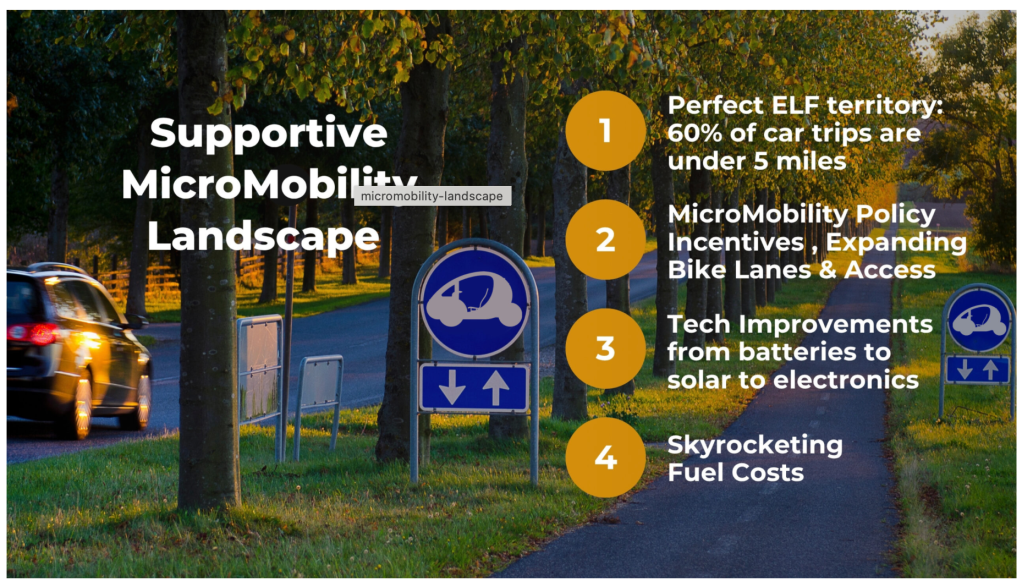
In the years since the ELF was last in production, Cotter notes that the ever-rising costs of car ownership have primed more Americans to explore non-automotive options for short trips, and that many state and local governments have answered with incentives to buy light electric vehicles. CNBC recently estimated that maintaining a car costs an average of $5,851 a year before any auto loan payments.
In a car-dependent country where a lot of people are hauling groceries and kids down multi-lane roads, though, Cotter says a “bike-car” might be the only e-bike many Americans would be willing to try — especially in regions prone to harsh weather.
“How can we replicate what cars do well, but base it on bicycle technology as much as we possibly can?” Cotter asked. “If you’re planning to travel long distances and want to pull a trailer — well, then this is the appropriate the vehicle for that type of use. If you’re disabled, we can make a vehicle for that. And if you just need a Class 1 vehicle to get back and forth to school with, because of your age or because the requirements in your state, we’ve created the vehicle for that, too.”
At least compared to a full-scale electric car, the ELF 3.0 looks like a bargain, with a projected sale price of $7,500, minimal maintenance costs, and no need for full-scale insurance. It also has little to no charging costs, since many riders report that the solar panels alone are enough to keep the battery full.
Of course, some e-bike enthusiasts might argue their preferred form factor has already filled the ELF’s niche — and at a much lower price point that’s kept e-bike sales brisk for the last five years.
That surge, though, has been accompanied by an influx of ultra-fast e-motos marketed as “e-bikes,” tarnishing the reputation of the e-cycling movement as a whole as injuries caused by e-moto riders mount. State and local regulators have raced to contain the damage, but those laws vary wildly by jurisdiction, and sometimes snag perfectly safe pedal-assist vehicles in overly-restrictive dragnets.
Cotter argues the ELF 3.0 — which will certainly never be confused for a motorcycle-with-pedals — can help assuage that controversy by issuing over-the-air updates to customers in states with new laws, capping speeds at legally-compliant limits whenever regulations shift.
“It’s nice, because every state is going to be or can potentially be different,” he adds.
The new ELF promises other novel benefits, too. Safety cameras, LED turn-signals, and full suspensions to smooth out rides are just a few of the features offered to riders; the new model’s solar capacity will double the old one, too, and it also includes “lockdown method” and trackers to prevent theft.
Cotter is particularly proud of an optional package that will allow the ELF to double as a battery back-up unit to charge phones and even power home appliances during a blackout.
“Instead of getting backup generators, here’s one that functions mostly on solar — and it also provides transportation,” he added.
Listening to Cotter rattle off the features of the new ELF, it’s hard to think of a problem the adorable bike-car wouldn’t solve — at least if you believe its founder’s hype. With no firm delivery date set for the 3.0 model, that’s a big “if.” Many of its potential riders will undoubtedly opt for already-available e-bikes in the meantime, even if it means having to wear a raincoat or strap cargo onto a rack once in a while.
The 750 people on the wait list for the next model, though, suggest that ELF could find a niche. And if more innovative options like it were broadly available — not to mention more bike-friendly places in which to ride them — it’s possible we’d have a world with a lot fewer drivers.
This article has been updated with additional clarity about the ‘blue ocean/red ocean’ theory.

Read More:
Streetsblog has migrated to a new comment system. New commenters can register directly in the comments section of any article. Returning commenters: your previous comments and display name have been preserved, but you'll need to reclaim your account by clicking "Forgot your password?" on the sign-in form, entering your email, and following the verification link to set a new password — this is required because passwords could not be carried over during the migration. For questions, contact tips@streetsblog.org.