Are Brain-Rot Transit Ads Ruining Our Commutes?
A version of this article appeared on Street Stack and is republished with permission.
Recently, a righteous anger has been building inside me.
Longtime readers know I spent 8 years working in advertising before I became an urban planner. Turns out a liberal arts degree in cultural anthropology is suitable training for discovering what makes people tick, and exploiting it. For about one of those years, I aspired to be the sort of ad man who could sell ice in the winter and fire in hell. For the next seven, I increasingly felt that I was working grueling hours doing something dirty.
Today, I hate ads. I think they contribute nothing to society. I think the marketing industry has convinced a large swath of often quite smart, and occasionally genuinely creative people to grease the wheels of capital.
Let me make my bias clear from the start. I hate ads on TV; I hate them on my phone. But I really hate them in public places.
At the beginning of summer, I decided to use my AirPods and phone less during commutes. I try to be phone down, head up, ears and eyes open, to be more present in public spaces. For the first half of my commute, the results have been transformative. Bird chirps and snippets of conversation flow into my still-waking-up brain. I notice more without a podcast or song in my ear, and sometimes I create fully formed thoughts (gasp).
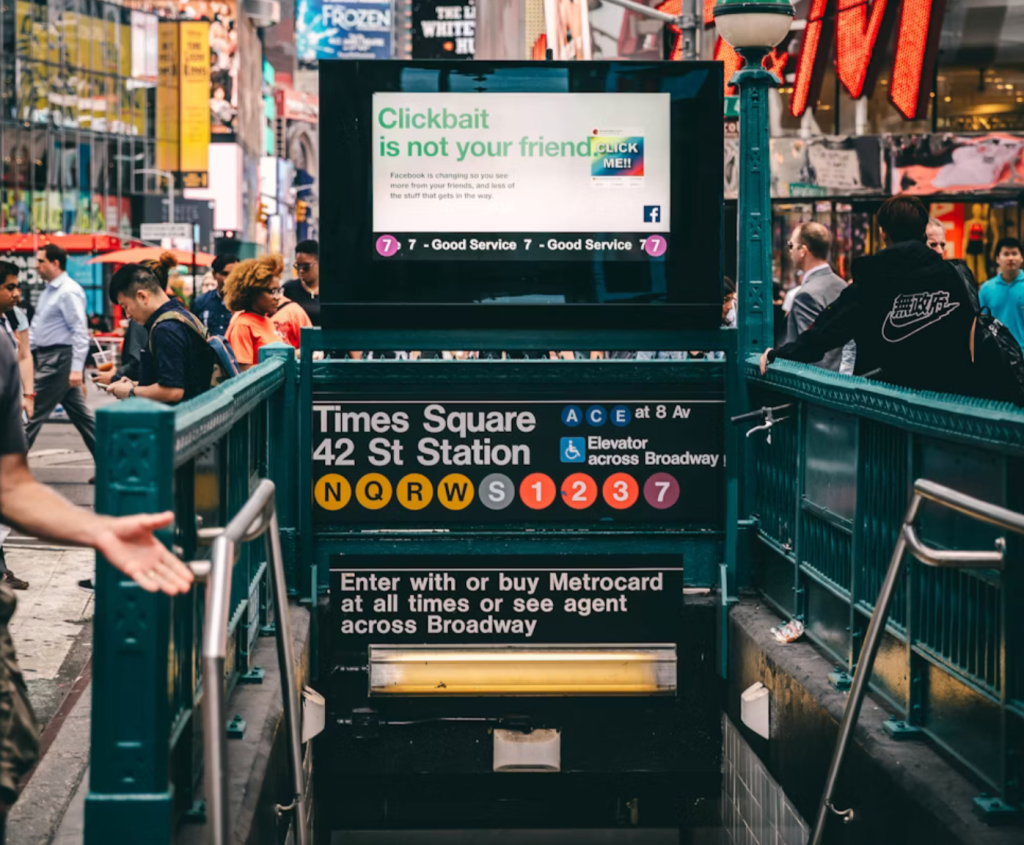
But then, I step into the subway, and it all goes to shit. Not because of the noise, or the dirt, or the crazies, but because of stuff like this:
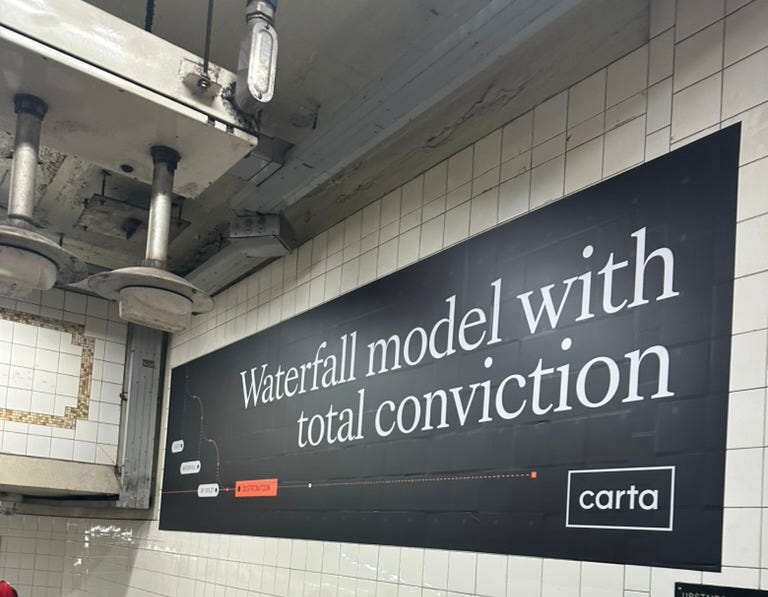
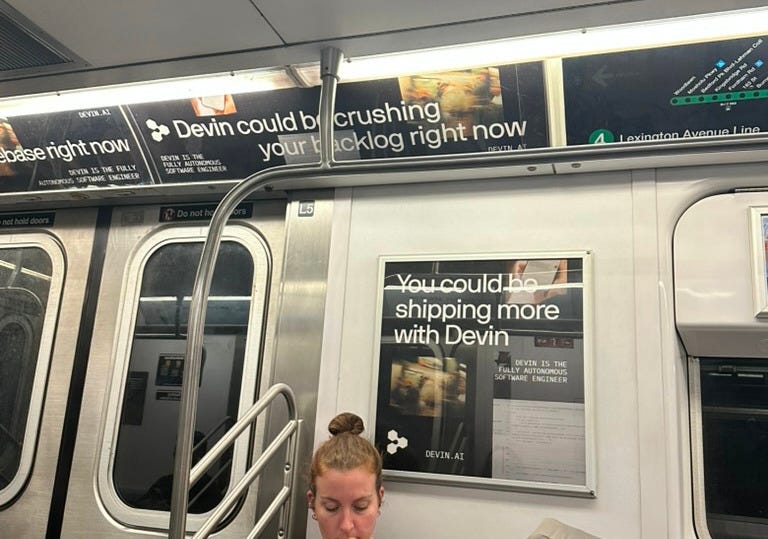
Being somewhat off my phone has made me realize how much the subway is now like being physically inside a phone. I nearly crashed out one day sitting across from an endlessly looping Airbnb ad of a guy dancing across seven screens, aping the social media aesthetic I was explicitly trying to give my brain a break from.
But being forced to look at this slop has also revealed a shift — a shift I wanted to consider in its context.
About 130 years ago, the awkwardly named Associated Bill Posters Association adopted the “billboard” as the industry gold standard, consolidating itinerant flyers, hand-painted signs, and wheatpastes into a well-maintained stand that lived in a specific outdoor location. People have been complaining ever since. In a 1924 issue of Architectural Review, a writer noted that
There is no hour of waking life in which we are not besought, incited, or commanded to buy something of somebody. Our morning paper is full of it; our walk to the nearest car bristles with it; the transfer which we take blazons it … When the shades of night fall, a portentous heraldry of trade leaps in living fire from the darkness, exhorting us to drink Boozer’s Whisky or perish in our shame.
Reading Laura Baker’s excellent brief history of outdoor advertising,one learns that members of the Automobile Club of America organized billboard-removal drives to destroy ads on rural roads and civic groups like the City Club of Chicago lobbied for bans on ads on residential streets.
This ban, which was upheld by the Supreme Court in 1917, established a city’s right to restrict the location of advertising — but not, as many reformers wanted, the right to regulate the content of ads based on aesthetics. The groundwork was set for outdoor advertising’s explosion in the mid-20th century. From then until recently, advertising reflected and shaped a mass culture of middle-class households with General Electric appliances in the kitchen and Nabisco in the cupboards.
With a broad audience, advertisers could conceptualize their trade as a sort of public service informing people about better lifestyles and products. This was also when the industry adopted the language of fine art, where ad-men became “art-directors” or “copy-writers” and ad companies segmented themselves into “art” departments and invented awards for “creativity.”
Outdoor advertising became popular art with aesthetic value. The poster was more powerful than the painting because many more people saw it, and in the increasing blankness of the industrial cityscape, it might be the only color and reading material on the average worker’s commute.
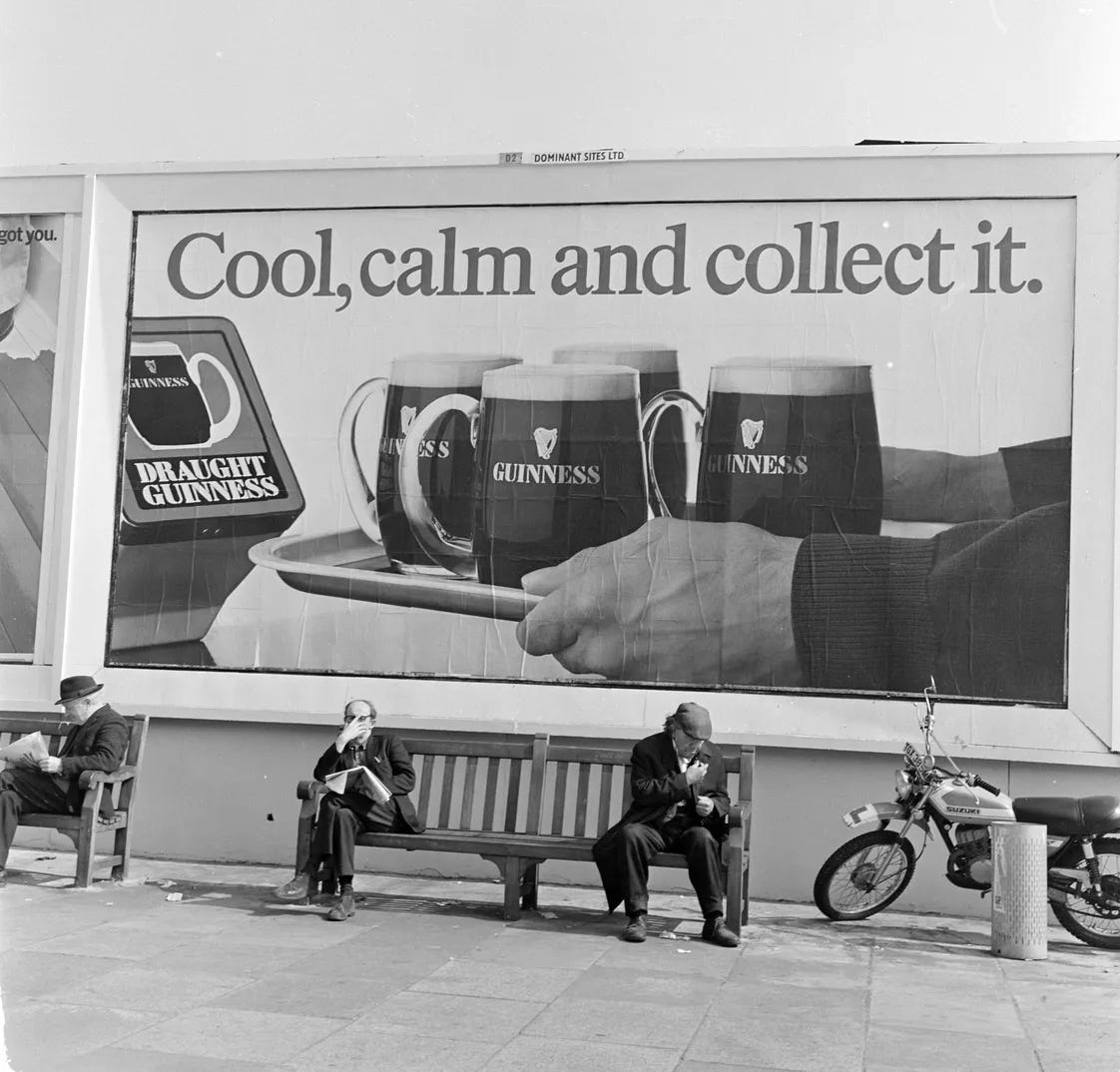
The marketers claimed to entertain and inform broad swaths of people. The critics said they were polluting the common spaces of the citizenry and tempting them with cigarettes and gambling.
What unified both proponents and critics of outdoor ads was a concern with “the masses.” Advertisers used to rely on a few, imprecise channels — radio, TV, and most imprecise of all, billboards — that tapped into a strong monoculture.
But today the monoculture is splintered, and we are a collection of niche interests sharing space temporarily in a subway. Ad “campaigns” are all about “targeting” and “precision” (the language of marketing borrows heavily from the language of war). In this era of Instagram ads algorithmically tailored to appeal to a few thousand viewers of a certain nail art channel, an outdoor ad has the precision of a 1000 pound bomb.
And yet, outdoor ads seem to be multiplying. New York has long subsidized public transit with advertising. The MTA brought in $180 million from ads across its properties in 2025, up from $136 million in 2019. With Outfront, the MTA’s media partner, it has developed and installed a series of new formats, from illuminated billboards to digital displays running looping video.
Many of these formats copy the aesthetic we’ve seen on our phones and feeds for years: Quick cuts, in-your-face visuals, bright colors, scrolling text.
It’s also worth considering not just the format but the content of these ads, which are increasingly about tech or lifestyle products that are aimed at an infinitesimal number of subway riders — engineers at Google, hiring managers at financial institutions, wellness consumers of a specific peptide stack — but are nevertheless seen by thousands of people to whom they have no relevance.
This is a paradigm shift. Ads that were widely seen used to strive for mass appeal. Anyone could fall down at work and need to call Celino & Barnes. Now, ads that may still be seen by thousands are fine being relevant to only a small number of viewers. See if you belong in any of the audience segments Outfront Media promises to reach through its subway advertising. If you don’t, you’ll see the ads anyway.
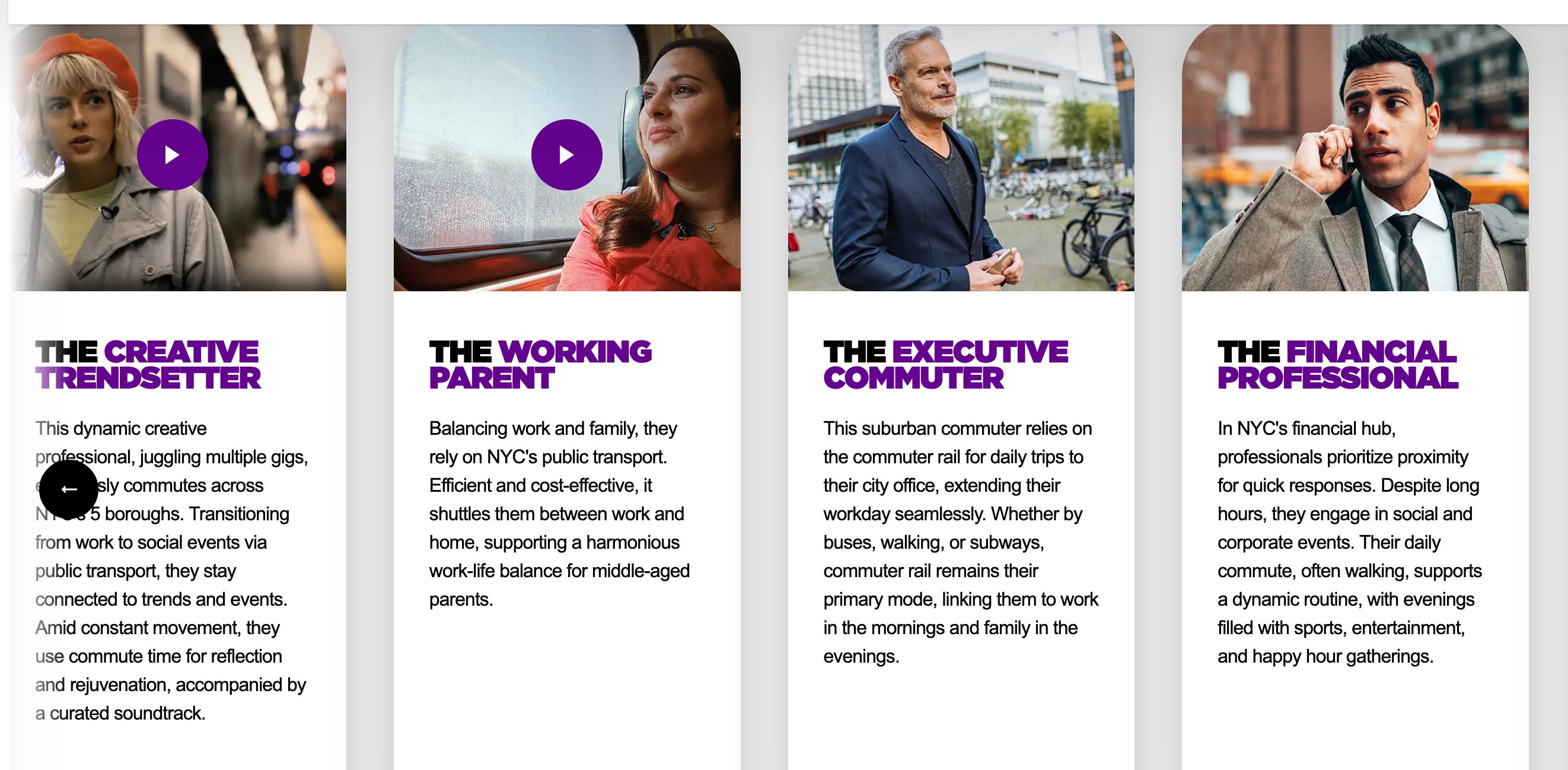
Using a subway ad to sell an AI trading agent to an “executive commuter” is like killing an ant with a shotgun. For anyone who’s not the intended target, the sense of disorientation and confusion might be part of the point. I have, after all, gotten so mad that I’ve written an entire post and shared pictures of ads with my subscribers. This is what those in the biz call “organic reach” — a funny term to use for the deeply inorganic process of creating mass marketing.
When I worked in advertising, we used to talk about the “bizarreness effect,” the psychological principle that strange or nonsensical things become distinctive because they present a problem for our brain to solve. A coworker once used this sentence as an example. “Dogs are not like other animals. Compared to tea kettles, they are much more red.”
Many subway ads now have the same effect. They are impossible to understand but somehow also impossible to ignore. How Outfront can claim the below is beyond me. I’m sorry, Cait, but you are a loser.
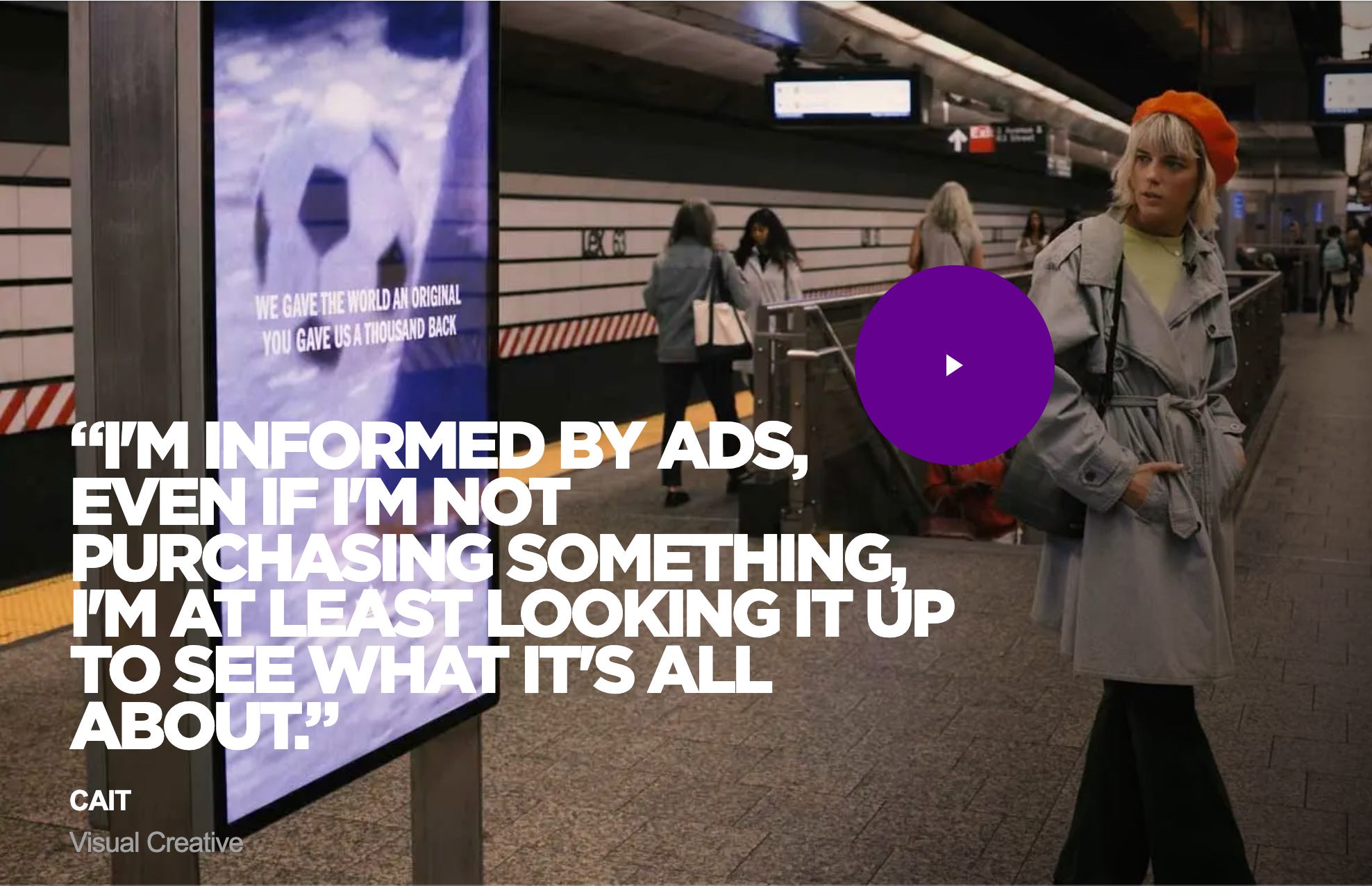
This is all pitched as a neccecity to maintain good service.
“Ad revenue is an incredibly important source of revenue for the MTA outside our farebox. Revenue sources like this are what help us keep fares low for customers, or those increases low year-over-year,” Mary John, the MTA’s director of commercial ventures, said in an interview with Gothamist. This is not all that different from the original concept of TV or radio ads as something we tolerate because it pays for what we actually want — we bring you the Knicks game or the hard-hitting journalism of Walter Cronkite every night for free, and in exchange you watch the Marlboro Man smoke for thirty seconds.
CBS used to be free, once you got a TV anyway. You paid for it with your attention. Now I pay through the nose to stream the Knicks, and guess what, there are still ads. We’re all paying twice, and when I ride the subway I feel like I’m paying thrice.
I’m an urban planner; I know $3 is far below the true cost of riding, and the MTA desperately needs more money to maintain and upgrade the world’s oldest subway system. And yet I feel cheated. I pay the ever-increasing fares; my taxes fund the MTA, and through my (tiny) 401k and mutual fund holdings, I’ve purchased its bonds. On the rare occasion I take a cab home, I now give it even more money through Congestion Pricing.
All this to an agency that (meaningful strides aside) is still riddled with financial inefficiencies. And yet I have to sit trapped in a subway car that feels built to annoy me.
I’m clearly not alone in my angst. The comedians Harris Alterman and Dave Ross have been pasting parody tech ads across stations. A few of them are almost too subtle.
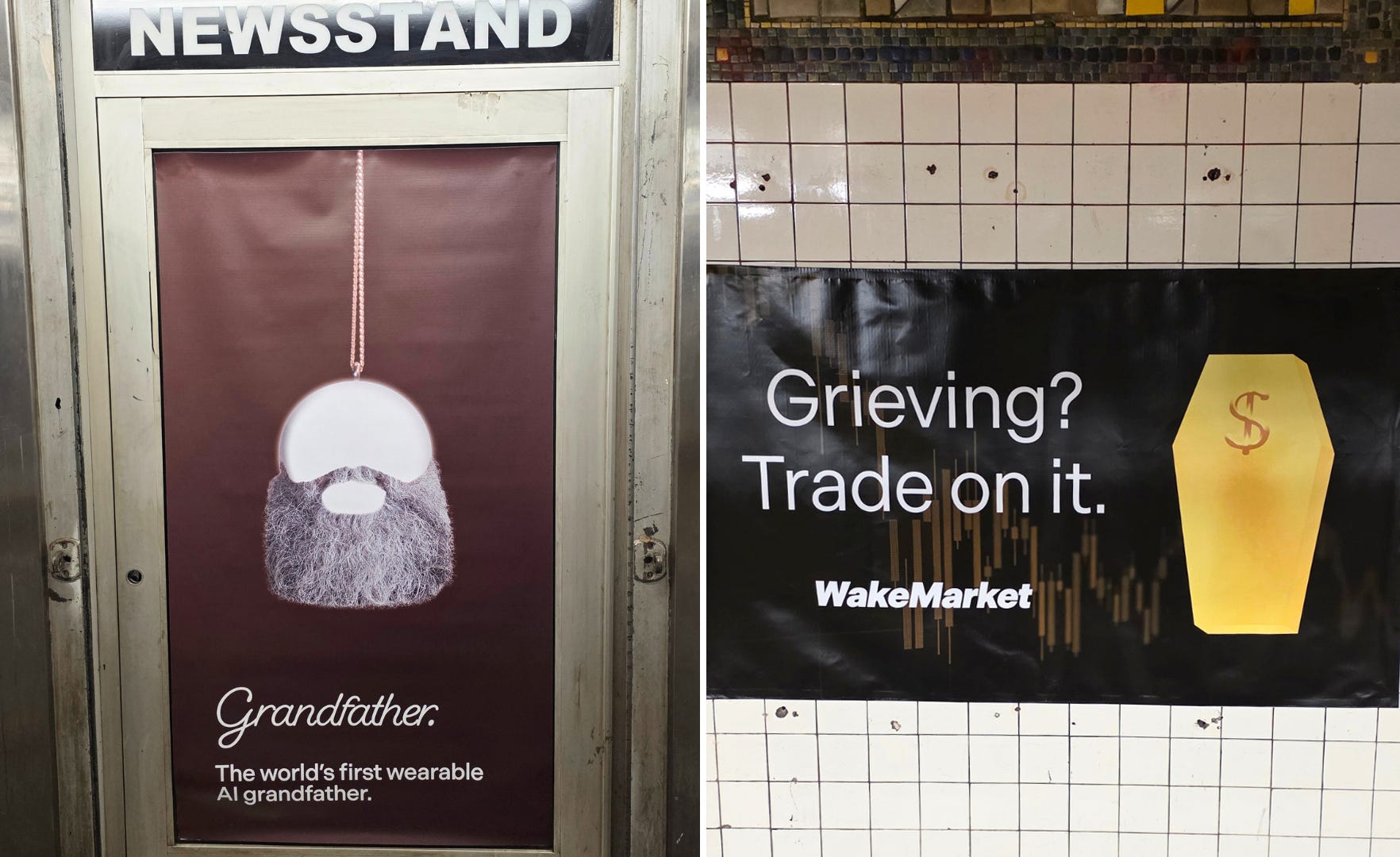
A study in Poland actually considered how much Warsaw residents would collectively pay not to see outdoor ads, and found it was between five and nine million euros a year depending on the size of reductions. Recently, I came across a parody(?) video for a “tunnel vision” device that could block out subway ads in your peripheral vision. The video’s creator, Jack Klein, also created a mountable screen that blocks out digital ads in train cars.
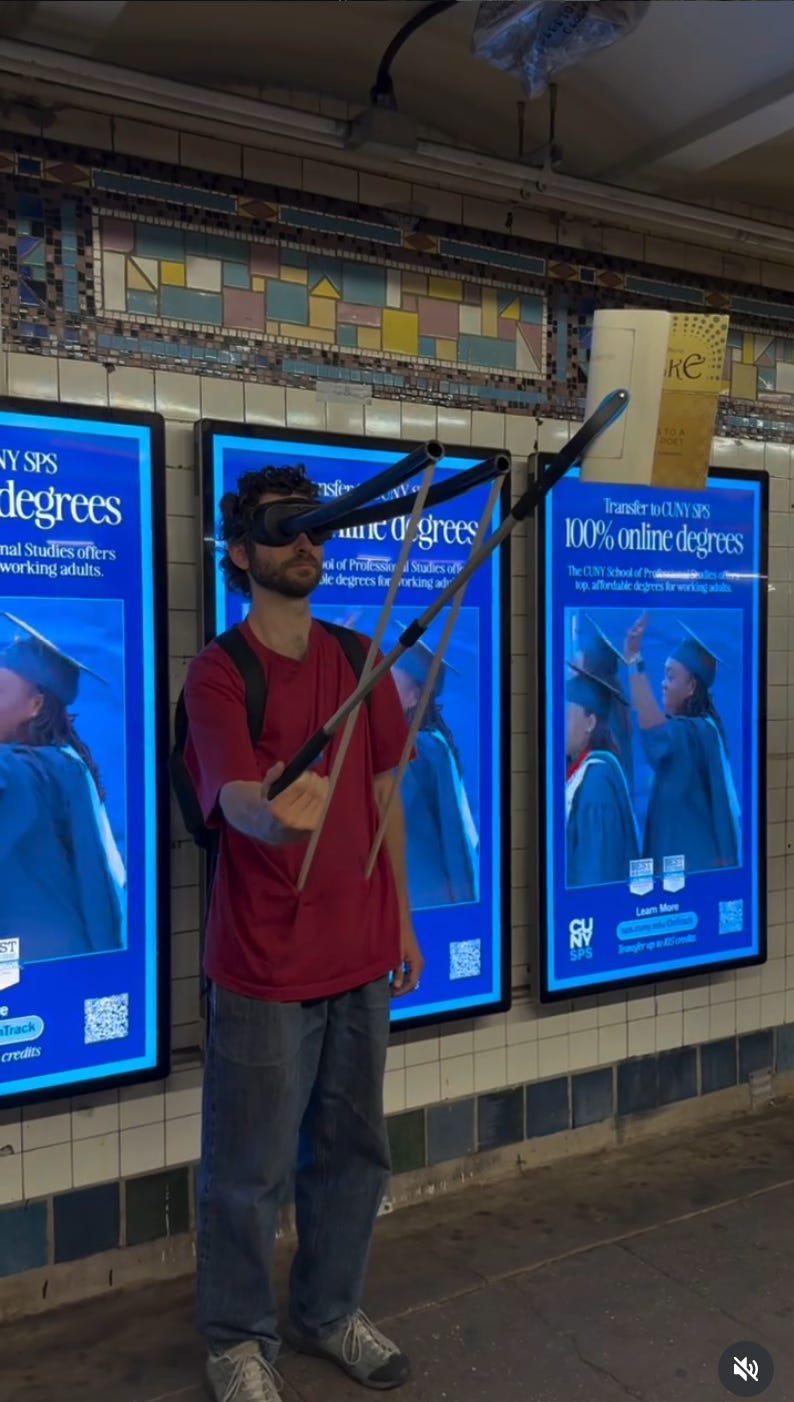
But I haven’t seen actions proposed for making any of this more bearable. Like the AI apocalypse or climate change, we seem resigned to a future where the subway rots our brains.
At the very least, I would love the MTA to set limits on motion and brightness in its ads consistent with growing science showing short-form video is harmful to our attention spans and cognitive abilities. Frankly, I wouldn’t mind banning digital displays altogether for anything other than transit info.
But what needs to change most is the idea that advertising is a sacred source of revenue for the MTA. $180 million dollars is a lot of money, but it’s a tiny fraction of the budget for an agency whose projects cost billions.
Smarter people than me have proposed new revenue or cost-saving measures for the agency. We could rely less on outside consultants, sell more air rights over stations, or increase the payroll mobility tax. Space given to ads could be used to expand the MTA’s excellent public art programs, which are increasingly drowned out by slop.
History is littered with people who hated ads and lost. “In modern life…contemplation is almost a lost faculty.” Wrote the president of the Chicago Art Institute… in 1912.
But never forget: the subway is funded by you and me. A pleasant commute is not too much to ask for. And if nothing happens, I guess I’ll just put my AirPods back in.

Read More:
Streetsblog has migrated to a new comment system. New commenters can register directly in the comments section of any article. Returning commenters: your previous comments and display name have been preserved, but you'll need to reclaim your account by clicking "Forgot your password?" on the sign-in form, entering your email, and following the verification link to set a new password — this is required because passwords could not be carried over during the migration. For questions, contact tips@streetsblog.org.