How to Save 8 Million Lives in 20 Years
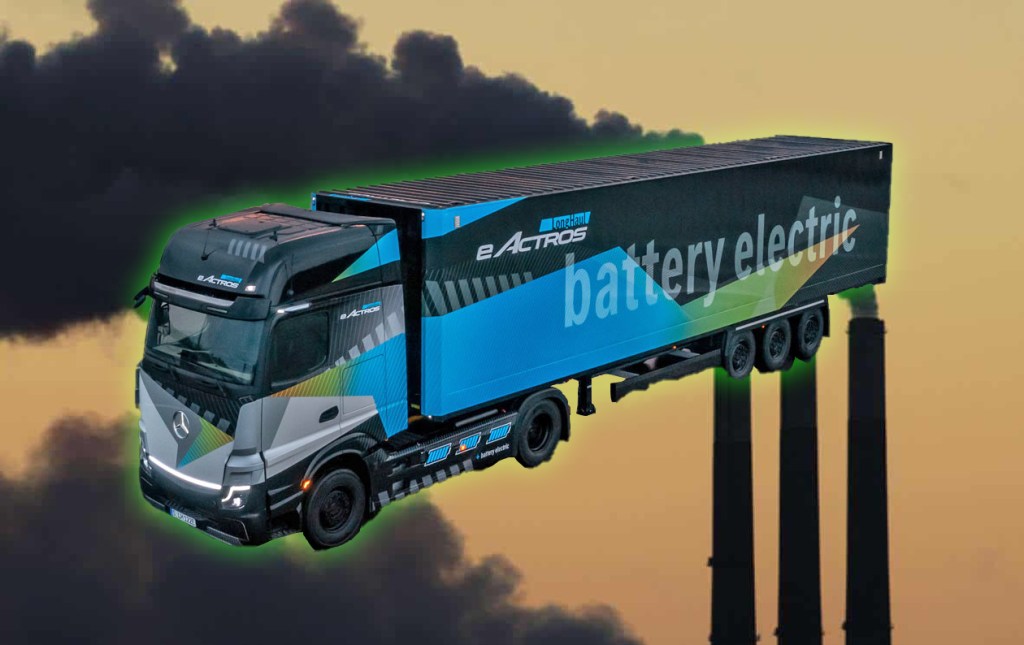
Electrifying the world’s gas-guzzlers isn’t just necessary to prevent a climate disaster — it could save hundreds of thousands of lives in the United States, and millions of lives worldwide as pollution continues to extract a disproportionate toll on the poor.
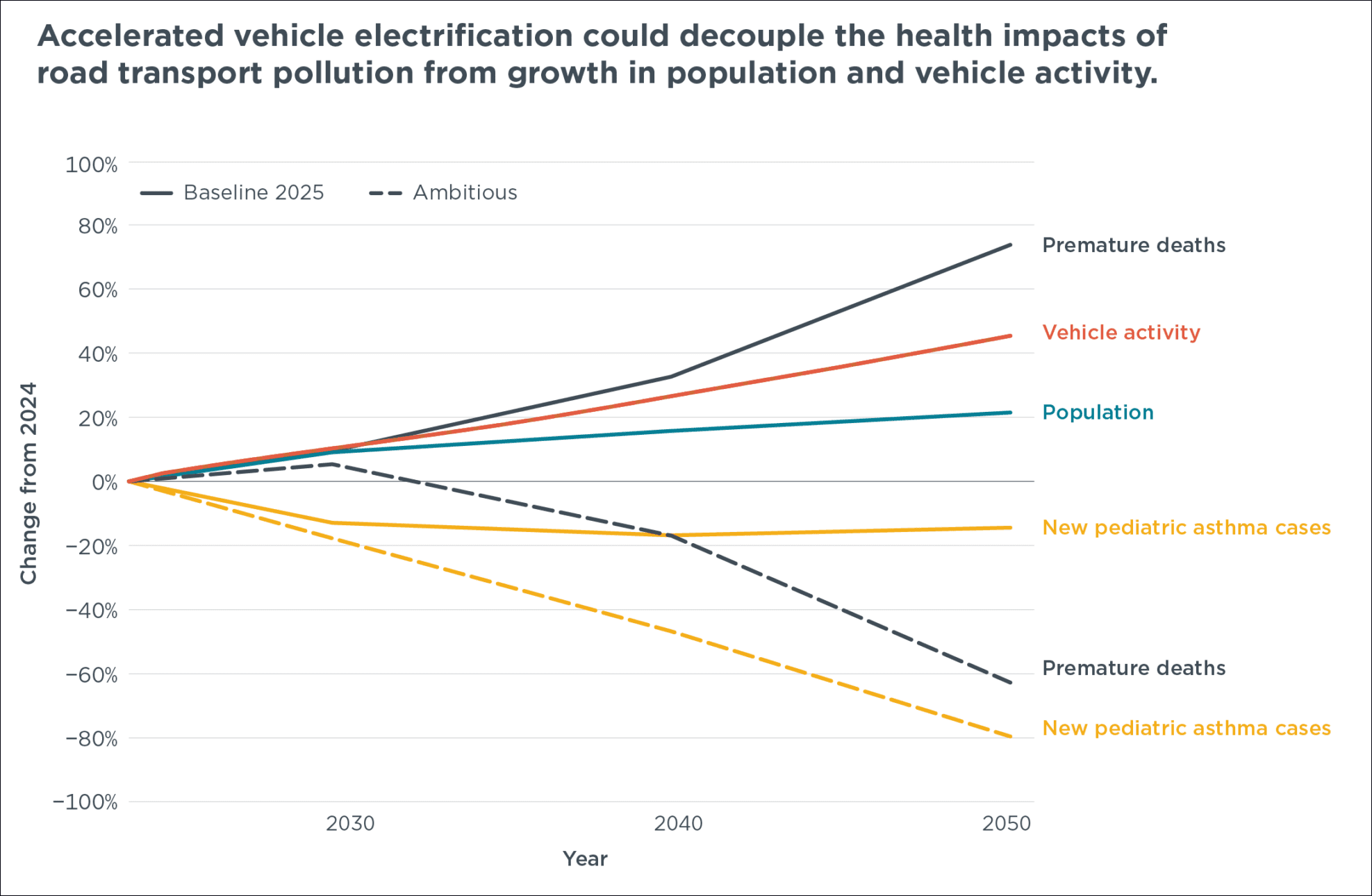
According to the International Council on Clean Transportation, humanity could avoid 8.8 million premature deaths due to air pollution from cars and trucks if all vehicles were 100 percent emission-free by 2045.
This scenario, which a new Council report admits is “ambitious,” would also save 1.7 million children from pediatric asthma through 2050.
Electrification is seen as necessary because vehicle usage is projected to explode by 45 percent over the next few decades, even as the global population is forecast to increase by just 21 percent, to 10 billion, over the same period, the report’s authors say.
Under the status quo, wealthier nations will see preventable deaths from ground transportation pollution decline by 48 percent, but poorer nations will experience a 200-percent increase. This current trajectory of slowly implementing a patchwork regulation — more stringent in some countries, nonexistent in others — won’t cut it.
“Despite baseline decreases in most road transport air pollutants, premature deaths from road transport-attributable pollution are projected to grow by 74 percent by 2050, reaching 1.2 million per year — outpacing growth in both population and vehicle activity,” the report states. “Without additional policies, road transport-attributable air pollution is projected to claim one life every 26 seconds by 2050 — nearly double the current rate.”
The report mentions that the United States has “relatively cleaner road transport activity” compared with other countries, but more Americans die preventable deaths every year from vehicular pollution than from crashes — some 41,800 premature deaths every year. That’s at least four Americans every hour succumbing to chronic obstructive pulmonary disease, lung cancer, stroke, Type II diabetes mellitus, heart disease, and other illnesses that stem from the pollution and particulate matter being ejected from exhaust pipes.
The United States also has the highest number of pediatric asthma cases in the world that stem from road pollution — higher than Indonesia, China, Egypt, India, and Mexico, according to the ICCT’s tally.
Lingzhi Jin, a senior researcher at ICCT and a co-author of the report, told Streetsblog USA that getting to the “ambitious scenario” would require worldwide buy-in on the kinds of strict emissions standards that are currently being implemented in Europe, but also leadership from the United States on transitioning to zero-emission vehicles.
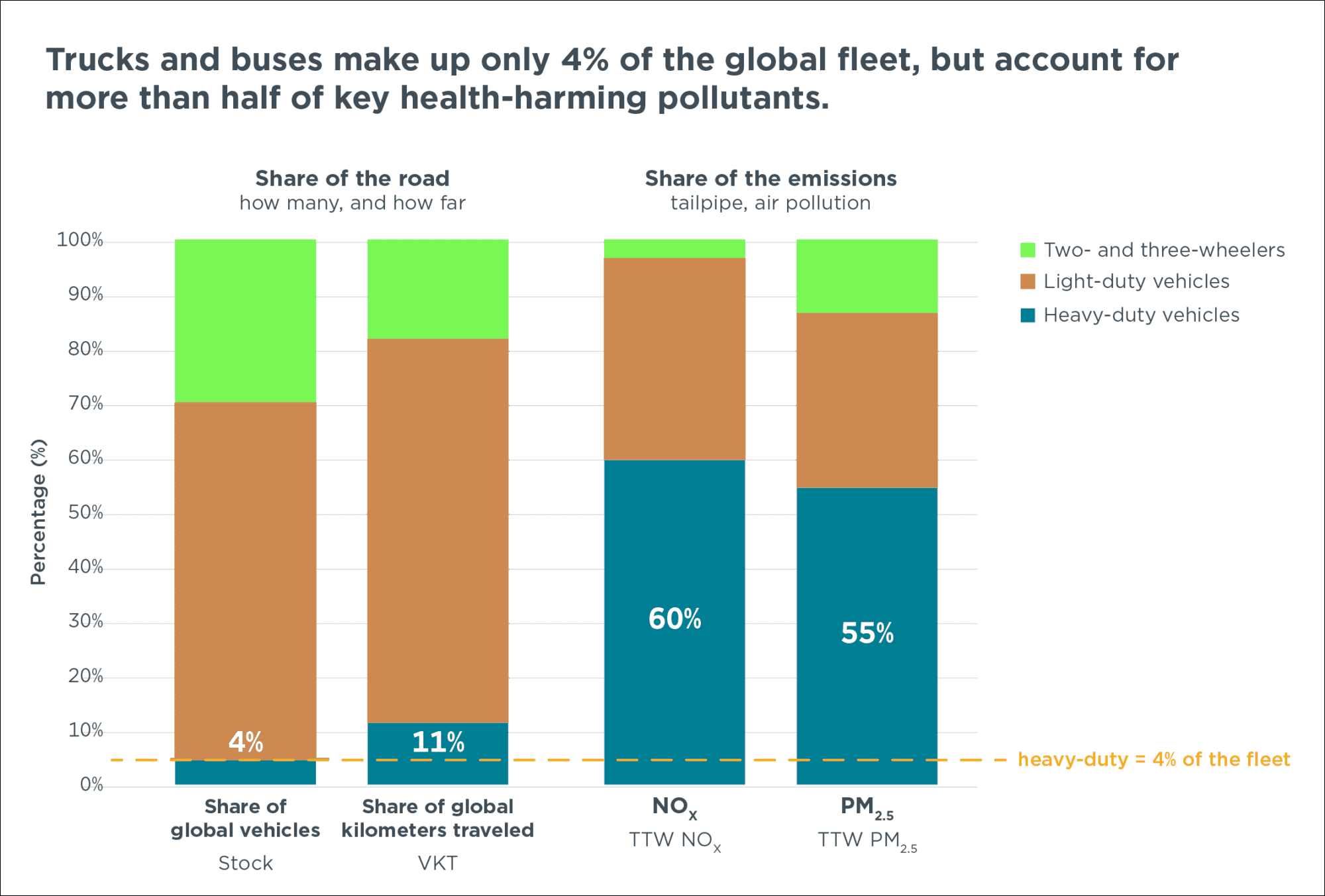
For instance, the ICCT report notes that while heavy-duty vehicles like buses and 18-wheelers account for just 5 percent of all global vehicles, they make up 60 percent of the world’s noxious emissions. As a top producer of automobiles, the U.S. could implement policy that would speed up the worldwide transition of these vehicles to zero-emissions.
“Driving down the costs of electric trucks and buses would benefit both people in the country and in other countries, because of the U.S.’s role in the global economy,” Jin said. “What the U.S. does actually matters because a lot of these other countries look at what is happening in the U.S.”
Unfortunately, “what is happening in the U.S.” right now is very bad if you care about preventing deaths from road emissions.
“The U.S. no longer has emission standards of any meaning,” a former regulator for the Environmental Protection Agency told the New York Times earlier this year, after the Trump administration stopped regulating greenhouse gas emissions.
In 2024, then-President Joe Biden announced new rules that would significantly increase the number of zero-emissions trucks and buses on the road; Trump killed them almost immediately after taking office in 2025. The Trump administration recently announced that other benchmarks for light duty vehicles have been delayed until 2029, a move that was cheered by the auto industry.
States like California and New York have their own lower emission standards that automakers have to meet, but the Trump administration is attempting to destroy those, too, by using the EPA’s power to force them to submit to a vote in the Republican-controlled, oil-money-addicted Congress. California’s attorney general is currently suing the EPA to keep them.
California is also home to some of the most smog-ridden, traffic-snarled locales in the country — some 22 Californians die prematurely from automobile pollution every day, more than 8,000 people each year, according to the ICCT report, a worse death rate than New York’s 3,200 annual deaths stemming from the pollutants.
If there is hope to change course, it may lie in the fact that Americans see we are on the wrong path: According to a Pew Research Center poll from earlier this spring, 63 percent of Americans feel that the federal government is doing too little to protect the quality of the air.

Read More:
Streetsblog has migrated to a new comment system. New commenters can register directly in the comments section of any article. Returning commenters: your previous comments and display name have been preserved, but you'll need to reclaim your account by clicking "Forgot your password?" on the sign-in form, entering your email, and following the verification link to set a new password — this is required because passwords could not be carried over during the migration. For questions, contact tips@streetsblog.org.