Safety Last: Under Trump, U.S. Roads Continue To Be ‘Dangerous By Design’
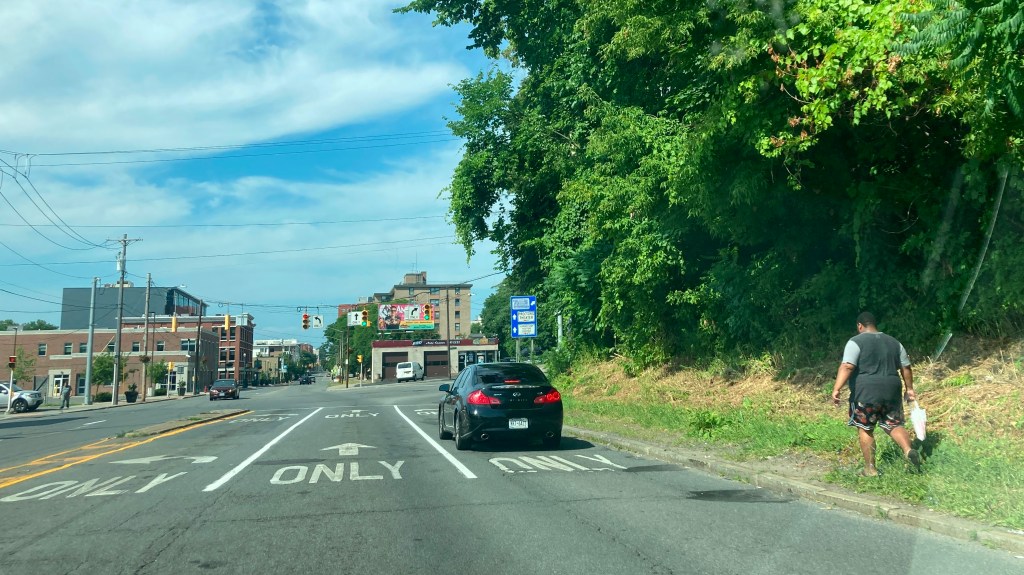
We’re well into the 21st century, but pedestrians in the United States are being killed like it’s still 1982.
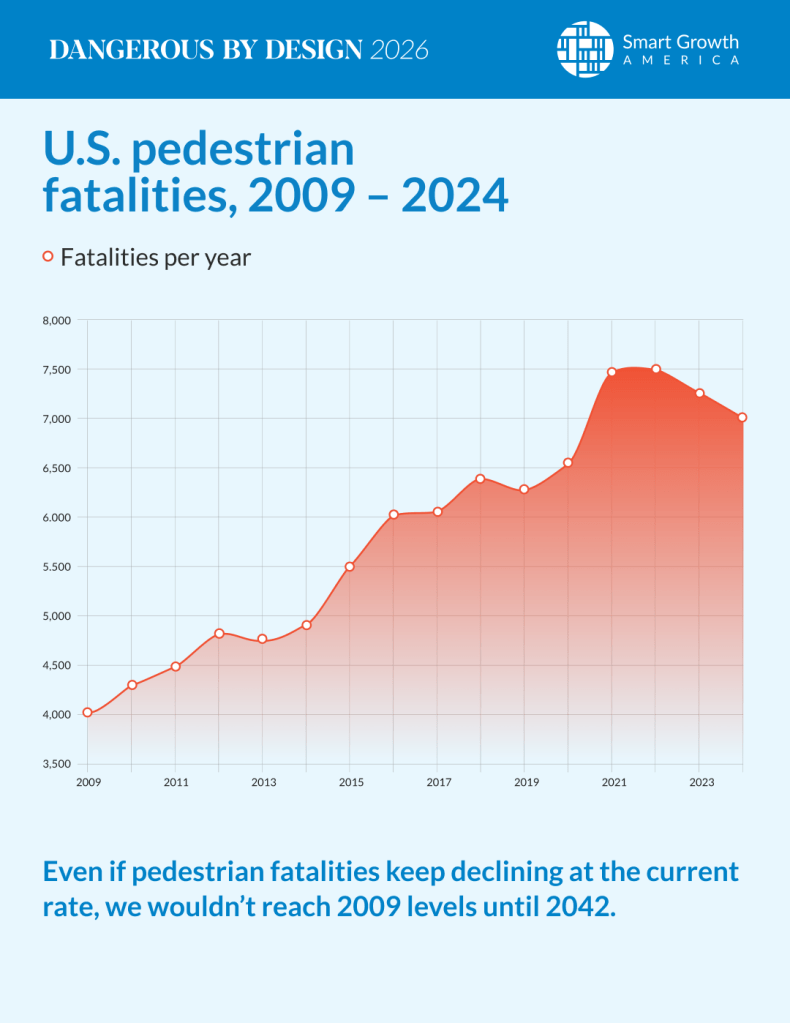
According to a new analysis of nationwide traffic deaths, 7,080 pedestrians died on American roads in 2024. That number is 6 percent lower than 2022’s figure, but still a 72-percent increase since 2009, and almost the exact same number of pedestrian deaths as 42 years ago.
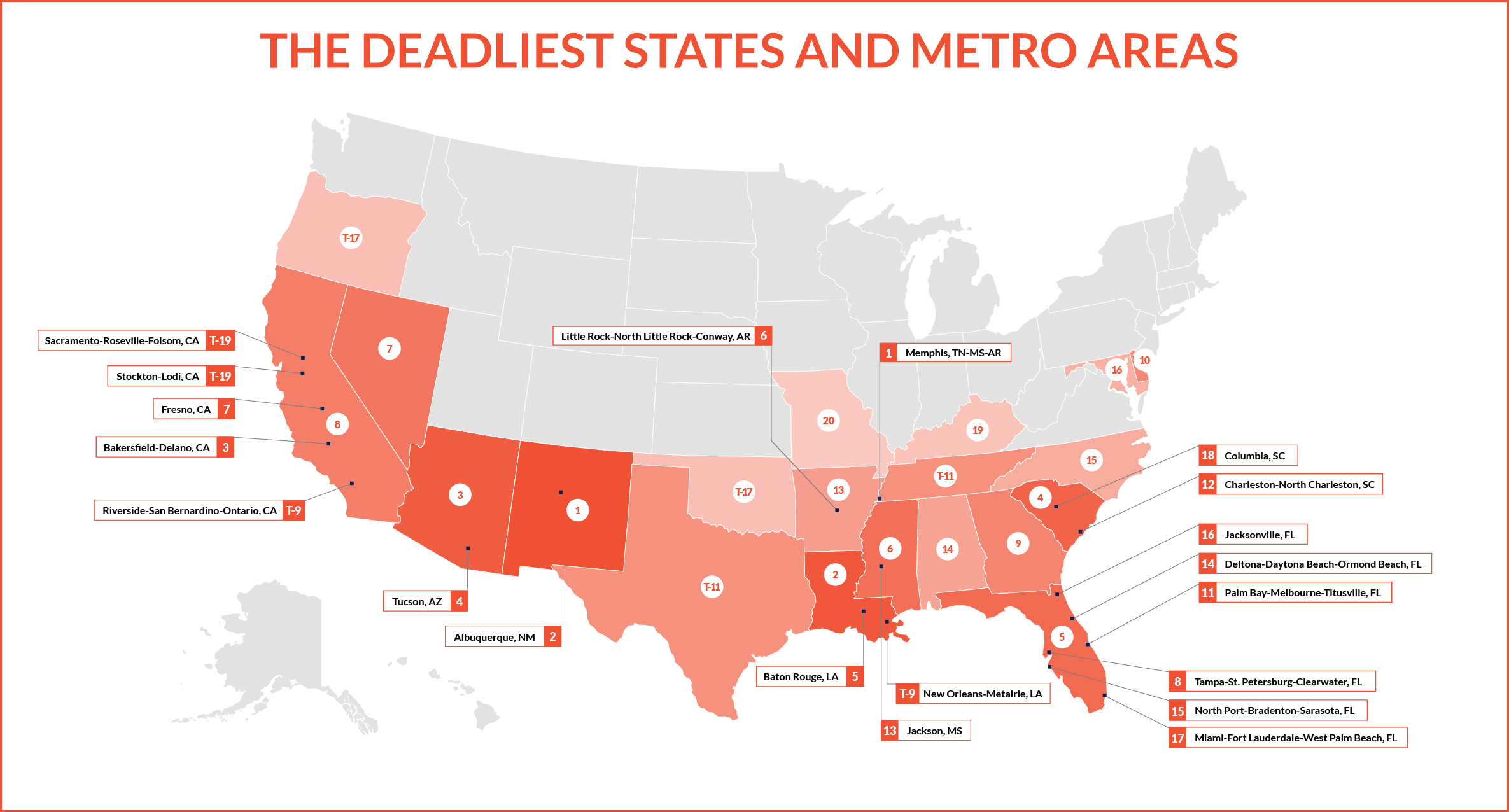
This staggering figure, which heralds our country’s years-long devolution in road safety, is part of the annual Dangerous by Design report released last week by the advocates at Smart Growth America and the National Complete Streets Coalition. The report uses the most recent year of federal data available, puts it in five-year windows for context, and crunches the numbers to reveal the metro areas and states with the deadliest roads per capita for pedestrians.
According to the report, 57 percent of all roadway fatalities in 2024 occurred on state-owned roads, and state DOTs wield significant power in both creating (or blocking) live-saving policies.
Despite this power, meaningful state-level progress is almost non-existent.
“Of the 20 most-deadly states, 19 showed no signs of improvement or became even more dangerous,” the report notes. “Only five states that improved in the 2024 report have continued to improve and build upon that progress in this report, and only eight states in total have improved since the last report when comparing five-year periods.”
Delaware was the most-improved state, lowering pedestrian fatalities by 0.41 percent over that five-year period, but it still remains the 10th most-deadly state in the country.
Memphis was the deadliest metro area for pedestrians in the country in that five-year period, with a fatality rate of 5.5 pedestrians per 100,000 people, according to the report. One local news TV segment from earlier this month encapsulated the city’s problem, both with its headline (“More than a dozen Memphis pedestrians hit by cars in just over a week”) and with its anti-pedestrian framing.
“It’s more about being observed, paying attention when you’re crossing the street, not being distracted by cell phone usage or whatever the case may be,” a local sheriff tells the camera, apparently addressing a likely-to-be-struck pedestrian.
Earlier this spring, the Trump administration, citing the slight decline in pedestrian fatalities last year, declared victory: “Under President Trump and Sec. [Sean] Duffy, American roads are safer,” National Highway Traffic Safety Administration Administrator Jonathan Morrison crowed in a press release in April — while ignoring the fact that we have returned to the Reagan era when it comes to killing pedestrians with vehicles.
Advocates want real and sustained safety improvements, not press releases.
“Our leaders are celebrating small improvements from historic deaths as some major victory, while thousands of people continue to be hit and killed while walking every year,” Beth Osborne, president and CEO of Smart Growth America, said in a written response to the NHTSA. “If we were any other country, this would be treated as a national crisis. Instead, our leaders are quick to accept these deaths as a necessary aspect of our transportation system.”
The federal government has a warped perception of traffic fatalities partly because of how NHTSA measures traffic fatalities, which is per 100 million vehicle miles traveled. This odd metric, which is mostly unique to the United States, obscures the epidemic. Deaths remain high, but as Americans drive more, the death rate falls. (Another terrifying statistic: Americans drove 3.279 trillion (!) vehicle-miles in 2024, an increase of 1 percent from the year before).
The rest of the world, including Smart Growth America, measures death rates per capita — and using this metric, the U.S. continues to head in the wrong direction compared to other developed nations. In 2024, we had 11.7 traffic fatalities per 100,000 people, compared to 8.73 in the 34 “peer nations” that managed to achieve over a 10-year span of addressing traffic safety, according to the report. If the U.S. had managed that same level of improvement, the report asserts, more than 63,000 lives would have been saved between 2014 and 2024.
Pedestrian fatalities continue to disproportionately fall along lines of class and race — American Indian and Alaskan Natives had a fatality rate of 7.9 per 100,000 people, nearly quadruple the overall rate of 2.15, according to the report. Black Americans had a rate of 3.67, Hispanic or Latino Americans were at 1.9, and whites were at 1.6. Low-income Americans are more likely to die in crashes.
Historically, traffic fatalities have decreased in the U.S. following huge pushes in national policy — like mandating seatbelts in new vehicles in 1968, or setting a national speed limit of 55 mph in 1974. But the Trump administration has little appetite for the safety measures that are being adopted in Europe — like forcing all new vehicles to be installed with GPS speed governors, or imposing higher taxes and parking fees on heavier, more dangerous trucks and SUVs. Pedestrian plazas and bike lanes are still somehow controversial, even in places like New York City.
The $1.2-trillion Infrastructure Investment and Jobs Act passed by Congress in 2021 also contained next to nothing to fund the kind of safety-minded, traffic-calming design changes that ultimately force drivers to slow down and pay attention. The authors of the report point out that the bill was supposed to force the US DOT to adopt a “Safe System approach” to new road projects, but that the NHTSA’s own “Safe System” dashboard seems to be, uh, broken.
There’s not much evidence to suggest that our federal lawmakers fully grasp the issue. In a letter sent to Senate Republican earlier this month, Massachusetts Sen. Ed Markey put “Make Transportation Safer” near the top of his list of what he and his Democratic colleagues see as priorities for this year’s surface transportation bill.
Markey correctly notes that we are in the midst of a “safety crisis,” and adds that the vehicular death rate in the U.S. is “four times higher than that in Britain or Germany.” But in the same breath, he claims that the IIJA made “important progress” in advancing safety initiatives, and that somehow, “the next surface transportation bill has the potential to move the nation meaningfully closer to zero road deaths.” (Tellingly, Markey’s first request, above safety, to these MAGA-pilled politicals, is “Protect Infrastructure Grants from Political Interference.”)
A spokesperson for the NHTSA has not responded to Streetsblog’s request for comment on the report.

Streetsblog has migrated to a new comment system. New commenters can register directly in the comments section of any article. Returning commenters: your previous comments and display name have been preserved, but you'll need to reclaim your account by clicking "Forgot your password?" on the sign-in form, entering your email, and following the verification link to set a new password — this is required because passwords could not be carried over during the migration. For questions, contact tips@streetsblog.org.