Boston Charges Ahead With E-Buses After NYC Raises Issues Of Reliability
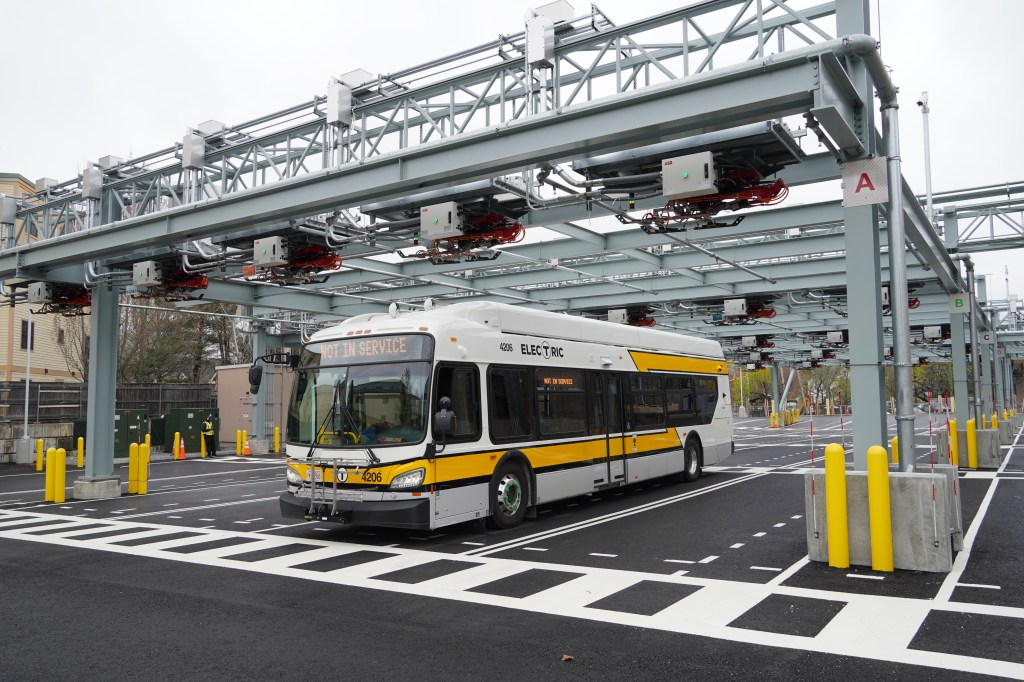
The MBTA says that it is still charging ahead with plans to buy more electric buses for its fleet, even as the New York City Metropolitan Transportation Authority (MTA) recently paused an order with the same manufacturer because of widespread reliability issues.
Both the MBTA and New York’s MTA have contracts to procure fleets of new battery-electric buses from New Flyer, one of the only companies that satisfies stringent “Buy America” requirements for federally-funded transit buses.
The MBTA has been accepting the first few vehicles under its contract over the past few months. A T spokesperson told StreetsblogMASS that 12 of the New Flyer battery-electric buses are currently in service, and testing is still underway.
The MTA, by contrast, took delivery of its first 60 New Flyer battery-electric buses back in 2024 – the first step in its plans to phase out fossil-fueled buses entirely by 2040.
But, as Dave Colon recently reported for StreetsblogNYC, the MTA’s new buses have been struggling with reliability problems, particularly with their batteries. As a result, the agency has put plans to buy hundreds of additional electric buses on hold.
“Those zero-emission buses are not where they need to be in terms of delivering reliable bus service,” warned Jessie Lazarus, the MTA’s head of rolling stock procurement, at a June MTA board meeting.
Lazarus presented data that indicates that the MTA’s battery-powered New Flyer buses have been breaking down more than three times as frequently as their diesel-powered counterparts.
“They’re also in service about 30 or 40 percent less than our diesel buses,” said Lazarus.
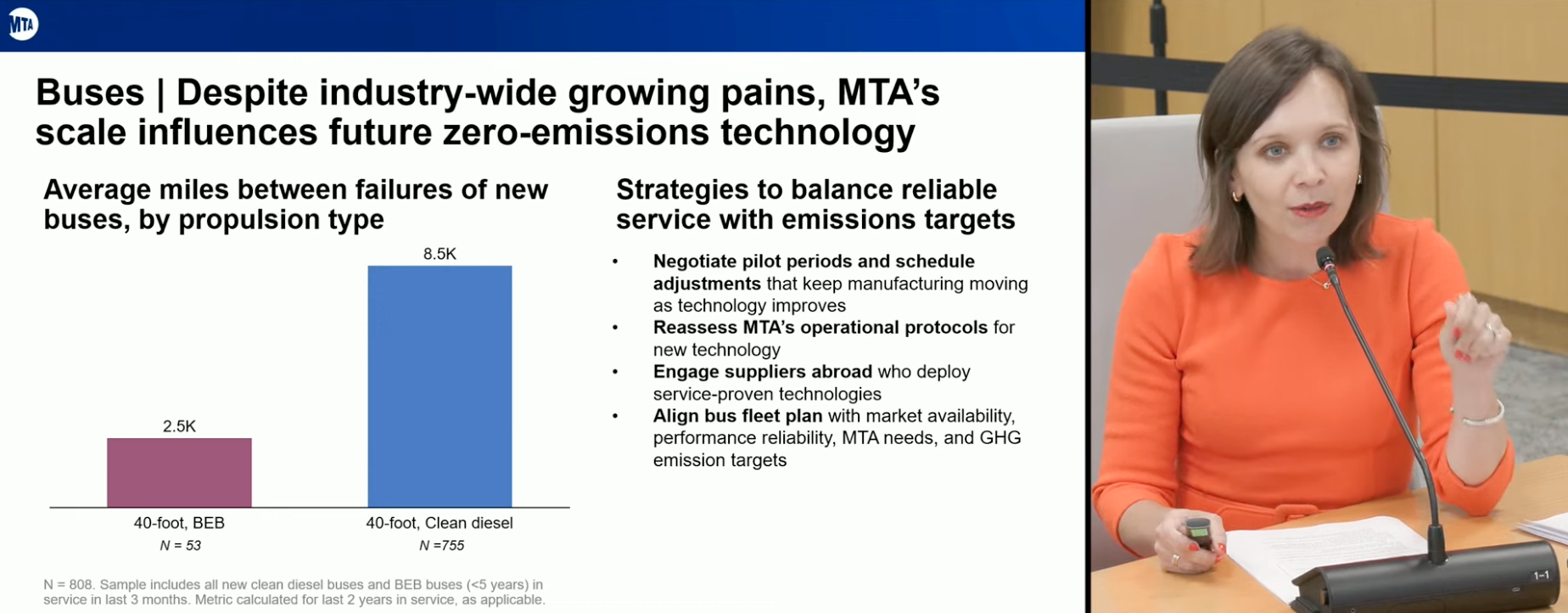
Still, Lazarus told board members that the agency is still committed to helping bus manufacturers refine the new technology. She noted that the MTA is also building out new bus-charging infrastructure at 7 of its bus garages this year.
And she said that the MTA is working with manufacturers to work out the kinks of the new technology.
“We’re running pilot performance periods to make sure we can test their technology in real time, and give that iterative feedback to allow for incremental improvements on these buses when they’re in our operating environment,” said Lazarus.
A second-mover advantage?
MBTA officials told StreetsblogMASS that, so far, they haven’t been experiencing the same problems with their own New Flyer buses.
Although there are considerably fewer buses in operation at the T, and they’ve only been operating for a few months now, the T reports that its new battery-electric buses have so far averaged 28,653 miles between failures.
That’s roughly in line with the performance of older diesel and methane-powered buses: the T reported earlier this year that its entire bus fleet averaged 30,574 miles between failures in the three-year period from 2022 to 2024.
“We continue evaluating bus metrics daily, and are working with New Flyer on software improvements, along with vendor evaluation of unexpected early failures,” an MBTA spokesperson told StreetsblogMASS. “We have just started to accumulate true in-service mileage with a larger number of buses over the last few months, (and) we are seeing improvements as we accumulate mileage.”
“Now that we are past the initial insertion into service, their performance will be closely evaluated with New Flyer and their sub-vendors to validate our performance requirements,” they added.
Under the MBTA’s current $119 million contract with New Flyer, the T will receive 80 new battery-electric buses over the next few years. The same contract allows for options for the T to purchase up to 380 additional electric buses under the same terms.
The T is also building two new bus garages that have been specifically designed for electric bus fleets.
The first, a 32-bus charging facility in North Cambridge, is expected to open this summer, and a much bigger garage for 120 buses in Quincy is on track to open in 2027.
StreetsblogMASS also reached out to New Flyer for comment on this story, but they did not respond before our deadline. We’ll update this story if we hear back from them.

Read More:
Streetsblog has migrated to a new comment system. New commenters can register directly in the comments section of any article. Returning commenters: your previous comments and display name have been preserved, but you'll need to reclaim your account by clicking "Forgot your password?" on the sign-in form, entering your email, and following the verification link to set a new password — this is required because passwords could not be carried over during the migration. For questions, contact tips@streetsblog.org.