Report: Waymo Surpasses The Way-Too-Low Human Driver Safety Bar
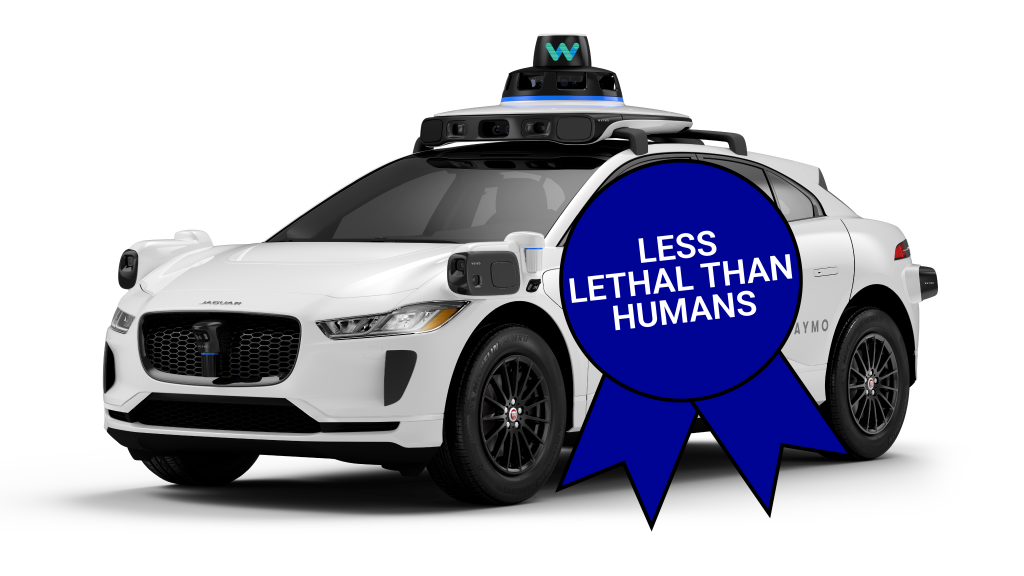
Waymos — the driverless taxis that operate in many cities — are involved in 68-percent fewer crashes than humans, a new independent study found.
The Insurance Institute for Highway Safety report compared state and federal crash data with incident reports from major autonomous vehicle companies in Los Angeles, Phoenix, San Francisco, and Austin. To improve the accuracy of its conclusions, the AV sample was limited to collisions to which police would normally respond. In addition to having fewer incidents than humans, researchers concluded that driverless car crashes are generally less egregious.
In addition to experiencing fewer crashes overall, Waymos experienced 85-percent fewer single-vehicle crashes per mile than human drivers, and 81-percent fewer crashes resulting in injury. The driverless cars also rear-ended other vehicles 91 percent less than their human-operated competitors.
The study corroborates Waymo’s previous claim that its fleet is less prone to collisions than humans are. Waymo cars did best in Phoenix, where its crash rate was 76 percent lower than that of human drivers in Phoenix. There were 71 percent fewer crashes in Los Angeles, but only 35 percent fewer in San Francisco, though the data may simply be reflecting inconsistencies around police reportability as a metric.
“We welcome this new research from IIHS, which confirms our previous peer-reviewed analyses and reinforces the significant safety benefits of the Waymo Driver,” the company said in a statement.
“Safer than humans” is better than nothing, but it’s still an unpleasant concept.
Driverless cars have been at-fault in several high-profile collisions since rolling out onto American streets. An Uber test vehicle struck and killed Arizona resident Elaine Herzberg while she was crossing a Tempe street in 2018. In 2023 a vehicle from Cruise, General Motors’s now-defunct robotaxi service, dragged a woman 20 feet after she was struck by a human driver. Earlier this year, a Waymo crashed into a 9-year-old child in a school zone in Santa Monica, California.
The report’s scope is limited to collisions, and does not take into account the dangers caused by Waymos parked in bike lanes, passing school buses, or blocking emergency vehicles, to name a few recent incidents.
Driverless cars are still cars and, as such, contribute to the many problems that cars bring to US streets.
Waymo has yet to invent a car that does not add to congestion on city streets. Traffic, as it turns out, is one metric by which Waymo might even be worse than human drivers. A report released earlier this week found that Waymos spend nearly 15 percent more time driving around empty than Uber and Lyft with drivers vehicles. In turn, they add tens of thousands of vehicle miles traveled to roads every day.
The solution to car problems is older than the cars themselves. Public transit is critical to curbing traffic and reducing pollution. It vastly outperforms cars, autonomous and not, on safety. Todd Litman, executive director of the Victoria Transport Policy Institute, reported that drivers are killed at 10 times the rate as transit riders.
Investing in transit to save more lives, with less of the negative side effects, would be even better.

Read More:
Streetsblog has migrated to a new comment system. New commenters can register directly in the comments section of any article. Returning commenters: your previous comments and display name have been preserved, but you'll need to reclaim your account by clicking "Forgot your password?" on the sign-in form, entering your email, and following the verification link to set a new password — this is required because passwords could not be carried over during the migration. For questions, contact tips@streetsblog.org.