Exclusive Excerpt: ‘Gridlock’ Sam’s Autonomous Car Thriller, ‘Autokill’
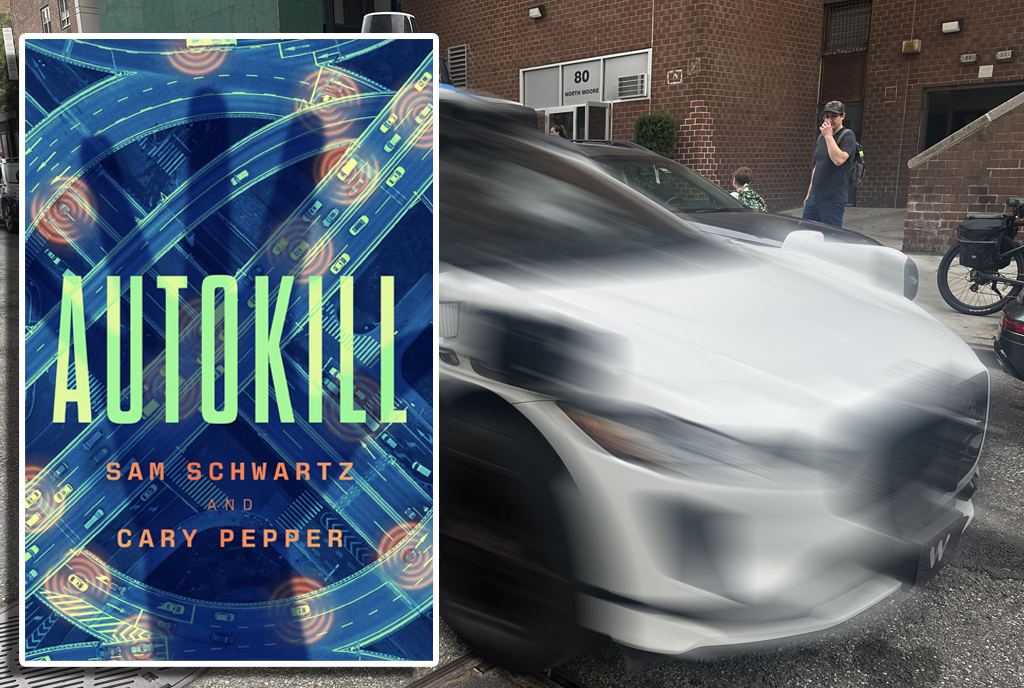
The year is 2036. Connected Autonomous Vehicles comprise 25 percent of the cars on the nation’s streets and roads and fleets of robo-cabs crisscross cities. But after one such CAV blows a stop sign and kills a pedestrian, federal cybermarshal Dana Grant starts asking questions — but can Grant get to the bottom of the “accident” … or undercover a plot to use these connected AVs to kill thousands? That’s the plot of “Autokill” (Open Road Media) by “Gridlock” Sam Schwartz and playwright Cary Pepper. To purchase the full book, click here. But for now, curl up with Chapter 3, “What Was Wrong?” in this exclusive excerpt.
After staring at the computer screen for several minutes, Dana Grant sat back and slowly shook her head. She wasn’t happy and she didn’t know why.
The case seemed simple enough. Last week, a Connected Autonomous Vehicle killed a 35-year-old woman in California. She was sitting in a park, set back from the road some 50 feet, when she was struck by the vehicle. According to local police, the car ignored a stop sign, which was one reason the case landed on Dana’s desk. That, and of course, the fatality.
Dana Grant was a federal cybermarshal assigned to the National Transportation Safety Board’s Portland-based CAV unit, Western Sector. With thousands of robo-cabs, trucks, and buses on the nation’s roads and streets, the National Transportation Safety Board had created a new branch to investigate CAV-related accidents. It was similar to the division that investigated aviation incidents, but only two offices had been opened so far (Eastern Sector was head-quartered in Boston), its operating budget was smaller, its staff had not been provided with the in-depth training that allowed agents in the aviation division to effectively probe air-transport events, and, unlike the aviation division, the CAV unit had no NTSB Training Center.
The marshals had been promised such expertise, but the agency, despite being in existence for six years, was still getting “up to speed” and Congress (swayed by the powerful CAV lobby) had repeatedly failed to adequately fund it, leaving many marshals to obtain any special training they felt they needed on their own, at their own expense. Dana had overheard several of her colleagues proudly vowing not to “go all tech” as long as they had to pay for it themselves.
Not Dana. If she were doing the job, she wanted to be as good at it as she could be. Just as she’d gone the extra distance as a cop in Phoenix. Since joining the unit, she’d been taking workshops and reading as much as she could to educate herself on the intricacies of CAVs. When she needed help, she didn’t hesitate to reach out to the small network of advisors and consultants she’d slowly assembled around her during the five years she’d been on the job.
Influenced by those advisors and consultants, Dana had stopped using the word accident when talking about her cases. She investigated crashes.
An accident is an unfortunate incident that happens unexpectedly and unintentionally, an event that happens by chance or that is without apparent or deliberate cause. But CAVs, obeying algorithms designed for maximum safety and free of road-rage-inducing ego, didn’t do things unexpectedly or take potentially-dangerous risks. So when a CAV collided with anything, it wasn’t an accident. It was a crash.
Dana also quickly learned that crucial to investigating and understanding any incident involving a CAV meant knowing how to read and interpret the information gleaned from its black box, which included every decision, maneuver, and change the vehicle made during a trip. It included interactions with passengers. It included everything the car did, saw, and heard. And because this data was all in computer code, it required knowing how to understand what you were looking at.
Even with all the time Dana had spent learning about this arcane corner of the universe, she still had large gaps in her knowledge of it. But she was light years ahead of every other agent in her office, and she knew it.
Now Dana sat pondering why the CAV ignored the stop sign. Programming error? Software failure? Faulty sensing equipment? If any of those were the issue, did the problem lie with Relyable, the company that manufactured the car? Or was it a matter of a repair, similar to fixing the brakes on a human-driven car? And if that were so, was the root cause a failure by the company that operated the vehicle to properly maintain it?
Or, if it was a programming or software error, did that signal a failure by the engineers at the company that made the car? Which would mean Dana had to see if the same company created both the computer code and the software, because it was possible that correct computer code had been negated by faulty software.
A third possibility was that someone tampered with the stop sign, which happened often in the 2020s, when kids defaced traffic signs or anti-AVers tried to demonstrate the weakness of autonomous infrastructure. Then came the 2029 Topeka School AV bus crash. A couple of teenagers out for kicks turned a 30-mph sign in to one reading 80 mph by making the three an eight. The bus raced around a sharp curve doing 80, left the road, and plunged 35 feet down an embankment, killing 21 children and the bus attendant.
For the next three years, all AV school buses had to have a human driver. Meanwhile, every inch of roadway in the United States was minutely mapped: every traffic sign, signal, lane marking, and channelization. And the federal government required any change, no matter how small, to be immediately entered in the central Geographic Information System Command file, the huge database where all this information lived. Failure to do so resulted in states and cities losing as much as billions in federal highway dollars. Now, any discrepancy between what an AV saw and what was in the GIS database, was detected by the CAV’s Command Center (all the companies that operated CAVs had command centers that controlled their fleet) in a nanosecond, and the GIS Command Center threw the vehicle into fail-safe mode, choosing the safest available option for its next action.
If a vehicle saw “80 mph” but the database listed “30 mph,” the GISCC would send an alert, slow or stop the vehicle, and a remote driver would take over the CAV. In addition, all other vehicles from that company would be alerted and a post-mortem would be conducted.
The system worked almost flawlessly in cities and on state roads; the only gaps now were the small towns and rural areas that didn’t have the ability to update the GIS files, or the few places where locals believed that routinely updating their files was an infringement by an overbearing government. Since 2033, there had been only nine instances of minor crashes due to un-updated traffic devices, and none due to vandalism. Could this be the first?
Maybe. Yet Dana had a gut feeling it was something else. There were thousands of Relyable delivery robos operating in the county and there hadn’t been similar incidents. Which suggested that the computer code, the software, and pretty much everything else in the vehicle was operating properly. So what else could it be?
Relyable had already responded to the police-finding that the car went through the stop sign. Company spokespeople maintained that the sign had been defaced with both a hole and grafitti, so the fault lay not with the vehicle and its sensing equipment, but with the town for not repairing the sign. Relyable also noted that the town had been cited four times for not complying with GIS Command. The company could not be held responsible, it reasoned, for signage or traffic signals that were not repaired or replaced in a timely manner.
Dana studied pictures of the sign; there was no question that it had been vandalized. A tagger had gone to work on it, and there was a hole dead center in the middle of the O. If it was a bullet hole, someone was quite a shot.
Did that mean the CAV had not seen the sign? Or had it seen the sign but was no longer able to identify it as a signal to stop, perhaps interpreting it as nothing more than a lamppost or structure designating street parking? Why did the Topeka fail-safe protocol fail?
“Oh, you caught that California thing.”
She hadn’t heard Kyle coming up behind her. But now there was that soft wheezing through his seemingly-always-clogged nasal passages. Perhaps if he lost some weight… The thought ran through her head almost every time she saw Kyle. He wasn’t obese. Just unnecessarily overweight, all in his belly, which hung over his belt in a loose fold.
Kyle Beaumont would always be overweight, always breathe heavily through his nose, always be, in Dana’s mind, one nasal breath away from a heart attack. Which of course she hoped would never happen. She didn’t hate Kyle or wish any bad would come to him. She just wished he wasn’t her boss.
Not because he was overweight and breathed through his nose. Because he was always hovering, and he wasn’t thorough. He’d been with the NTSB 20 years to her 5, and was more interested in clearing cases than conducting competent, thorough investigations.
So, rather than encourage his people to spend as much time as they needed to properly run a case, he’d be satisfied with a preliminary finding, even one still open to questions, if it added to the “Case Closed” log he submitted weekly to the head of the Portland bureau.
As a result, Dana’s unit had a high closure rate, which Kyle was determined to maintain. But given how they were achieving it, she wasn’t sure that was something to be proud of.
Their findings tended to hold the vehicles or companies blameless, and Dana sometimes wondered about that. But the truth was, in crashes involving CAVs and human drivers, it was almost always the human driver at fault. CAVs had proven themselves to be more consistent, more stable, and less erratic than human drivers. They were not distracted as easily or as often, never tried to beat a changing traffic light or speed past an approaching train, and had no interest in pushing themselves to test their power, speed, or endurance.
So the fact that Kyle’s long list of closed cases often found in favor of the CAV wasn’t surprising. Nevertheless, Dana often found herself wishing he didn’t reach that conclusion quite so fast.
Standing behind her looking over her shoulder, he’d moved closer. She knew, without turning, because the heavy breathing was now only inches from her ear.
“New perfume?” he asked.
“Nope.”
“You smell different. New shampoo?”
“Nope.”
“Different soap, maybe?”
She pictured him sniffing the air around her. Or, worse, sniffing her.
“Same soap.”
“Something about you is different. Are you …?”
It was time to end this. She shifted in her chair, sending it backward into his foot, then turned around and was “surprised” to see the wheel of the chair pressing on his shoe and the edge of her seat against his leg.
“Oh, sorry! I didn’t realize you were that close.”
“No harm done,” he assured her, reaching down to lightly rub his knee. “You still working on that?” he nodded toward her computer.
“Hmm-hmm,” she muttered, studying the screen again to indicate she was too distracted to talk.
“Stop sign was vandalized. The town didn’t update its GIS records. Like the company says, it’s their fault. Can’t you close it?”
“I’m not sure yet,” she started. “I—”
“You have ‘a feeling,”’ he finished for her. “Here we go.”
She hated when he did that. But it had been years since she took him seriously when he said those things in that tone of voice. That had stopped after working with him for two months, when she almost caved in the wake of his response to her first “feeling.”
That first time, still new to the unit and trying to find her way, she’d almost let him intimidate her because she was half-doubting herself: Had she really been on to something, or was it more an attempt to prove she could do the job?
But she stuck with it, and it paid off. Driver vs. CAV, and the driver swore the robo had swerved into his lane. There was activity to the right of the CAV that might have made it swerve toward the driver, but a check of the black box showed it swerved no more than a foot and did not cross the double yellow line that separated the vehicles.
On a hunch, Dana checked the driver’s cell-phone records and found that he’d been on the phone at the time of the accident. It was him, not the robo, that had swerved across the
double yellow line.
Two lessons learned: Always trust her gut, and never listen to Kyle about such matters.
It took her a while to stop railing at herself for letting him come as close as he did to shutting her down, but she finally landed in place of self-understanding: she was navigating new territory with insufficient training. She was allowed a few missteps; she could forgive herself. Afterward, she did more than that, using the episode to redefine their relationship.
Never one to be intimidated (easily or otherwise), not even as a child, she would never again be bullied by a bureaucrat now that she was 35, carried a badge, and believed (knew) that she was better suited for this work than he was.
“Here I go,” she corrected him. “It’s not gonna affect your life much.”
“Except what it’s gonna do to our clearance rate.”
“You mean my clearance rate?”
“Ours includes yours. You slow up, we slow up.”
“I’ll work this extra fast.”
“Work what? The cops confirmed the CAV went through the stop sign. No one’s contesting that. The cops confirmed the stop sign was vandalized. No one’s contesting that. The town didn’t update its GIS file. You wanna blame the robo? It’s like, someone blindfolds you, then blames you for walking into something. How much more open-shut can you get?”
“Looks that way.”
“Except you know better.”
“I just want to leave it open a little longer so I can—”
“You can have a little more time on this. But don’t take too long. And don’t neglect your other cases.”
“I never do,” she answered, fingers busy on her keyboard, focusing on her screen, as a way to end the conversation.
Finally sensing their talk was over, Kyle walked away, triggering a new train of thought for Dana: What kind of ratings was he getting on his quarterly evaluations? But why go there? For years he’d been part of a federal bureaucracy that valued meeting quotas and demonstrating its own skewered sense of “efficiency.” She knew exactly the kind of evaluations he was getting. And he knew exactly how to keep getting them. And keep his job.
She peered at the screen for real now, hoping to find something new. Kyle was right about one thing: It did seem like an open-and-shut case. The CAV had functioned perfectly until it encountered the vandalized stop sign.
So what was bothering her? What was wrong?


Cary Pepper is novelist, screenwriter, and award-winning-playwright whose work has been presented throughout the United States and internationally. He is a four-time contributor to Applause Books’ Best American Short Plays series. AutoKill is his fifth novel. Check out his website here.
Read More:
Streetsblog has migrated to a new comment system. New commenters can register directly in the comments section of any article. Returning commenters: your previous comments and display name have been preserved, but you'll need to reclaim your account by clicking "Forgot your password?" on the sign-in form, entering your email, and following the verification link to set a new password — this is required because passwords could not be carried over during the migration. For questions, contact tips@streetsblog.org.