Good Public Transit + Good Public Funding = Good Public Health
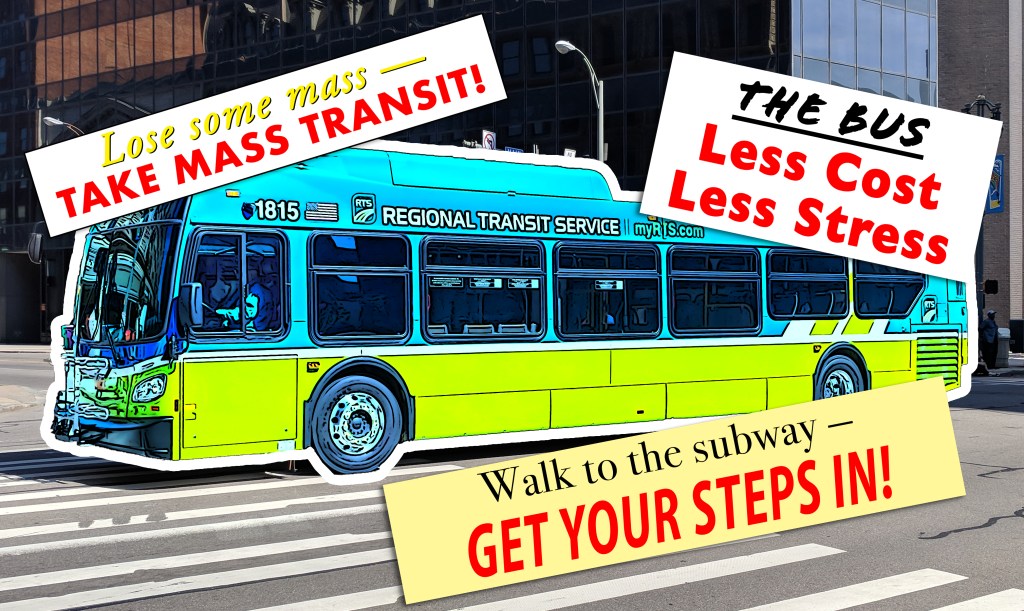
Ride the bus — and get your steps in.
Transit agencies don’t do enough to remind policy makers, and even their own customers, of the connection between good public transportation and good public health, argues a new report that asserts that better messaging can strengthen the agencies’ funding and impact.
There is obviously already a consensus around transit’s physical and mental health benefits, but report, prepared for the Transportation Research Board, calls for agencies to communicate it better.
“Transit agencies [should] acknowledge the health benefits and use it to help get resources,” said Andrew Dannenberg, an affiliate professor at the University of Washington. “It’d be great if they’re saying, ‘Take transit, it’s good for your health,’ when they’re talking to legislators trying to get funding to build, maintain, and expand transit.”
The authors identified seven healthy outcomes directly linked to public transit — such as basic physical activity, cleaner air, fewer crashes and expanding social networks — but Danneberg emphasized that transit officials shouldn’t merely recite the list, but create messaging.
For instance, he said, “A quarter of people reach their recommended daily physical activity just by walking to and from transit. That is not a trivial amount.”
Case studies demonstrate the success of good health messaging in transit funding. In Boston a decade ago, a health assessment that identified the negative consequences that service cuts would have on community health and economic well-being led to those cuts as well as fare hikes to be pared back.
“The [assessment] fed directly into the decision-makers’ process towards coming up with a solution for the budget gap,” the report said. “By presenting monetized impacts in a succinct report, it appears the results were able to gain traction, and broaden the discourse to include consideration of health impacts.”
Transit funding is so often on the chopping block to close year-over-year budgets, but policy makers must be compelled to see the long-term budgetary implications of good transit towards people’s health. A case study from rural New Mexico recalled how a bus service saved Dona Ana County more than $600,000 annually by reducing hypertension and connecting people to preventative care. And two studies in Portland found that people living near transit have lower health-care costs — not a small finding in a nation that spent $5.3 trillion, or roughly $16,000 per person, on health care in 2024.
Yet health-care savings created by transit aren’t often plowed back into transit.
“The cost that you might save in health by having people more physically active are good for society overall,” says Dannenberg. “But they don’t translate into, ‘Good, now we got extra money that we can put into the transit systems.’”
Thus, some recommendations: First, transit agencies need to know their impact on community health. As the report notes, health benefits are complex, making it challenging at times to quantify. However, the report identifies research partnerships as key to doing so. For example, Boston’s health impact assessment was conducted by its regional planning agency in collaboration with researchers from Harvard and Boston University.
Second, communicating transit’s health benefits is just as important. The dense nature of scientific research tends to limit its audience to specialists. But the Boston example demonstrates that making findings generalizable also helps transit’s case. Broadening their audience, as well as who benefits from transit (hint: everyone!), is a key pivot.
“Benefits can also be realized by people who do not use transit,” the report stresses. “This is an important distinction when communicating the value of public transportation to decision-makers and the public.”
It’s unfair to expect transit officials — who are often in a desperate struggle for funding and must spend almost all of their time simply running their systems — to create health messaging. Instead, groups like the American Public Transportation Association must reframe transit for everyone’s well being, Dannenberg said.
“If you look at what’s on [the APTA] website about why transit’s good for you, health is kind of buried in there,” Dannenberg said. “But why not make that one of the stronger messages?”

Read More:
Streetsblog has migrated to a new comment system. New commenters can register directly in the comments section of any article. Returning commenters: your previous comments and display name have been preserved, but you'll need to reclaim your account by clicking "Forgot your password?" on the sign-in form, entering your email, and following the verification link to set a new password — this is required because passwords could not be carried over during the migration. For questions, contact tips@streetsblog.org.