Kansas City is Again Expanding Its Once-Mocked Streetcar
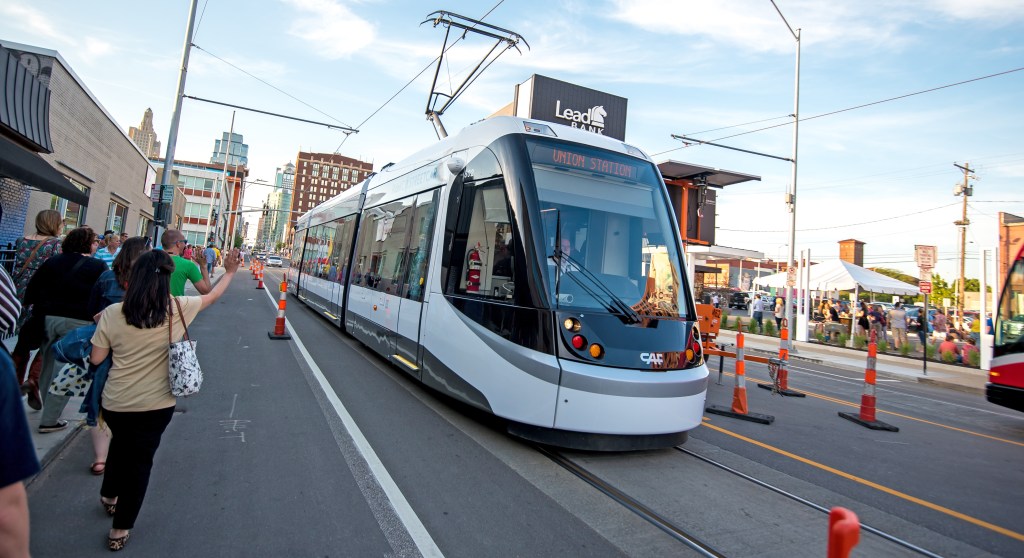
The Kansas City streetcar is expanding again — the latest evidence that targeted transit can boost economic development and reduce car use.
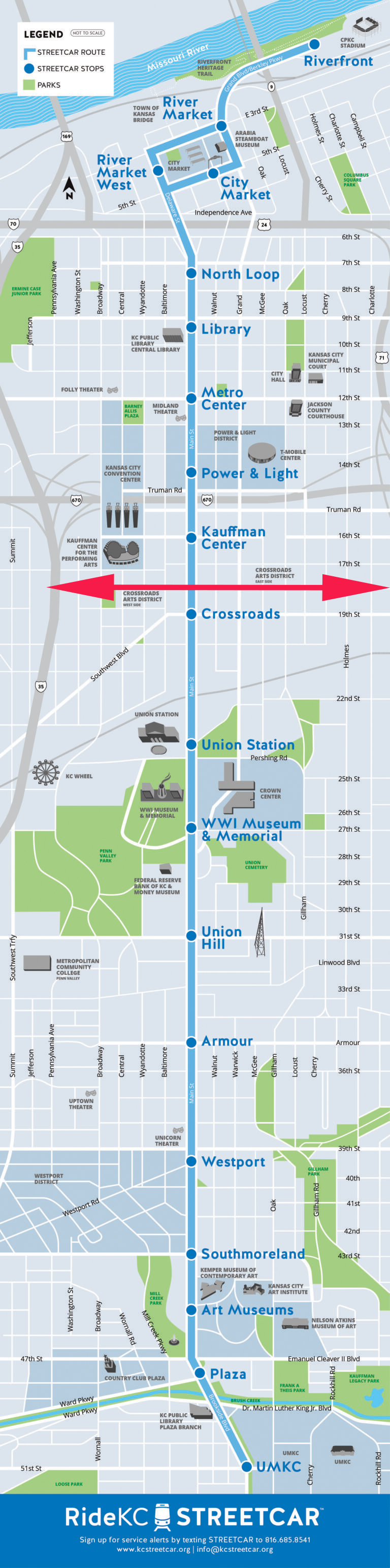
On Feb. 1, the Kansas City Streetcar Authority unveiled its plan for another free-fare line, this one going east-west to bolster the existing 5.7-mile north-south stretch along the city’s dense Main Street corridor, whose first segment opened in 2016. No matter the final route, both proposals would bring visitors to the historic jazz district 18th and Vine. The line would cross over Troost Avenue, a major road famous for helping segregate the city’s white population on the west with its majority Black population on the east. The proposed lines would also provide easy transfers with popular north/south bus routes, helping to further reconnect the east and west sides of the city.
And that new route comes on top of an 1.2-mile extension that is slated to open in late spring, the spur off the main line northeast to the Berkley Riverfront. The Riverfront, much like the east side of Kansas City, has been historically neglected; despite only being a half-mile away from downtown, highways and train tracks make it inaccessible on foot. The Riverfront station is poised to be a major strike against car-dependency in the neighborhood, one that the city is taking full advantage of by approving the construction of multiple major apartment complexes nearby.
The Riverfront extension wouldn’t be the first time a streetcar station helped reshape a city famed for its barbecue. In 2018, the city voted for a 3.5-mile extension plan, which opened (under budget and on schedule) in October, 2025. Suddenly the line took riders into the dense, vibrant Midtown, stopped by the Country Club Plaza (the city’s famous, historic shopping area) and ended at the University of Missouri-Kansas City, a school with more than 15,000 students. Unlike for the original streetcar line, the stations on the extension are spaced further apart, and this new section of the line is largely grade-separated. From Union Station to the University, the KC streetcar is faster than rush-hour traffic.
“My car use has decreased massively since the streetcar opened,” says Austin Childs, a Midtown resident who volunteers at the World War I Museum and the Nelson-Atkins Museum, both of which have named stops along the line. “Pretty much everywhere I used to take my car to has been replaced by the streetcar. I probably only drive my car one or two times a week now when I was using it daily before.”
Most residents haven’t changed their habits quite as much: “A lot of the people I know still have to drive for work,” said Zara, a River Market resident living near the top of the streetcar line. “Most will prefer to drive for groceries.”
But for Kansas City, letting more citizens enjoy a car-light lifestyle is still a step in the right direction. The streetcar specifically cuts down on the need for parking space in the downtown area, making it easier to build much-needed dense housing in its place.
Real estate values of land near streetcar stations have risen, but the City Council passed an anti-displacement ordinance in hopes of mitigating the issue.
The 48-page ordinance highlights a plan to build more dense housing in the streetcar corridor and to preserve existing affordable housing through formula grants. The city has largely committed to building new housing along the streetcar line, a goal made slightly easier by how underdeveloped the area was prior to the streetcar’s approval.
If there’s an upside to being one of the most parking-lot-abundant cities in America, it’s that there’s a lot of low-hanging fruit for city planners.
Helping out the streetcar’s momentum is just how proud the city seems to be of it. The stations are well-marked with info signs, and on the ride itself you’ll often hear a recorded message from Mayor Quinton Lucas welcoming riders to the city’s fare-free, zero-emission transportation system.
“The vibe is generally pretty friendly,” said Michele, a KC resident living by the Library station, “especially when folks from the suburbs use it for special events.”
Buses throughout Kansas City may be dropping their fare-free approach in June, but the streetcar will remain free thanks to an established 1-percent sales tax on businesses within one-third of a mile of the line, as well as through property taxes on surrounding buildings. This change further distinguishes the streetcar as a special experience for residents and tourists, a step above the bus routes that make up the rest of the city’s public transit infrastructure.
How did KC get here?
Of course, the success of the KC streetcar was never a sure thing. Yes, the city had an epic love affair with the mode in the early part of the last century — at its 1922 peak the city boasted a 319-mile network behind only San Francisco and Chicago — but auto-centric planning hollowed out Kansas City in the post-war years.
You know the story: By 1957, there were no streetcars left. And periodic talk of reviving them was dead on arrival; there was no longer enough density along any proposed routes, so the plans were rejected for federal funding due to the lines’ low projected ridership. Few residents were on board anyway.
“Kansas city needs streetcars like a fish needs a bicycle,” wrote one reader to the Kansas City Star’s opinion page. “What a colossal waste just for a minor shot of nostalgia.”
It was a common sentiment in the city, even echoed by some self-proclaimed public transit supporters. As another resident wrote in to the paper, “I want to support projects that will serve the public and create economic development. A streetcar will do neither.”
By 2012, Kansas City had completed its transformation from the Paris of the Plains to one of the most-unwalkable cities in America, with the most highway lane miles per capita, with several of those highways carving right through once-vibrant downtown neighborhoods. More than 30 percent of the downtown area’s land was dedicated to parking lots, and its public transit ridership per capita was some of the lowest in the nation.
You only need to look at the before-and-after photos to be horrified.
But hope and change sometimes come together. In 2010, the Obama administration made a meaningful tweak to the federal funding standards to give priority to rail lines that would spur economic development in its surrounding area, rather than its ability to transport large numbers of people quickly.
“The new criteria give Kansas City renewed hope as planners develop a downtown streetcar line,” the Kansas City Star reported that year, describing the original proposal for a 2.2-mile line down Main Street, going from the city’s Union Station to the historic River Market neighborhood. It’s one of the most densely populated stretches of the city; it’s the central business district; and it’s home to of some of the city’s most famous restaurants, theaters and museums.
The Obama funding tweak led to a string of downtown streetcars across the country, most of which have been criticized for being too slow, for not covering enough ground, and for not being that useful for regular commuters. The Kansas City streetcar initially appeared to be no exception: it was not grade-separated, it only covered two miles, and the distance between stops was typically only around two blocks. With its 10-minute frequencies, it was often faster to walk between downtown destinations than to take the streetcar, which was derided as merely a tourist-mover (which was reflected in the higher ridership on the weekends).
Yet the Kansas City streetcar defied the naysayers to become one of the most successful public transit projects to come out of the 2010s. Ridership exceeded expectations. Businesses boomed all along the streetcar corridor. From 2017 to 2025, more than 1,700 new apartment units were constructed along Main Street, helping increase the downtown population by 44 percent in a 10-year period. And even though most riders acknowledged that the streetcar functioned not much better than the regular bus that preceded it (which operated at a smaller price tag), they enjoyed it anyway.
“It’s not really logical that we’d take the streetcar when the Main Street [bus] ran essentially the same route and we never took it,” said one local, an attorney whose office is located downtown. “But there’s something more communal about the streetcar — we’re not all just staring straight ahead.”
Kansas City may still be a sprawling, car-centric city, but the success of its streetcar line shows the importance of playing the long game in car-dependent areas. The original 2.2-mile streetcar line did not do much to reduce car use, but it did provide a foundation for an extended streetcar network that can reduce vehicle miles traveled and boost economic development.
The City of Fountains may never fully recover from the damage of its 20th-century highway boom, but it’s still pushing back against car dependency one streetcar station at a time.

Read More:
Streetsblog has migrated to a new comment system. New commenters can register directly in the comments section of any article. Returning commenters: your previous comments and display name have been preserved, but you'll need to reclaim your account by clicking "Forgot your password?" on the sign-in form, entering your email, and following the verification link to set a new password — this is required because passwords could not be carried over during the migration. For questions, contact tips@streetsblog.org.