Trump’s Canada Bridge Tantrum Could Be Bad News For An International Bike Trail

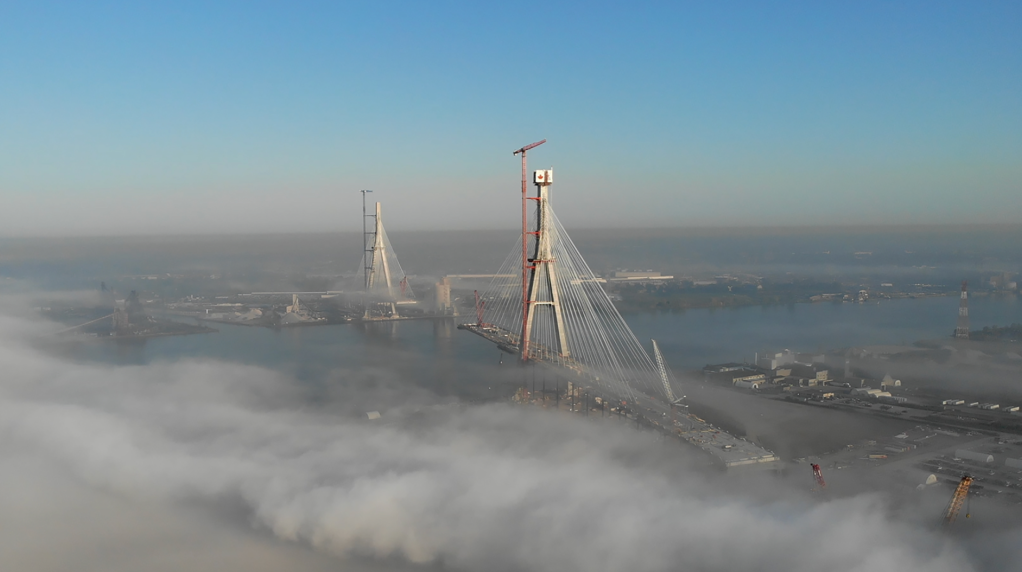
In his latest provocation towards Canada, President Trump is threatening to block the opening of a new connection between Detroit and Windsor — and in the process, shut down a bike path that would provide a rare non-automotive connection between the U.S. and our neighbors to the north.
In a February social media post, Trump said he would not allow the Gordie Howe International Bridge to open “until the United States is fully compensated for everything we have given them, and also, importantly, Canada treats the United States with the Fairness and Respect that we deserve.” House Democrats later introduced legislation to prevent “federal interference” in the project that is still pending.
Spanning the Detroit River and named for the Canadian ice hockey legend who played for the Detroit Red Wings, the Gordie Howe was designed to facilitate a more direct path for car and truck traffic between freeways on either side of the border — and it would have also included a bike and pedestrian path, protected from the six lanes of car traffic beside it.
First conceived in the early 2000s, the bridge was built and financed by Canada under an agreement in which Canada would recoup its costs via tolls, though cyclists and walkers could cross for free. After 25 years of planning and approvals that have finally brought the massive infrastructure project close to completion, though, the future of the bridge is now in limbo — and with it, the only car-free connection between the two cities, for which local advocates and trail organizations have fought for years.
“The number one thing that people wanted was a bike lane and it hadn’t even been on the plan,” said Lori Newton, a Windsor bike shop owner and cycling advocate who was actively involved in the Gordie Howe project. “It’s something that grabbed the imagination of people on both sides, whether or not they would use it.”
For over a decade, a coalition has championed the Gordie Howe bike path and laid the groundwork to connect the bridge to a network of urban bike paths and trail greenways on either side of the border, creating a powerful catalyst for cross-border tourism, cultural exchange and connection to the region’s environmental assets.
Other routes across the Detroit/Windsor border have been closed to bike and pedestrian traffic since the 1980s, and there is no public transit to speak of between the two communities. The single tunnel bus that transferred passengers across the border for close to 100 years was shut down in August.
Even before this week’s escalation, though, tensions between the U.S. and Canada had put a damper on the binational collaboration, driven by Trump’s topsy-turvy tariffs, repeated barbs, and hints of annexation.
“What Trump is doing has deeply affected people in Windsor,” said Newton, who was recently named the Bicycle mayor of Windsor. “We had imagined quite a fabulous opening for the bridge. And now so many people from my region — they just won’t cross.”
The Vision
Despite the President’s adversarial rhetoric, the cities of Detroit and Windsor have shared close commercial and communal ties for decades, and thousands of people commute across the river daily for school and work — key connections that would be threatened if the Gordie Howe gets held up any further, particularly for those who don’t drive.
The two communities got involved in the bridge project once the design phase began about a decade ago. A coalition of active transportation advocates on both sides of the river drew up a Vision Map, solicited feedback from residents, and made the economic case for the bike lane to the Bridge Authority, while also advocating for better public transit across existing border crossings.
John Hartig, an environmental scholar who is highly involved in multiple cycling and rail projects in Southeast Michigan, says better multimodal connections would be a particular boon to tourism, allowing car-free visitors to explore region’s rich history, natural and cultural offerings car-free. The region has a rich history in not just in the auto industry, but also in ship building and the civil rights movement, and it’s also a popular site for birding and waterway experiences, along with Ontario’s wine country, and Detroit’s recent urban renewal projects.
“Just think of the things you’re going to be able to do by bicycle,” he added.
The Gordie Howe, hopefully, will not just bring economic stimulus to the regional economy, but also represent a new era of collaboration between the U.S. and Canada, particularly via trail tourism. Local organizations plan to create a trail that follows the path of the Underground Railroad in the two cities, which served as the gateway for freedom for an estimated 50,000 people over 40 years.
On the U.S. side, a planned trail network that will connect to the bridge will include Detroit’s Joe Louis Greenway, the city’s brand new $80 million waterfront park, and the Iron Belle Trail, a state path that extends diagonally across the state of Michigan, from Detroit to the Upper Peninsula. On the Canada side, it will connect to the Great Lakes Waterfront Trail, which traces 3,600 kilometers of Ontario’s Great Lakes in Ontario and the newly planned Obijwey Park in Windsor.
The Trans-Canada Trail — which, at 17,500-kilometers, is the longest trail in the world — will even incorporate the bridge as its first international crossing, opening the possibility for long-haul hikers and cyclists to traverse both countries in a continuous trip. Someday, the bridge might even help join the Trans-Canada trail with the statewide North Country Trail, a 5,000-mile route which begins at the Appalachian Trail terminus in Vermont and crosses eight states.
The challenge
That awesome vision, though, could be challenged not just by Trump’s threats, but by the challenges of building bike infrastructure in the United States, period.
South of the Gordie Howe Bridge, the majority of Detroit’s bike trails are works in progress — and like most trail projects across the country, they are in part funded by the federal government. A segment of the 28-mile Joe Louis Greenway, for example — which will connect multiple Detroit neighborhoods — was funded by a $10 million discretionary grant through the Inflation Reduction Act, finalized in the final days of the Biden Administration. Surprisingly, it was not rescinded under Trump.
But funding isn’t the only challenge that America’s trail systems face. Federal staff purges and the cancellation of other Biden-era grants have impacted the North Country Trail’s work with the National Parks and National Forest service, potentially complicating the vision for a binational mega-trail that the Gordie Howe would have helped complete.
“A lot of our partners were just non-responsive because there was nobody there; nobody to do the work,” said Andrea Ketchmark, the executive director of the North Country Trail Association. “What’s really hard is not knowing.”
Before Trump’s threats, the Gordie Howe bridge opening once seemed like a beacon of hope amidst all that uncertainty. Advocates are already helping to plan a Detroit segment for an annual Canadian multi-day bike ride that’s being held this year in May.
“We have Canadians coming from all across Ontario for a bike ride,” said Todd Scott, head of the Detroit Greenway Coalition. “They decided to be in Windsor because of the Gordie Howe Bridge. We were planning a ride across it to visit Detroit.”
But now, even if the bridge were to be opened by then, some fear the Canadians might not want to cross.
“We don’t have an issue with Windsor and Ontario people and they don’t have an issue with us. It’s all at the federal level,” Scott said.
For now, though, advocates on both sides of the border intend to put their heads down and do the work on the ground that they can control — and hope that the bridge and its bike path open as planned.
“We in this Greenway space are thinking of the big picture — the long term,” Hartig said. “We’re going to get over this era of friction.”
Streetsblog has migrated to a new comment system. New commenters can register directly in the comments section of any article. Returning commenters: your previous comments and display name have been preserved, but you'll need to reclaim your account by clicking "Forgot your password?" on the sign-in form, entering your email, and following the verification link to set a new password — this is required because passwords could not be carried over during the migration. For questions, contact tips@streetsblog.org.