Why Does Trump Wants To Punish Cities For Free Buses?
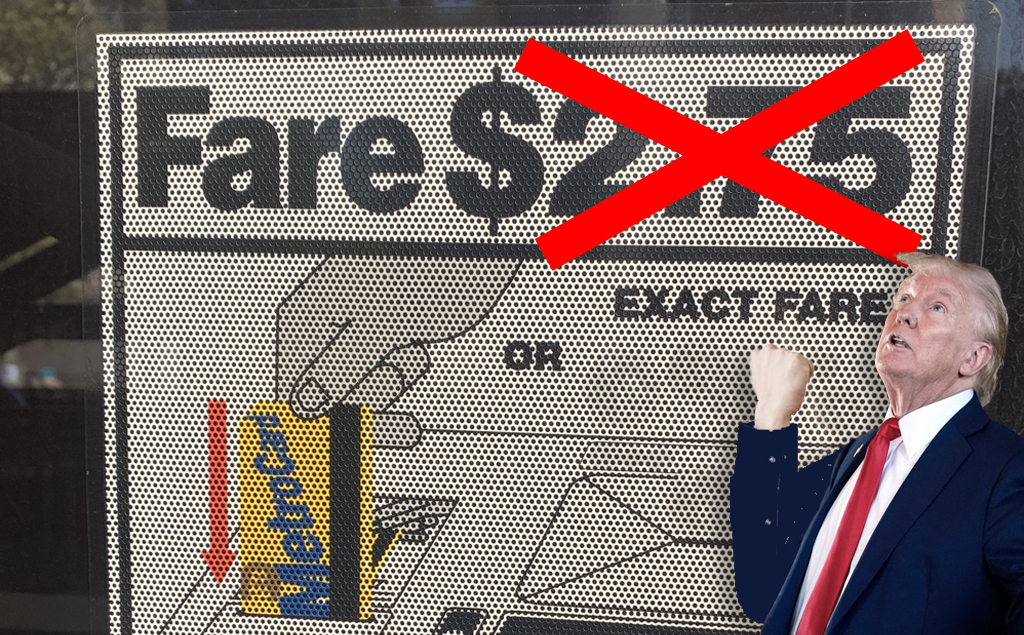
The Trump administration’s proposal to cut off federal transit funding to large cities that make their buses free could be motivated by political retribution rather than any meaningful policy goals, advocates fear — and in the process, it could create costly new inefficiencies for governments who are already struggling to deliver residents the mobility options they need.
Politico reported earlier this month that the White House is quietly urging Congress to adopt new laws that would “stop large cities that receive federal funds from providing free bus transit,” which it defines as communities more than 200,000 people and more than 100 buses in service.
That language — which, if adopted, would be enshrined into the federal transportation law that will replace the Infrastructure Investment and Jobs Act when it expires this fall — would conspicuously shut out big, blue cities with zero-fare buses and mayors who have spoken up against the Trump administration, like Albuquerque and Tucson. But it would also conspicuously preserve federal funding for predominantly red rural communities, which represent most of the fare-free bus systems in the U.S.
While Politico says that fare-free programs for “seniors, people with disabilities, children, students and veterans” would be excluded from the policy, it’s unclear whether fare waiver programs for the very low income would be, too, like Philadelphia’s celebrated Zero Fare pilot.
And it’s even more unclear how the policy is meant to improve transit in communities that are already struggling to grow ridership, reduce dwell times when fares are being collected, and speed up busses on car-congested roads with no money for dedicated bus lanes — all of which are among the top justifications for making rides free. The Trump administration did not respond to a request for comment from Streetsblog, and Politico did not release the full text of the proposal.
“When this department floats a rule that looks like it would impact a small handful of cities, it feels very suspect,” said Steven Higashide, who directs the clean transportation program at the Union of Concerned Scientists. “I’m a transit researcher. I’ve been in the thick of the debate over free transit — the benefits of the policy and the challenges of the policy. But I suspect this is quite divorced from any policy. This Department of Transportation is more interested in persecuting foes than improving lives, which is what a department is supposed to do.”
Also the author of “Better Buses, Better Cities,” Higashide acknowledges that larger cities face unique challenges with eliminating fares, like overcrowding on popular routes and difficulty maintaining their systems if new revenue sources to replace farebox losses aren’t quickly identified. Other critics of zero fare programs in general have argued that tossing out the bus ticket doesn’t typically equate with less driving — mostly because in America, many bus riders are too poor to own cars in the first place, and those who can afford to drive on dangerous, sprawling, car-dominated streets do.
In the wake of COVID-19, though, many communities have found those trade-offs to be worth it — first, to stop the spread of the deadly disease in the confined space of a transit car, but also to maintain access to jobs and basic services for the low-income. Some researchers have even found that making fares free can stimulate the economy by generating more leisure and shopping trips, potentially making up for lost fare revenues over time.
More to the point, though, Higashide notes that waiving fares costs almost nothing in the scale of America’s notoriously expensive autocentric transportation network, which routinely pours billions of dollars a year into highway expansions and driver subsidies that actively harm communities. Richmond, Va., for instance, reauthorized its zero-fare program last April for just $6.8 million; The commonwealth’s Department of Transportation will spend $3 billion on road construction alone in 2026, not including maintenance and operations.
“[$6.8 million] is basically the cost of one very small highway project; the state DOT doesn’t even blink about a project of that size,” said Higashide. “And yet, when it comes to the transit system, it’s a large debate about whether the region’s going to be able to raise that funding every year. Of course, if we’re talking about New York City, [waiving fares would be] a very sizable chunk of money, and there are real debates to be had about the trade-offs. But New York City is not the only place that would be impacted by a by a rule like this.”
Of course, it’s not hard to imagine how communities could work around a theoretical law that shut off their transit funding for daring to make the bus free — like charging a single penny per ride, or even instituting a meaningful fare, but simply not enforcing it.
Still, Higashide points out that even symbolically complying with the proposed law would still require agencies to undergo studies and administrative work that cost serious taxpayer money, introducing senseless government inefficiency even as the Trump administration ostensibly promises to slash red tape.
“It mostly feels like they’re trying to get cities and states to waste their time trying to figure out how to comply and stop the threats,” added Higashide. “And that is time and energy [communities] don’t have, that could be spent on actually making the service better. Whether it’s public transit, or the way the administration decided to just not provide congressionally required funding for things like electric vehicle chargers and other requirements of the law, it just feels like they are interested in throwing wrenches into places they don’t like.”
If Congress moves forward with the Trump administration’s anti-free bus agenda, Higashide says it will be part of a larger pattern of “weaponizing” the Department of Transportation against communities that oppose its policies, which he described in a recent article for the New Republic. And that means advocates and Congress have to take any transportation policy they propose with a bucket of salt.
“I just think it’s really unfortunate that these days, when you see a new rule from the Department of Transportation, you have to try to figure out not just what are the policy impacts, but [if] there are perceived political rivals that are going to be punished by this rule,” Higashide added. “Because it feels like more and more, that’s the motivation behind what we see from this DOT.”

Read More:
Streetsblog has migrated to a new comment system. New commenters can register directly in the comments section of any article. Returning commenters: your previous comments and display name have been preserved, but you'll need to reclaim your account by clicking "Forgot your password?" on the sign-in form, entering your email, and following the verification link to set a new password — this is required because passwords could not be carried over during the migration. For questions, contact tips@streetsblog.org.