Talking Headways Podcast: One Year of Congestion Pricing
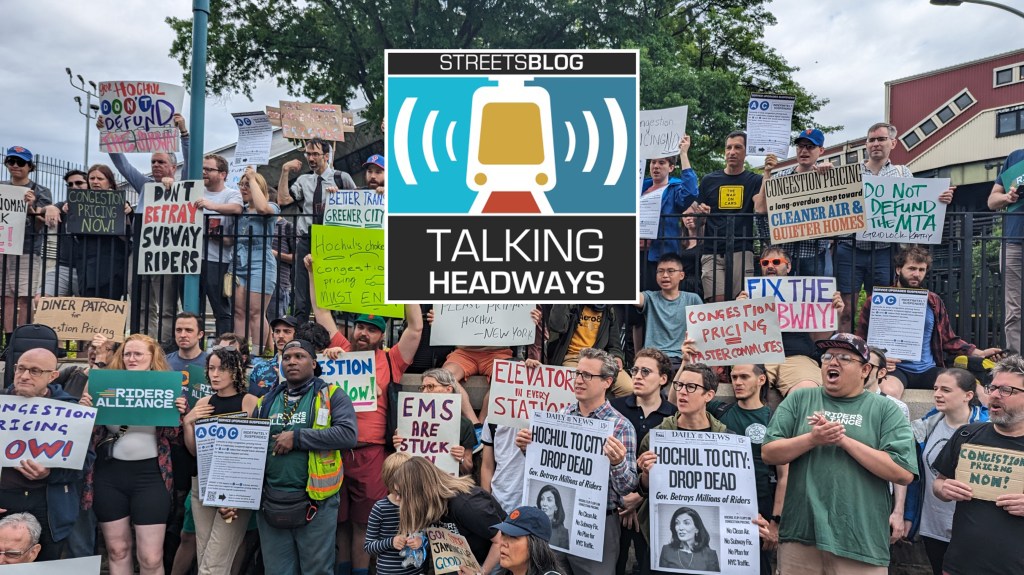
This week on the Talking Headways podcast, I’m joined by Danny Pearlstein of Riders Alliance, New York City’s premiere transit advocacy group, to talk about the one year anniversary of congestion pricing in the Big Apple.
We chat about the history of the idea, the mobilization of activists to turn the cameras on and sour grapes from New Jersey and U.S. DOT.
Scroll past the audio player below for a partial edited transcript of the episode — or click here for a full, AI-generated (and typo-ridden) readout.
Jeff Wood: I also want to ask you about the organizing and the activism of it all, because I think that’s a really interesting part of this that maybe gets skipped over when we have these discussions. We could talk about the 51 percent through the Holland Tunnel travel time savings and those types of things, which are great.
But I want to go into the expertise that you have about organizing and getting people together to support this because, one of the things that I’ve been thinking about lately is — and we had Carter Lavin on last week whose new book is really wonderful in this respect — but how we get change and how change actually comes to pass, and this isn’t just, as you mentioned earlier, this isn’t just Kathy Hochul turned it on and it was there and it took a lot longer and a lot more advocacy and work to get this to where it is now.
Danny Pearlstein: Yeah. I mean it wasn’t just Kathy Hochul, there were two governors who were lukewarm and insecure in their support for it. Andrew Cuomo had opposed it, then he embraced it, then it was passed. Then he didn’t do much to push it forward. Kathy Hochul came in when the environmental review had just gotten underway at the federal level, and she embraced it, but then she backed off when she saw the polling on affordability.
That turned out to be a real harbinger of the 2024 and 2025 elections. I think what she didn’t appreciate is that while everyone pays the price of groceries, very few people pay a toll to drive to Manhattan because very few people drive to Manhattan. It’s unpleasant, it’s already very expensive. What we were able to do at key points throughout the process is mobilize a grassroots base of transit riders who wanted to see substantial change.
And that started with our neighborhood-based Riders Alliance organizing a dozen years ago or so. Some local train stations in Brooklyn where the train didn’t come frequently enough, and then quickly realizing that actually there was a broader transit funding situation, and that, as the lack of transit funding became more apparent, the system also started to really stumble, train delays skyrocketed. There was no light at the end of the tunnel for people who needed subway accessibility. All good reasons to raise a lot of money to fix the subway and no obvious source of revenue.
And at the same time, traffic was bad and getting worse, right? The buses were slowing down. Buses had lost ridership. There was the advent of ride-share vehicles, right? Uber and Lyft coming onto the scene slowing down traffic even more, but also creating some additional support for congestion pricing in various ways. But what we did was we organized in strategic neighborhoods and moved key legislators off the fence in support of the program by coming to the realization that their constituents wanted them to take a controversial vote to fix the subway, and ultimately it was packaged inside the state budget, right? Nobody voted up or down on congestion pricing itself. But the [State Assembly] speaker, just like the previous speaker, didn’t want it in the budget unless he knew that there was majority support among the membership.
And so we got there. Mostly by mobilizing in Brooklyn and Queens, the largest counties in New York. Brooklyn has 21 assembly members. Queens has 18 out of a total of 150. So a lot of transit riders and a lot of legislators in those big counties. And then in a sort of rapid response, when Gov. Hochul paused congestion pricing with an apparent plan to scuttle it permanently we tried to close off the exits. We prevented passage, in a couple of critical days at the end of the 2024 legislative session [In June], there were some alternatives floated that we quashed [them]. We rallied in New York City, we rallied in Albany, I think a couple of days in a row and quashed those.
And so they didn’t come to pass and the legislators went home and they had the elections and then we also sued the governor and so she didn’t have another good funding option. She had a lawsuit holding her to account for the 2019 state law, and then she had an incoming Trump administration, which I think finally sealed the deal for her that there wasn’t gonna be new money coming to the rescue from Washington, D.C. — quite the contrary, and realizing she had to do it and she had to be brave. She had all the talking points. She had been talking the best game about it in town for a couple of years, so she knew just what to say again.
She cut the toll from $15 to $9, but she turned it on and she was very quickly pleasantly surprised, like so many people, that the thing just worked. And I think we all have stories from people who were skeptical, right? They couldn’t figure out exactly what wouldn’t go wrong, but a new toll doesn’t sound so appealing.
So of course something’s gotta go wrong and it didn’t. From the beginning it had been really battle-tested and every “i” and “t” dotted several times. It just worked. There was a tremendous investment by the MTA in making sure that would work, and it did, and it continues to work every day to the extent that there’s no longer any polling on the topic. It is part of the furniture. It is not a live political controversy. The pollsters have moved on to other issues.
Jeff Wood: I’ve been thinking about this a lot lately, especially related to just the big fight back that happened. The amount of work that was put in when it was decided that there was gonna be a pause, which was funny the other day, watching the press conference with the mayor and the governor and she said, oh yeah, I was always gonna turn this back on.
And I was like, what are you talking about? If you’re paying attention, you knew that wasn’t really the case unless somebody pressured you. But the pressure was really fascinating because — the other day I was listening to David Roberts, who has a podcast called Volts, and he was talking with Samuel Bragg about misinformation and the way that people have their ideas about what they think is the right answer or the wrong answer, and they’ll stick to it unless something changes their mind, and that change of their mind is like social proof basically.
And so what’s interesting about this is that all of that fighting that happened during the pushback galvanized a group of folks. And now everybody that was galvanized, as well as the people that saw this work, are now on the side of, “This program happened, it worked, and we can do things again.”
And I find that really fascinating from just a lot of different perspectives. It gives me hope again, but it also I feel like changed a generation of people into like active transportation activists to a certain extent.
Danny Pearlstein: In New York, there was never as much energy around congestion pricing as there was when the governor paused it. We had built it up over 2018, 2019 to push it over the finish line in the legislature. But there weren’t, like, several hundred people out for congestion pricing all at once at any given point until it happened for many days in a row after June 5, 2024. And one measure, and I don’t think this is true of anything else that I can think of, there’s a local news aggregator from City & State New York that comes out every morning and every evening. And it was the top story every morning and every evening for two weeks running. That doesn’t happen. And that was actually something where we were a little bit caught off guard by — the groundswell of support that suddenly came out.
The governor’s team, I think, and the governor in particular, was surprised by the press interest in the pause, but like there was just something so enticing about it — I think because it tied politics to traffic and everything in between.
And we thrive in our media environment, which is a precious thing more and more. But we thrive on having a lot of traffic reporting. There have been traffic reporters in New York forever and they cover transit and they cover what riders do. And that’s been a big part of our success — is getting the word out, and it works. I think that the transit press corps and the local press corps and the TV news crews made it really hard for the governor to escape the pause and to just get things to quiet down. And so they didn’t.
And so she kept saying things like, oh, it’s gonna raise the price of a “piece of pizza.” And then everyone would jump on her for saying, “New Yorkers don’t say piece. We say slice of pizza.” And so it was a real moment where New Yorkers came together. It wasn’t obviously the decisive factor, but contributed to the rise of Zoran Mamdani running on affordability, but also running on the quintessential features that subways and buses are in New Yorkers lives
Streetsblog has migrated to a new comment system. New commenters can register directly in the comments section of any article. Returning commenters: your previous comments and display name have been preserved, but you'll need to reclaim your account by clicking "Forgot your password?" on the sign-in form, entering your email, and following the verification link to set a new password — this is required because passwords could not be carried over during the migration. For questions, contact tips@streetsblog.org.