Improving Road Safety Is A Win For The Climate, Too
The federal government could save 1,000 lives a year — and take a massive bite out of emissions — if it would finally close the notorious loophole that allows states to rake in unrestricted highway dollars even if they don’t reduce road deaths, a new study finds.
Hundreds of preventable fatalities and more than 13 million metric tons of climate pollution would be avoided by 2045 if Congress passed legislation that answered advocates’ long–time demand to require state DOTs to set declining annual fatality targets — and reallocate highway money to safety projects if they don’t meet those goals, according to a new analysis from Evergreen Action.
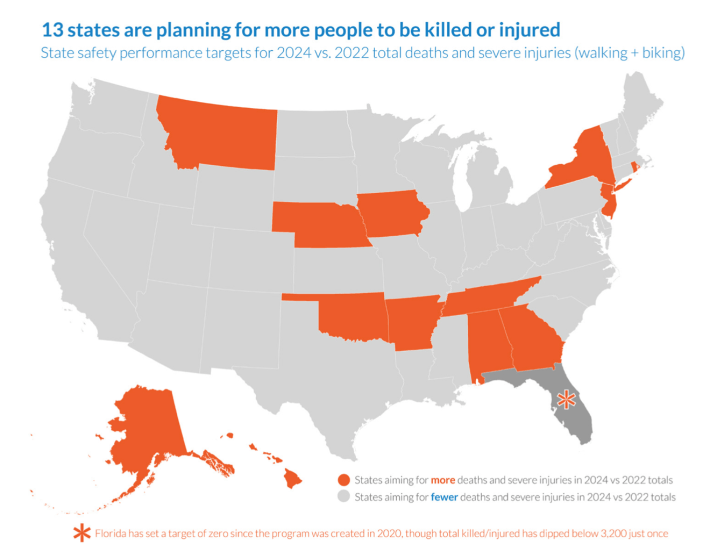
Under the Biden-era Infrastructure Investment and Jobs Act, which is set to expire in September, transportation officials can actually set a “goal” for more people to die on their roads in the next year — and at last count, 13 states were taking advantage of that disturbing technicality. Even states that do set declining fatality targets, meanwhile, don’t actually have to do anything different if they fail to meet them, unless their total vulnerable road user deaths top 15 percent of all fatalities — which they often don’t in dangerous, car-dependent states where few people walk and bike if they can even remotely avoid it.
But if state Departments of Transportation were required to shift enough money out of highway programs to functionally triple their Highway Safety Improvement Program budget anytime they fall short on saving lives, it could finally drive deaths down, while also avoiding 15,000 injuries and cutting 320,000 total crashes per year, advocates at Evergreen say. And as a happy side effect, it’d also eliminate emissions equivalent to removing 1.5 million gas-powered cars from the road over the next 20 years.
That would be a massive climate impact for a bill that wouldn’t need to mention climate at all — and a massive win for transportation advocates who understand how truly inextricable mobility and environmental policy are.
“There’s a siloing of transportation and climate, which doesn’t make sense to me, since transportation is the largest source of emissions in the U.S. economy,” said Liya Rechtman, Evergreen’s senior transportation policy lead. “[There are] major risks [to the climate] in the Surface Transportation reauthorization proposals — but, also, because I’m a deeply optimistic person, I think there are also major bipartisan avenues for emissions reduction opportunities.”
A DOT alum herself, Rechtman is careful to note that closing the safety target loophole won’t be a silver bullet for either climate or safety — even if she thinks it’s among the lowest-hanging legislative fruit in the upcoming reauthorization.
That’s why the report outlines three other key strategies that could reduce emissions and deaths, like giving transit agencies authority to conduct their own environmental reviews to speed up building new projects (which could avoid 3.5 million metric tons of CO2 by 2045) and reauthorizing the National Electric Vehicle Infrastructure charging program (6.7 million metric tons). The report also rejects new point-of-sale and registration fees to electric vehicles — a move that would increase emissions by 230 million metric tons over the same period — rather than addressing the root reasons why the Highway Trust Fund is going broke, like out-of-control highway spending and artificially low gas taxes.
Still, Rechtman said the fatality target proposal might be her favorite on the list, not least because of its strong potential for bipartisan support.
“In the transportation world, safety is always first. … If bridges are about to fall down, a state has to meet maintenance and repair criterion for bridge performance in order to get its federal dollars,” she added. “So I was surprised that the same wasn’t true for roadway fatalities. … Every legislator should be able to look families of roadway crash victims in the eyes and say, ‘I did everything I could.'”
Rechtman also believes that every legislator should be able to get behind the details of the new proposal — even conservatives that have most vocally supported their states’ “freedom” to build whatever transportation infrastructure they want, even if it costs their constituents their lives.
For one, the proposal wouldn’t dictate how low states have to set their fatality targets, nor would it mandate how states have to spend any beefed-up Highway Safety Improvement Program funds they’d be required to allocate if they fall short. That would leave the door open for skeptical states to prioritize low-lift strategies like reflective roadway striping and rumble strips, while advocates build political capital to pursue more ambitious ones, like full-on cycle tracks and road diets.
They can also elect to prioritize the rural areas where 43 percent of road deaths occur, despite being home to only 20 percent of the U.S. population.
“The people who have the most to gain from this are legislators in rural areas,” Rechtman added. “There’s been great reporting in the past couple of years about how disproportionately rural pedestrians are impacted by roadway crashes because they don’t even have a crumbling sidewalk, they don’t have a striped lane, they literally have nothing. They’re walking on the side of their road.”
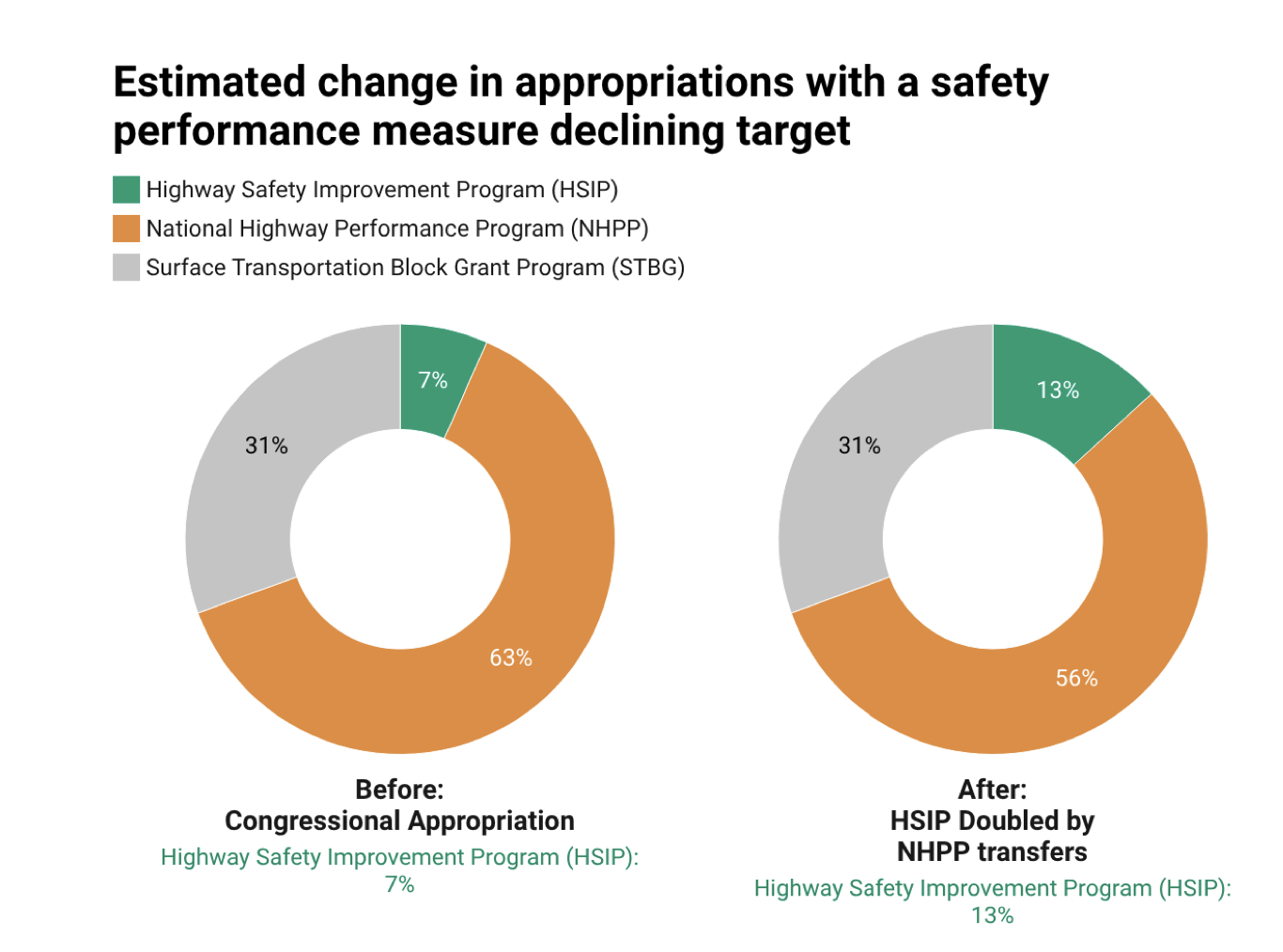
Moreover, Evergreen’s analysis projects that this policy would still leave most highway funds fully intact, while nearly doubling funding for HSIP and providing outsized safety benefits for communities across the country. And it would also ensure that taxpayers actually get some of the life-saving benefits they’ve been promised by transportation officials for decades – rather than seeing their money wasted on endless highway expansion projects that never seem to reduce congestion or cut deadly crashes.
“I’ve heard a lot of interest on both sides of the aisle about this kind of legislation, for what it’s worth,” Rechtman added. “That’s because people see the need for more efficient uses of every government dollar. This is not about discretionary funding or competitive grant awards; this is about making sure that federal dollars go to meet the performance [targets] that we all want to see on our national transportation infrastructure.”
For advocates across the political spectrum, Rechtman hopes that closing the safety target loophole will be a no-brainer when the federal transportation law comes up for reauthorization in the fall — even if the Congress that takes it up doesn’t have an appetite for ambitious climate policy.
“All we’re saying is they should try to meet their own fatality reductions — and put their money where their mouth is,” Rechtman added. “Yes, there’s an emissions reduction associated with that, which makes it a fantastic climate bill. [But it’s also] a fantastic bipartisan option for emissions reduction, even in a highly adversarial legislative environment.”

Read More:
Streetsblog has migrated to a new comment system. New commenters can register directly in the comments section of any article. Returning commenters: your previous comments and display name have been preserved, but you'll need to reclaim your account by clicking "Forgot your password?" on the sign-in form, entering your email, and following the verification link to set a new password — this is required because passwords could not be carried over during the migration. For questions, contact tips@streetsblog.org.