Talking Headways Podcast: Poster Sessions at Mpact in Portland
This week we’re back at the Mpact Transit + Community Conference in Portland Oregon at the Mpact Innovators Poster Sessions.
We talk with young professionals about the transportation implementation and policy work they’ve been doing in the field including designing new transportation hubs, rethinking parking, and improving bus service.
Scroll past the audio player below for a partial edited transcript of the episode — or click here for a full, AI-generated (and typo-ridden) readout.
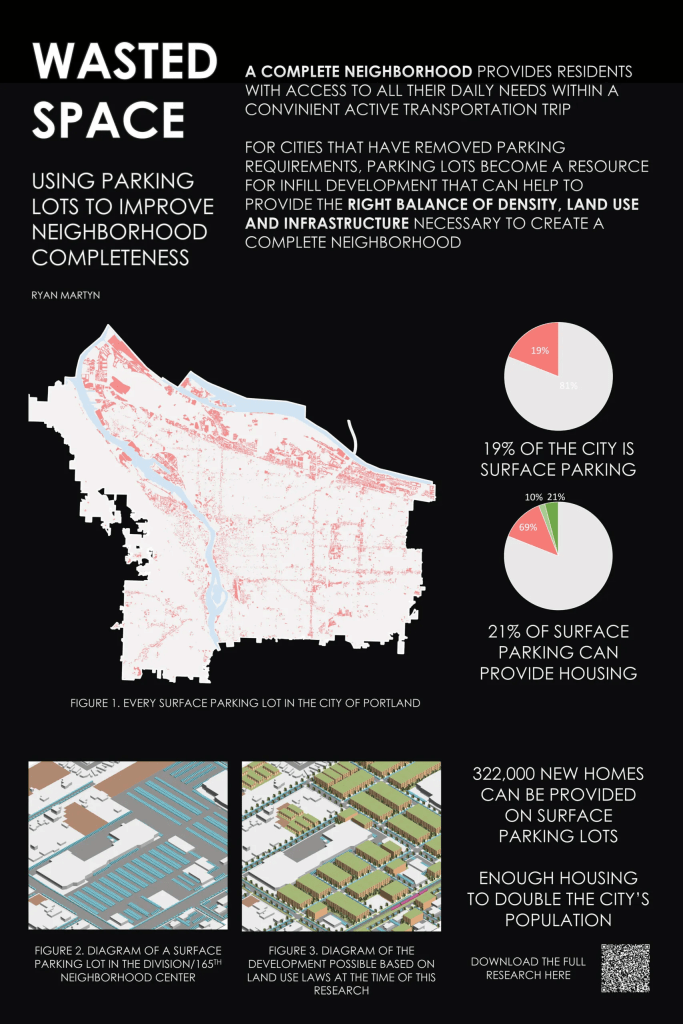
Jeff Wood: Next up is Ryan Martin, his poster is titled, “Wasted Space Using Parking Lots to Improve Neighborhood Completeness.”
Ryan Martyn: My name is Ryan Martin. I’m from Portland, Oregon.
Jeff Wood: So what’s your poster about?
Ryan Martyn: This is my master’s thesis where I discussed this idea of the complete neighborhood, and I identify parking lots as a huge opportunity for cities to improve completeness.
Jeff Wood: And what’s “completeness”?
Ryan Martyn: “Completeness” would be non-car access to daily essentials.
Jeff Wood: So like a 15-minute city, 15-minute neighborhood type of thing?
Ryan Martyn: Fifteen-minute neighborhood, 20-minute neighborhood, smart growth, new urbanism. Right. I think they all are discussing the same thing, come to the same conclusion. And so, you know, how do we create a closer proximity of like housing and those essentials?
I think parking lots are a big gap. And so Portland removed parking requirements, which kind of frees up this space to be developed into something else. So. I measured every single surface parking lot in the city of Portland. Turns out that 20 percent of this city is off street parking, and then I measured the capacity for housing on those parking lots. So 30 percent of parking lots in the city are zoned to allow housing. And, uh, 21 percent of parking lots total have the zoning and physical requirements to develop a building. And if we apply that across the entire city, these parking lots have the capacity to build over 300,000 new homes and double the city’s population.

Read More:
Streetsblog has migrated to a new comment system. New commenters can register directly in the comments section of any article. Returning commenters: your previous comments and display name have been preserved, but you'll need to reclaim your account by clicking "Forgot your password?" on the sign-in form, entering your email, and following the verification link to set a new password — this is required because passwords could not be carried over during the migration. For questions, contact tips@streetsblog.org.