Streetsblog provides high-quality journalism and analysis for free — which is something to be celebrated in an era of paywalls. Once a year, we ask for your tax-deductible donations to support our reporters and editors as they advance the movement to end car dependency and strengthen our communities.
If you already support our work, thank you! If not, can we ask for your help?
Together, we can create a walkable, bikeable, equitable and enjoyable USA for all. Happy holidays from the Streetsblog team!
It’s no secret that installing new bike lanes can boost ridership and safety across sustainable transport modes — but leveraging data from shared bikes and scooters can help cities illustrate just how massive that public appetite is, a new study suggests.
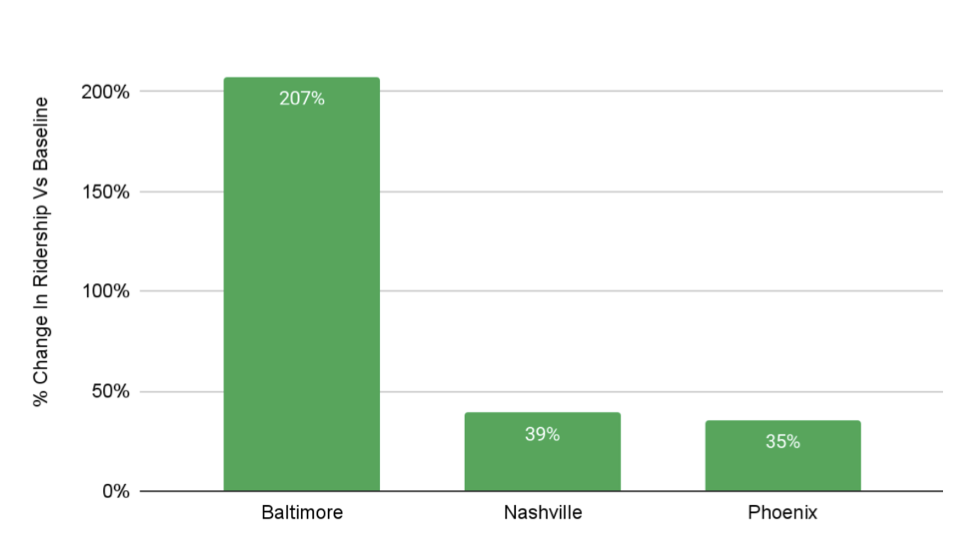
The League of American Bicyclists, working with the mircromobility outfit Lime, recently reported a whopping 207-percent increase in shared bike and scooter trips along corridors where the city of Baltimore had installed new protected bike lanes. Nashville (39 percent) and Phoenix (35 percent) also reported significant jumps along their latest protected cycling corridors — growth that the study authors say only seems modest because of factors like the time of year they were installed, or the presence of other micromobility operators that shared the market with Lime.
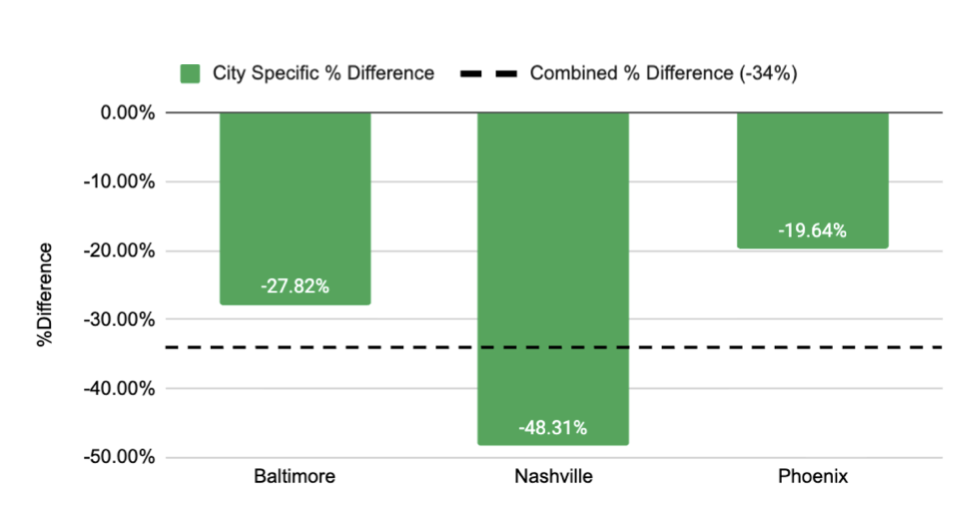
All three markets, meanwhile, reported greater than 19-percent decreases in “reported safety incidents” on routes where bike lanes went in, which included not just crashes with drivers, but also crashes with pedestrians, other micro mobility users, and even one-vehicle crashes.
Ridership growth on new bike lanes, compared to baseline growth on comparable streets without them. Graphic: Lime/LABReported incident rates on streets with bike infrastructure compared to streets without
That gold mine of ridership and safety data, though, is rarely available to cities, which often can’t afford to install bike counters or scour police and hospital records for solid information on the impacts of their cycling investments. But if more cities can leverage their data, Lime hopes that it can help communities put hard numbers behind the often-questioned truth that more bike lanes = more cyclists, scooter riders, and even transit users — and better safety outcomes for them all.
“A lot of these findings were what you would expect,” said Brandon Haydu, senior program manager of transportation policy and analytics at Lime. “But I think the thing that was really interesting — and why cities should be excited about using micro-mobility data — is how it allows you to dive deeper. In Baltimore, for example, we were able to map out where everyone traveled along using the 28th Street corridor, and we found that people from across the city use this infrastructure. The depth and the granularity is what was really interesting.”
Haydu explains that Charm City, Music City and The Valley of the Sun were all included in this analysis because their transportation officials competed for the technical assistance necessary to do it — a competition that they won, in part, because the company thought each was representative of car-dependent metros across America that are striving for bike friendliness. But he says that Lime works with communities to understand their micro-mobility data outside of contests, too, and that it can be a powerful complement to rider surveys that often undersell the public desire for new bike lanes.
A companion survey that Lime itself conducted found that just one in three riders preferred protected infrastructure — though all cities in the analysis reported triple-digit ridership increases on at least one corridor where that infrastructure was installed. That discrepancy suggests that residents are voting with their feet in support of bike lanes, even if they claim they’re comfortable sharing a lane with drivers.
“Overall, I think the data speaks for itself,” Haydu added. “The surveys are very interesting, especially with connections to transit — but I think the biggest indicator is really where people ride.”
Those “connections to transit,” Haydu explained, aren’t just theoretical; 16-percent of Lime riders self-reported taking a bus or train either before or after a spin on a shared vehicle.
And that percentage might be even higher if more riders understood just how often micro-mobility can solve the “last-mile problem” when transit lines don’t extend into their neighborhoods. A whopping 68 percent of riders already say that “Lime helps them access other public transit options,” even if cities struggle to capture how many of them actually use it as a connection to their daily commute.
“We showed that [making shared scooters and bikes available] doubles the access to transit stations — and doubling the distance actually quadruples the area [of the city accessible to people without cars],” Haydu added. “So it’s actually a much bigger impact then maybe it sounds likes. … [Expanding micromoblity] also expands access to many other modes. Whereas when you [expand] car access, you’re usually just serving one mode.”
Haydu acknowledges that Lime riders don’t represent the totality of the pedaling and scootering public, even if he argues they are demographically representative of their peers who use their own micromobility vehicles. And if it can be combined with traditional evaluation tools like bike counts, he says that micromobility data can help communities not only plot out where their next new bike lane should be based on where people are riding, but to overcome the loud minority that claims that “no one rides” in the new lanes they already have.
“A lot of the times cities have a tough time building infrastructure, because it’s so politically contentious,” he adds. “You can use [this data] to sell pieces of infrastructure that have already been built and highlight their popularity … I think this could be done more to celebrate the infrastructure that’s been built, and can be a useful tool for cities.”
A previous version of this story misstated the scope of the Lime competition, which awarded cities technical assistance, not funding.
Kea Wilson is Senior Editor for Streetsblog USA. She has more than a dozen years experience as a writer telling emotional, urgent and actionable stories that motivate average Americans to get involved in making their cities better places. She is also a novelist, cyclist, and affordable housing advocate. She lives in St. Louis, MO. For tips, submissions, and general questions, reach out to her at kea@streetsblog.org, or on Bluesky @keawilson.bsky.social.
Streetsblog has migrated to a new comment system. New commenters can register directly in the comments section of any article. Returning commenters: your previous comments and display name have been preserved, but you'll need to reclaim your account by clicking "Forgot your password?" on the sign-in form, entering your email, and following the verification link to set a new password — this is required because passwords could not be carried over during the migration. For questions, contact tips@streetsblog.org.
Toronto might be in the center of the fight to resist bike lane teardown today. But if some far-right politicians have their way, this fight won't be the last.