States Across America Are Taking Action to Stop ‘Super Speeders’

Editor’s note: This article is part of a series published in honor of World Day of Remembrance, which will be observed on Sunday, Nov. 16. This year’s event This year’s event’s theme is “Safe Speed Saves Lives”; learn more and find a WDoR event near you here.
A growing wave of states are considering a single piece of legislation that could stop the most dangerous drivers by installing speed-limiting devices on their cars — and a leading advocacy group needs your help to increase their number to include every state in America.
Legislators in 18 states and counting have either passed, introduced, or signaled their commitment to pursue a “Stop Super Speeders” bill, which would mandate the installation of active “Intelligent Speed Assist” technology on any vehicles registered to a driver with a track record of specific deadly driving offenses. Researchers say that technology, which automatically senses local limits and throttles cars to those speeds, would reduce road deaths between 26 and 50 percent if it were mandatory on all vehicles in America, at least if those systems weren’t outfitted with override button.
Even if only the worst of the worst drivers used such speed governors, though, that could still take a huge chunk out of America’s traffic violence epidemic, which claimed the lives of 40,901 people in 2023 alone — roughly one-third of which died in crashes involving a speeding driver.
Advocates at Families For Safe Streets point out that “a recent New York City study found that drivers who received ten automated tickets contributed to deadly crashes at a rate nearly three times as high as the general population — a risk that rose to five times with twenty tickets.”
“Everyone can agree that we should be using this proven technology to prevent the worst-of-the-worst, dangerous behavior,” adds Leah Shahum, founder and director of the Vision Zero Network. “Super-speeders may make up a small number of people, overall, but they cause disproportionate harm in our communities. Thank goodness more and more state leaders are recognizing that a solution exists and are starting to embrace it. Because when we talk about a smart, upstream, preventative approach to advancing Vision Zero, this is it.”
As common-sense as “super speeder” laws might seem to safety advocates like Shahum, though, some state lawmakers have struggled to craft legislation that could stand up to questions about equity, privacy, and more — until Families for Safe Streets threw their weight behind the cause.
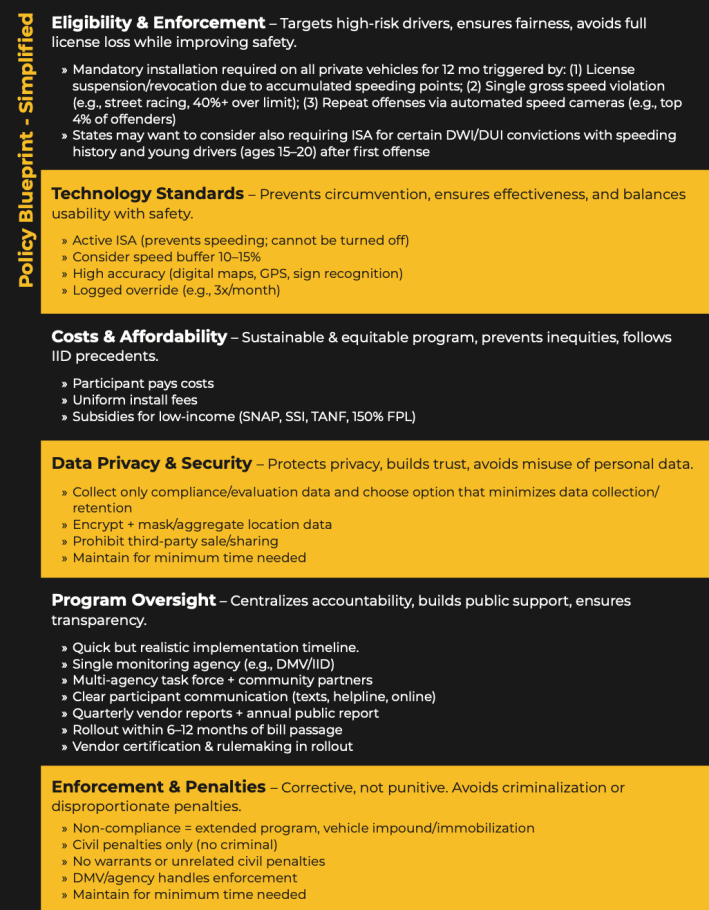
The activist group, which comprises people who have lost loved ones to traffic violence or survived it themselves, has empowered advocates to petition their legislators to pass these life-saving policies, along with providing a research backed white paper with legislative and policy recommendations that outlines how to do super speeder laws right. They’re also working with lobbyists across America to help state lawmakers understand the benefits of ISA for their unique communities — not the least of which is stopping crime before it starts.
“Unlike traditional enforcement, such as police officers stopping these super speeders, or getting into some high-speed chase, or an automated ticket arriving in the mail days later, Intelligent Speed Assist is proactive technology, ” said BriTanya Brown, the group’s national communications and digital organizing director. “It’s preventing speeding from occurring in real time.”
Brown explains that while most states rely on license suspensions to punish recidivist speeders, 75 percent of motorists who receive them continue to get behind the wheel anyway — in part because many of them live in places where driving is the only option. Mandatory speed-governor laws, though, could allow those drivers to continue to participate in society without endangering everyone around them, because they physically won’t be able to hit deadly velocities.
The model legislation also recommends robust privacy protections, like requiring Intelligent Speed Assist systems to collect only the most minimal data necessary to do things like ensure driver compliance and assess the accuracy of the device.
“[To those who would say], ‘This is Big Brother overreaching with technology,’ [I’d say that] Intelligent Speed Assist is really only targeting the repeat extreme speeders on our roads today — those who are recklessly endangering others,” Brown added. “ISA is not something to be feared. It is a proven, proactive tool that helps us meet the needs of drivers today.”

Families for Safe Streets acknowledges that America has a long way to go before super speeder laws are on the books everywhere. Only Virginia, Washington, and the District of Columbia have passed them so far, though they’re pending in five more states (Arizona, California, Georgia, Maryland, and New York), and legislators in an additional 10 have tentatively agreed to explore them.
As America observes World Day of Remembrance for Traffic Violence Victims this weekend, though, Brown says that it’s more important than ever to recognize how policies like this could save lives — and thank states that have already had the courage to lead the charge.
One of those events in Virginia will feature Tammy Guido McGee, whose son, Conner Guido, was killed in 2019 on the night of his homecoming dance when another teen who was driving the car in which he rode lost control of the vehicle at an unsafe speed. If that driver’s car had been outfitted with AISA, all three of the occupants of that car might be alive today.
“[This is a] very important, proven technology to prevent the worst of the worst drivers from killing people,” Brown added.

Read More:
Streetsblog has migrated to a new comment system. New commenters can register directly in the comments section of any article. Returning commenters: your previous comments and display name have been preserved, but you'll need to reclaim your account by clicking "Forgot your password?" on the sign-in form, entering your email, and following the verification link to set a new password — this is required because passwords could not be carried over during the migration. For questions, contact tips@streetsblog.org.