Study: 15-minute walk/bike access to key resources is not enough to guarantee prosperity
Paris mayor Anne Hidalgo has set a goal of making Paris a 15-minute city. That is, providing Parisians with grocery stores, parks, cafes, sports facilities, health centers, and workplaces easily accessible within a 15-minute walk or bike ride. Earlier this year Streetsblog Chicago co-editor Courtney Cobbs looked at what it would take to turn Chicago into a 15-minute city. (At an average walking speed of 3 mph and a biking speed of 10 mph, that would be 0.75 miles or 6 full Chicago blocks, and 2.5 miles or 20 blocks, respectively.)
Back in August 2020, Metropolitan Planning Council transportation associate Jeremy Glover looked at that subject in a blog post entitled “The 15-Minute City: How close is Chicago?” Recently Doug Bright, a Chicago native who currently works for the city of Durham North Carolina on equitable strategies for reducing serious and fatal crashes, took a deeper dive into that subject in a master’s project, “Whose 15-Minute Windy City?: Evaluating Access to Walkable Places in Chicago,”
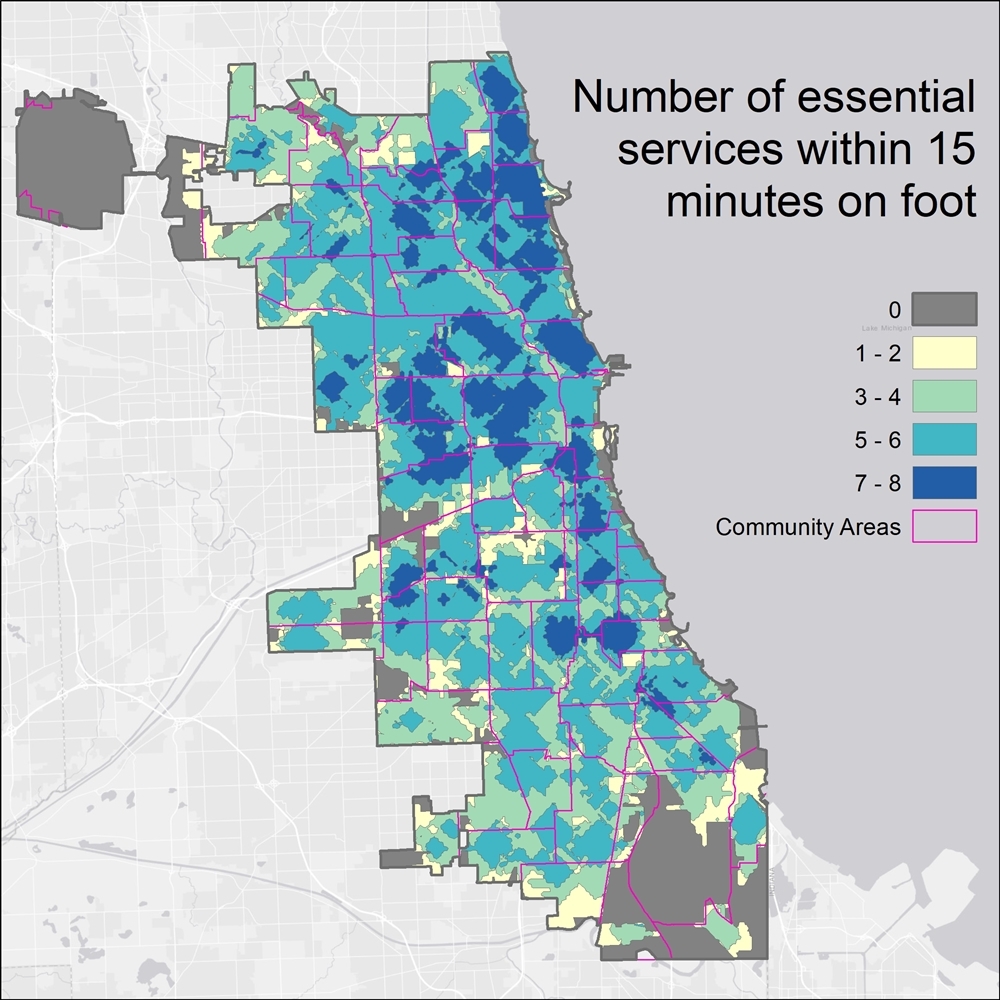
Glover used used GIS (geographic information system) software to create maps showing which areas of Chicago have easy access to essential services. He found that while most parts of town are within a 15-minute bike ride, areas where key services can be reached within a 15-minute walk are mostly clustered on the North and West sides.
Bright’s goal was to compare demographics in areas with different levels of access to resources, and also take a closer look at areas with high access in a few different parts of Chicago.
Glover’s analysis looked at access to eight different types of destinations: grocery stores, parks, libraries, elementary schools, high schools, hospitals or urgent care centers, pharmacies, and ‘L’ stations. He assigned an access zone to each point in the city, ranging from zero to eight based on how many types of resources a person can reach within 15 minutes in these areas. Bright combined this info with Census data to get a sense of the demographics of residents living at each level of access.
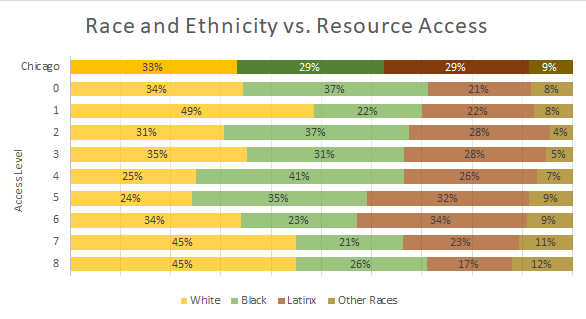
Unsurprisingly Bright found that white residents, who are more likely than other groups to live in dense neighborhoods, such as downtown and in the North Lakefront neighborhoods, are overrepresented in the areas that have high levels of access to essential resources. But counterintuitively, he also determined that “The highest poverty rate (22%, compared to an 18% city average) is also found at the highest level of access.”
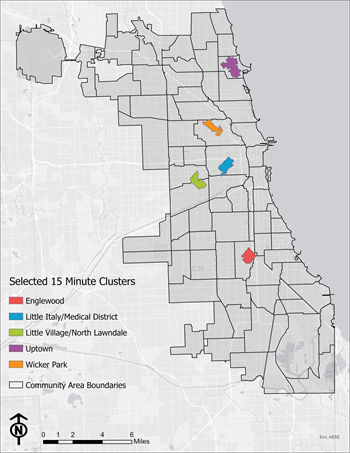
Bright took a closer look at five “patches” with access to all eight types of destinations: Uptown, Wicker Park, Little Italy/Medical District, Little Village/North Lawndale, and Englewood, whose demographics vary greatly from each other. For example, while Wicker Park is 68 percent white and has only a 2 percent unemployment rate and 10 percent poverty rate, Englewood is 97 percent Black and has a 21 percent joblessness rate and 43 percent poverty rate.
Bright’s takeaway from his research is that “a baseline proximity to resources—while a requisite of urban accessibility, 15-Minute City model or otherwise—will not in and of itself generate equitable outcomes… Any strategies for planning imported (especially in a top-down manner) from other cities, countries, or continents should be regarded with healthy skepticism, as one-size-fits-all approaches are bound to ignore important nuances and autonomy of a place.”
So while the 15-minute city is a great goal for Chicago, that alone will not guarantee equitable outcomes.

Read More:
Streetsblog has migrated to a new comment system. New commenters can register directly in the comments section of any article. Returning commenters: your previous comments and display name have been preserved, but you'll need to reclaim your account by clicking "Forgot your password?" on the sign-in form, entering your email, and following the verification link to set a new password — this is required because passwords could not be carried over during the migration. For questions, contact tips@streetsblog.org.