Kochs Want to Kill Light Rail in Phoenix
The Koch Brothers’ nationwide campaign against transit has a new target: Phoenix.
A $31.5-billion transit levy approved by a 10-point margin just three years ago is now under threat thanks to an anti-light rail group that portrays itself as grassroots. But records show it is being backed by — wait for it! — Koch-funded organizations and a wealthy developer.
The new group Building a Better Phoenix has launched a campaign to gather 20,000 signatures for a voter referendum to overturn the city’s light rail plans. The organization listed Mel Martin — a Phoenix business- and land-owner — as the chairperson [PDF]. Just a few weeks later, however, the organization changed the chairperson to Jadon Contreras, whose occupation is listed as student [PDF]. The address he provided is 4108 Central Ave., which is the business address of Tony’s Window Tinting. Contreras appears to be a relative of Celia Contreras, the owner of the business, who has been leading the charge to halt light rail expansion. He could not be reached.
The group hasn’t filed any financial disclosures yet — but it is receiving financial support from the Arizona Free Enterprise Institute, which is a “Koch-connected dark-money group,” the Arizona Republic reported. The organization paid for the domain name for Building a Better Phoenix’s website, which is clear from the domain registration [PDF].
Byron Waldrep, who is now listed as the treasurer for the month-old organization, told Streetsblog that, Martin, a multi-millionaire developer, enlisted South Central business owners for chairman and treasurer because “he couldn’t go further” with his proposition to kill light rail “without us.”
It’s clear why Martin would want locals fronting his organization. When the light rail funding measure passed soundly, it had even wider support in South Central, the center of the controversy, where voters gave it a 70-percent landslide.
Waldrep said he didn’t know anything about the Charles and David Koch or the Arizona Free Enterprise Institute. But he could not explain why or how the group had paid for the organization’s website.
It’s not the first time the Koch Brothers’ shadowy political network has played an outsized role in a local anti-transit effort. The New York Times highlighted the siblings’ successful campaigns to defeat light rail plans in Nashville and other cities. The billionaire industrialists made their fortune in oil and gas and have, since then, supported far-right political causes and have opposing local transit projects. In Arizona, their statewide action group is called Americans for Prosperity.
“They don’t want to be the face of this. They want to pretend this is a community group,” said Lisa Fernandez of the pro-transit Build South Central Coalition. “If they succeed, this could be the playbook that they use to kill light rail for cities that have approved it.”
On Wednesday, Phoenix City Council will vote on whether to proceed with the South Central light rail project as planned. Changing the design to accommodate Four Lanes or No Train’s concerns would be a death sentence for the $1-billion project, which is facing a November deadline to finish the design phase and move into engineering. The Trump administration — which is already holding up many transit projects around the country, as Streetsblog reported — may be looking for an excuse to withhold its $600-million share of the project, recently instructing Valley Metro to not submit paperwork until the City Council had voted again on the matter.
The Council may give Martin the delay he wants. Pro-transit forces suffered a blow when Mayor Greg Stanton, a key light rail backer, resigned in May to run for Congress.
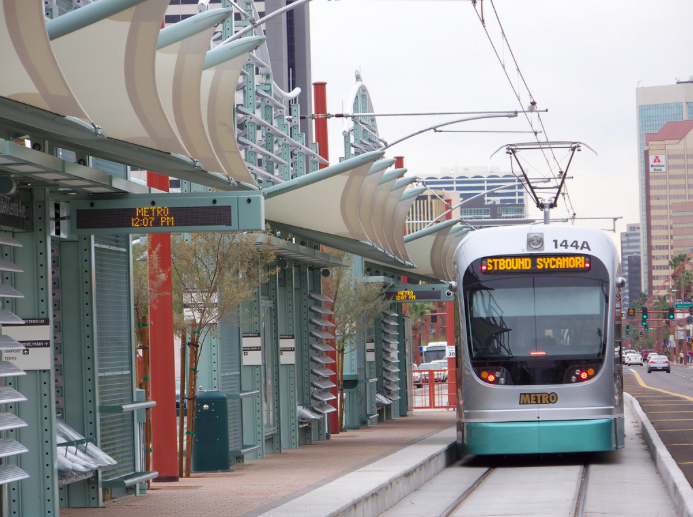
The first line — and two extensions — of Phoenix’s light rail investment have been a success any way you look at them. Daily ridership is relatively strong and the investment in the initial line has spurred hundreds of new housing units in walkable, transit-oriented locations. South Central light rail was to expand it into an underserved area and help connect residents with more economic opportunities.

Read More:
Streetsblog has migrated to a new comment system. New commenters can register directly in the comments section of any article. Returning commenters: your previous comments and display name have been preserved, but you'll need to reclaim your account by clicking "Forgot your password?" on the sign-in form, entering your email, and following the verification link to set a new password — this is required because passwords could not be carried over during the migration. For questions, contact tips@streetsblog.org.