
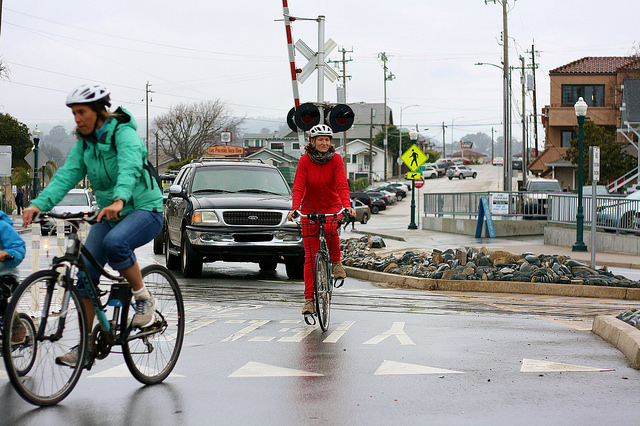
It's dangerous not to bike to work.
Overall mortality among bike commuters is significantly lower than among people who don't bike or walk to work, according to a robust study recently published in the British Medical Journal. Controlling for a range of other factors, author Carlos Celis-Morales and his team found that bike commuting is linked to significantly lower risk of death from cardiovascular disease and cancer.
Using data collected by the UK Biobank, which surveys the health status of more than half a million people over time, the research team found that bike commuters were 41 percent less likely to die during the five-year study period than people who drove or took transit.
In other words, people who bike to work are living longer than people who drive or take transit to work. The connection between bike commuting and lower mortality is "independent of sex, age, deprivation, ethnicity, smoking status, recreational and occupational physical activity, sedentary behaviour, dietary patterns, and other confounding factors," the authors write.
The data came from more than 260,000 British workers between the ages of 40 and 69, whose health outcomes were recorded over five years.
Among bike commuters, the likelihood of contracting or dying from heart disease was about half that of sedentary commuters. Bike commuters were also 45 percent less likely to contract cancer and 40 percent less likely to die from it.
Similar but weaker correlations were observed for people who walked to work or biked for part of their commute. Walking to work was associated with reduced risk of contracting or dying from cardiovascular disease, but not cancer or overall mortality.
The authors speculate that, as opposed to cycling, walking does not require enough physical activity to affect health outcomes, except for those who had long walking commutes -- at least six miles per week.
While the study does not prove causation, Celis-Morales writes that the results strongly suggest that efforts to build transportation networks that encourage cycling "may be a viable approach to deliver health benefits related to physical activity at the population level."
Hat tip: Peter Flax.