Portland — And Soon, Detroit — Bring Bike-Share to People With Disabilities

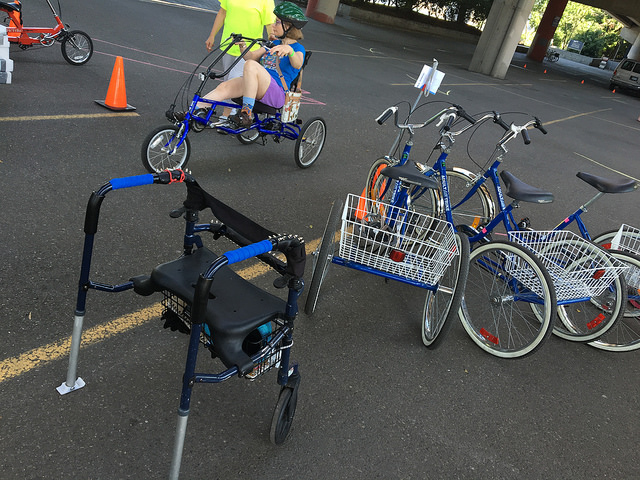
Riding a bicycle is too often thought of as an activity that’s off-limits for many disabled people. And that has continued to be the case with the bike-share systems getting off the ground in several American cities, which provide standard bicycles meant for the able-bodied. But that’s starting to change, thanks to a yearlong effort in Portland that’s the first of its kind in the United States.
Next month, Portland plans to start offering speciality bicycles branded to match the rest of its Biketown bike-share system. Stefani Cox reports for the Better Bike Share Partnership on what the city learned in talking to advocates for the disabled about bicycling:
Portland discovered that residents with disabilities didn’t want a replica of the existing bike share system. Instead they were looking for a service that could help them get onto the rental bikes, as well as keep their assistive devices safe while they rode. They were also looking for easy parking and transit access to the site where they could rent the bikes, as well as the ability to ride on multi-use trails, rather than city streets.
To address these needs, the Portland Bureau of Transportation is partnering with local bike shops to offer Biketown rentals for people with disabilities. The initiative will ultimately include a variety of different types of bicycles, such as tandem bicycles so blind people can ride with sighted people, handcycles, and tricycles for people with balance problems. The goal is to offer short rides of an hour or two, not long-term rentals, so the program can give access to people who don’t already own a specialized bike or find it’s too difficult to bring a bicycle from home to a place they feel comfortable riding.
Portland launched its accessible bike-share initiative after it became an issue in a City Council race. Steve Novick, a council member who served as the city’s transportation commissioner, was facing a crowded field of primary challengers last year, two of whom — Sue Stahl, a member of the Portland Commission on Disability, and Chloe Eudaly, who has a son with cerebral palsy — spoke about the lack of accessible bike-share during the campaign.
The issue was also personal for Novick, who “was born without a left hand or fibula bones in his legs” and “struggled to pedal a bicycle in childhood and hasn’t tried since,” according to BikePortland.
Eudaly eventually beat Novick in a run-off last November. By then, Novick had pushed the transportation bureau to come up with a solution. The city ended up working with bike shops and advocates for the disabled to host a clinic where people could test out adaptive bikes. Soon afterward, the city announced that it would be setting up an accessible bike-share pilot program. Now, after nearly a year of work by city staff, that program, which has also gotten attention from the Los Angeles Times, is almost ready to roll.
Advocates for the disabled, many citing the Americans with Disabilities Act, say accessible bike-share ought to be provided from the start, rather than being added after prodding. “When the city gets involved in any type of public service, they have an obligation to make sure it’s accessible to people with disabilities,” Disability Rights Oregon Executive Director Bob Joondeph told BikePortland last year.
Detroit, meanwhile, is watching developments in Portland as it plans its own accessible bike-share once its able-bodied system launches later this month. “We’ve done a focus group, and we’ve done surveying to get a sense of people’s interest in this and how they would like to use the system,” Detroit Bike Share executive director Lisa Nuszkowski told the Better Bike Share Partnership. “We certainly hope to be one of those early cities that other cities could replicate.”

Read More:
Streetsblog has migrated to a new comment system. New commenters can register directly in the comments section of any article. Returning commenters: your previous comments and display name have been preserved, but you'll need to reclaim your account by clicking "Forgot your password?" on the sign-in form, entering your email, and following the verification link to set a new password — this is required because passwords could not be carried over during the migration. For questions, contact tips@streetsblog.org.