Tesla’s Parking Problem Says a Lot About Elon Musk’s Brand of Tech Saviorism
Tech magnate Elon Musk is often held up as the guy with all the answers to our transportation problems. But on infrastructure, his answers always seem to be wildly impractical and oblivious to how transportation and cities work: tunnels to cure L.A. traffic, or pneumatic tubes for speeding intercity travel.
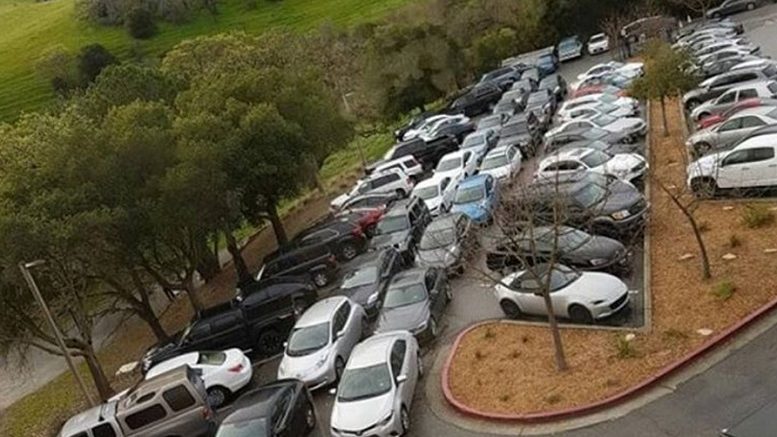
So it’s fitting that the Palo Alto headquarters for Musk’s flagship company, Tesla, has an epic logistical problem caused by the spatial inefficiency of its core product. The Wall Street Journal reported this week that Tesla’s parking lot has become a Hobbesian nightmare. One Instagram account mocks employee parking habits like leaving cars on medians and pedestrian walkways.
Joseph Cutrufo at Mobilizing the Region says Musk has to face up to the fact that transportation systems don’t work well when everyone drives:
Instead of asking “where do we park everyone,” Musk really ought to take a step back and ask, “why is everybody driving?” This is a major metropolitan area, so there must be some transit around, right? Is there no other way to get to Tesla’s corporate office in Palo Alto or its manufacturing facility in Fremont?
As it turns out, Bay Area Rapid Transit (BART) just opened its newest station, Warm Springs/South Fremont, just a stone’s throw from the massive Tesla manufacturing facility in Fremont. But we’d be surprised if anyone working at this facility actually uses it: while it’s just a half-mile to the station as the crow flies, the actual distance for a human is almost two miles. That’s almost 40 minutes on foot, but it probably feels a lot longer when the streets look like this [above].
It seems Musk is belatedly catching on. CBS San Francisco reports that Tesla will begin paying employees to bike to work.
More recommended reading today: Seattle Transit Blog has the supremely disappointing news that every single Democratic member of the Washington House voted in favor of a bill to slash funding for the city’s light rail expansion plan. Systemic Failure reports that just days after California passed a gas tax hike, state highway planners are already putting forward road expansion projects, contrary to public promises. And Pricetags explains why gas stations are disappearing from downtowns in big cities.

Read More:
Streetsblog has migrated to a new comment system. New commenters can register directly in the comments section of any article. Returning commenters: your previous comments and display name have been preserved, but you'll need to reclaim your account by clicking "Forgot your password?" on the sign-in form, entering your email, and following the verification link to set a new password — this is required because passwords could not be carried over during the migration. For questions, contact tips@streetsblog.org.