American Bike-Share Is Growing Quickly — In a Handful of Cities
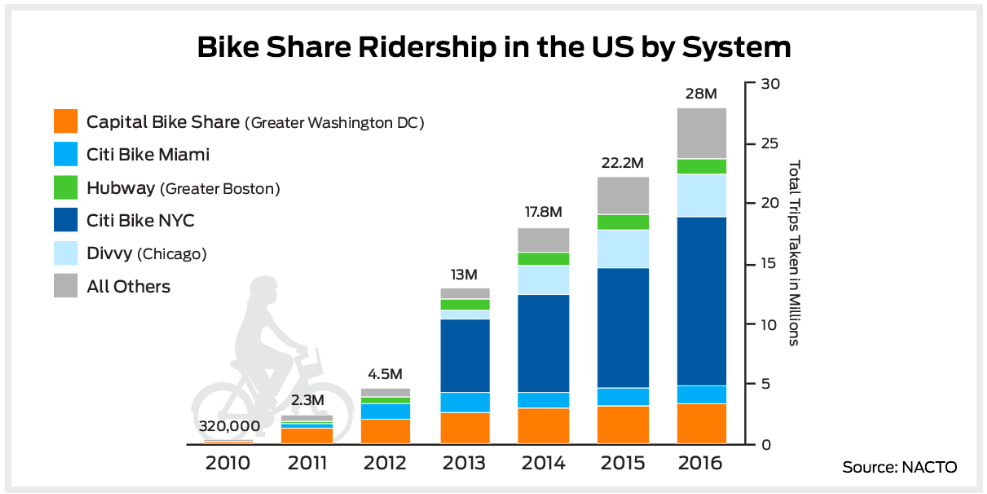
Last year, there were 28 million bike-shares trips in American cities — a remarkable 25 percent increase in one year alone, according to a new report from the National Association of City Transportation Officials.
Since 2012, the number of bike-share trips has grown ten-fold, double the rate of growth in bike-share bikes, meaning the systems are being used more intensively. This is all with a safety record that is practically unblemished. So far there has been just one recorded death of a bike share user.
Bike-share growth should continue in 2017, with San Francisco and New York both planning major expansions.
An increasing number of U.S. bike-share systems are offering discounts for low-income riders, NACTO reports. The big success in terms of making bike-share more accessible is Indego in Philadelphia, where monthly passes can be purchased for $5. NACTO reports that 44 percent of Indego users come from households with annual income below $35,000.
Most of the growth in bike-share usage is limited to a few major cities, however. Citi Bike in New York, Capital Bikeshare in the DC region, Citi Bike in Miami, Divvy in Chicago, and Hubway in Boston account for 85 percent of all trips — an indication of how much catching up other cities have to do.
What distinguishes the successful cities are their dense station networks, according to NACTO, which enable high-volume usage by siting bike-share stations within convenient walking distance anywhere in the service area. Many smaller systems — there are 55 cities with more than 100 bikes across the U.S. — simply aren’t designed to be viable transportation options for large numbers of people.

Read More:
Streetsblog has migrated to a new comment system. New commenters can register directly in the comments section of any article. Returning commenters: your previous comments and display name have been preserved, but you'll need to reclaim your account by clicking "Forgot your password?" on the sign-in form, entering your email, and following the verification link to set a new password — this is required because passwords could not be carried over during the migration. For questions, contact tips@streetsblog.org.