The Feds Quietly Acknowledge the Driving Boom Is Over

The Federal Highway Administration has very quietly acknowledged that the driving boom is over.
After many years of aggressively and inaccurately claiming that Americans would likely begin a new era of rapid driving growth, the agency’s more recent forecast finally recognizes that the protracted post-World War II era has given way to a different paradigm.
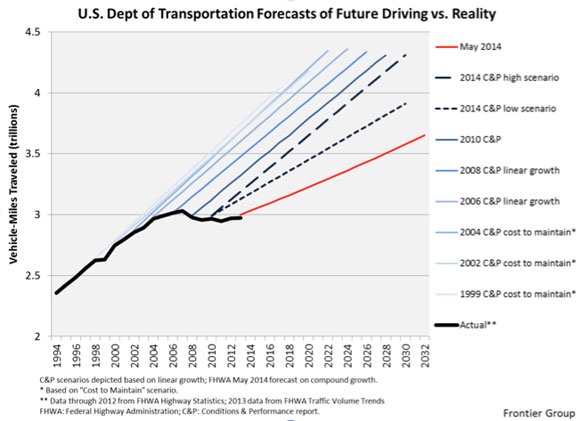
The new vision of the future suggests that driving per capita will essentially remain flat in the future. The benchmark is important because excessively high estimates of future driving volume get used to justify wasteful spending on new and wider highways. In the face of scarce transportation funds, overestimates of future driving translate into too little attention paid to repairing the roads we already have and too little investment in other modes of travel.
The forecast is a big step forward from the FHWA’s past record of chronically aggressive driving forecasts. Most recently, in February 2014 the U.S. DOT released its 2013 “Conditions and Performance Report” to Congress, which estimated that total vehicle miles (VMT) will increase between 1.36 percent to 1.85 percent each year through 2030. This raised some eyebrows because total annual VMT hasn’t increased by even as much as 1 percent in any year since 2004.
Comparing the 20-year estimates of the “Conditions and Performance Report” issued at the beginning of 2014 to the new 20-year estimates shows the agency has cut its forecasted growth rate by between 24 percent to 44 percent.
The new report’s 30-year estimates predict even less rapid growth in driving, forecasting that total driving miles will increase only 0.75 percent annually from 2012 to 2042. With population growth estimated to average 0.7 percent each year, this leaves per-person driving miles essentially flat. “This represents a significant slowdown from the growth in total VMT experienced over the past 30 years, which averaged 2.08% annually,” says the report.
The expectation of VMT growth hinges on the expectation of rapid growth in freight travel. When looking only at cars and pickup trucks, as opposed to larger vehicles, the agency’s baseline expectation is for total driving miles to grow only 0.67 percent annually – slower than the projected population growth rate over 30 years. If so, then the average number of miles Americans travel in their commutes, taking recreational trips and running errands by car would stagnate in the decades ahead.
The study released by the Federal Highway Administration and finalized last May has not been publicized, and assumes that gas prices would decline significantly from their earlier peak.
The Smart State Transportation Initiative (with assistance from Frontier Group) reported earlier last year that the Department of Transportation had issued 61 driving forecasts in a row that overshot their mark. Until now, there had not been a major reconsideration of past methods, which have chiefly depended on aggregating forecasts issued by states that are seeking federal funding for highway expansion projects.
As a result of the decline in driving since 2004, Americans currently drive about half a trillion fewer miles per year than they would have if the post-War driving boom had continued. Some of the reduction in recent years may be due to possibilities afforded by new technology and the distinct preferences of the rising millennial generation — factors that are not included in any of the FHWA’s forecasts.
Some states, like Washington and Maryland, have begun to ratchet down their forecasts of future VMT.
Ideally, U.S. DOT would officially supplant its previous forecast and feature this important shift in press releases, blogs, speeches, and other communications. The shift should be a major focus of the department’s 30-year visioning process.
For U.S. DOT to embrace a future less dominated by driving, it first must recognize when change has occurred and that a different trajectory is possible. Quiet and incremental as the current changes may be, they represent a profound step in the right direction.

Streetsblog has migrated to a new comment system. New commenters can register directly in the comments section of any article. Returning commenters: your previous comments and display name have been preserved, but you'll need to reclaim your account by clicking "Forgot your password?" on the sign-in form, entering your email, and following the verification link to set a new password — this is required because passwords could not be carried over during the migration. For questions, contact tips@streetsblog.org.