The Washington Nationals: Winning at Sustainable Transportation?
Ever wondered how your favorite sports team is doing in the sustainable transportation arena? Many urban stadiums have some transit connections and some bike racks. From there, though, it can be difficult to measure success.

Maybe what we need is a scoreboard for these things. Darren Buck at Network blog Bike Pedantic has done some preliminary legwork for Nationals Park in Washington, DC.
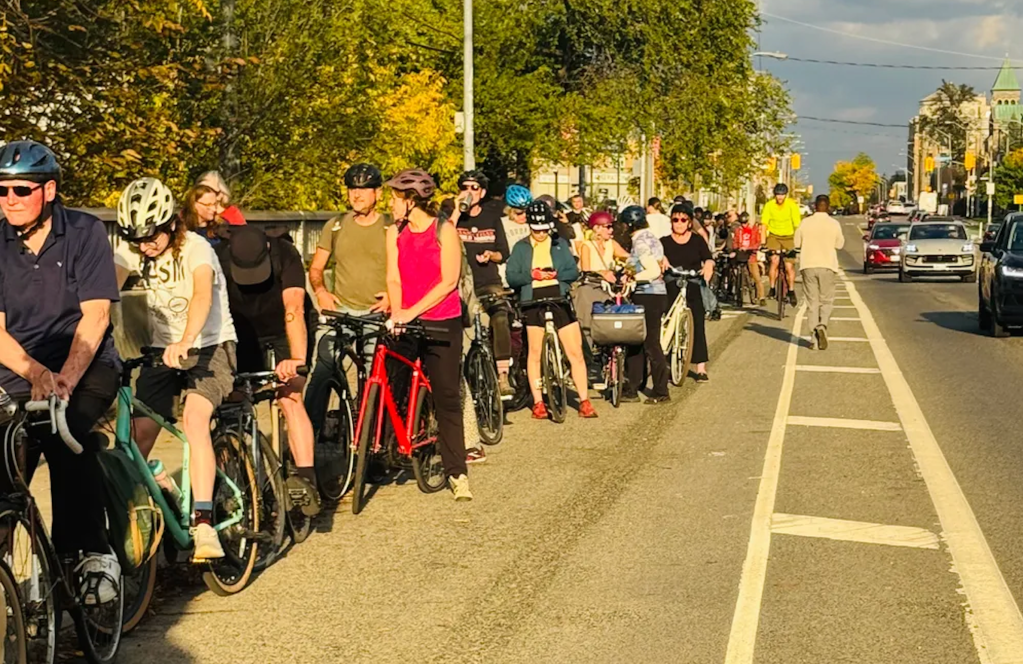
In order to determine what percentage of fans are biking, he took to counting bikes at a recent NL Divisional Series game. He counted Capital Bikeshare bikes in their docks (about 160). He counted the contents of the Nats’ bike valet (120). He counted racks (250) and he counted spillover, locked to trees, posts and fences (98). What he came up with was a rough bicycle mode share for Nationals Park at the height of playoffs excitement:
By my count, that’s a total of 628 bikes. Only 530 (or 84%) were accommodated by official parking/storage, including the 26% of all riders who used Capital Bikeshare (above my estimate of CaBi comprising 11% of all ridership in DC/Arlington, it should be noted).
With a stadium capacity of around 45,017, that’s about 1.4% of people biking to the game. Following an odd DC trend, this is far lower than our commute-to-work share of 3.3%, and right on par with Washington DC’s estimated bike modeshare for all trips of 1.5%. Given the unfathomably awesome weather, the fact that transit is beginning the rush-hour meltdown everyone knew was coming even as I type this, and the fact that Nats Park lies right in the heart of Livable Walkable Ward 6, I would have expected more (acknowledging that looking solely at the one transportation mode I obsess about is a distortion). What’s missing?
More than usual appeared to take Capital Bikeshare, and perhaps the promise of a guaranteed “dock” influenced that choice. Some additional bike parking, even as a temporary measure, would at the very least save folks from the slightly shameful act of having to lock up to a tree or fence. Some sheltered bike facilities anywhere in the SE/SW quadrants would boost ridership for everyone. And on and on.
Elsewhere on the Network today: Cap’n Transit has some advice about applying the transportation planning philosophy of Hans Monderman, inventor of the “woonerf.” Systemic Failure looks at a California town poised to repeat a familiar narrative: bypass kills Main Street. And Market Urbanism examines Washington, DC’s inclusionary zoning policies, and how they affect urban development in expected and unexpected ways.

Read More:
Streetsblog has migrated to a new comment system. New commenters can register directly in the comments section of any article. Returning commenters: your previous comments and display name have been preserved, but you'll need to reclaim your account by clicking "Forgot your password?" on the sign-in form, entering your email, and following the verification link to set a new password — this is required because passwords could not be carried over during the migration. For questions, contact tips@streetsblog.org.