Stroller-Share: Can I Get an Amen?

Childless urbanites love to hate the stroller. New Yorker Laura Miller started a blog, “Too Big For Stroller,” dedicated to mocking older children who get around the easy way. Commenters on a Greater Greater Washington story about strollers on buses last year showcased surprising vitriol, saying, “Carry your child, like an able-bodied adult should” and “Pretty lousy parenting, when you could fold the stroller and hold the child” and “Keep those strollers off our buses.” There are internet rants against giant, SUV-style strollers (and, five years ago on Streetsblog, a defense). A New York Times story about stroller rage ended up plumbing deeper emotional issues around unequal social status for breeders and non-breeders.
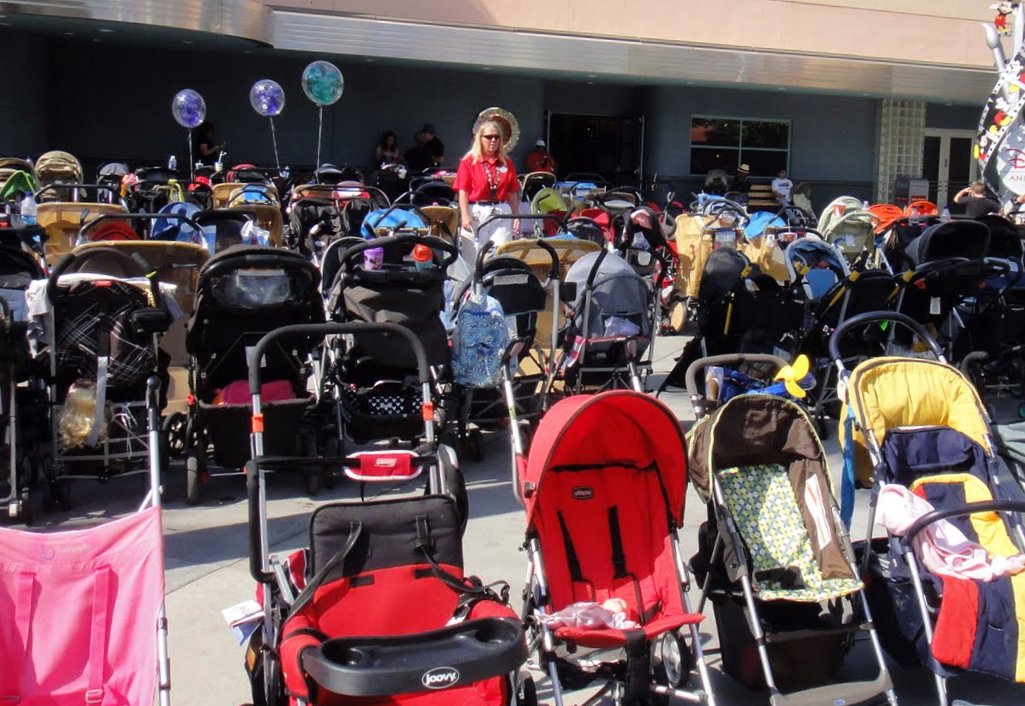
It’s all well and good to be smug about your smaller footprint when your baby is still small enough to be carried long distances in a sling. But let’s be clear: For car-free, city-dwelling parents, strollers are a necessity — and sometimes even for bigger kids. A four-year-old can certainly walk on his own from the parking lot to the mall, but if your day involves miles of walking as your primary mode of transportation, you’re going to end up carrying that kid a lot.
“For urban parents, the stroller is the equivalent of a suburbanite’s automobile,” said the designers of a transit-compatible stroller a few months ago. ”It is the vehicle that enables mobility and freedom in day-to-day life for families with young children. But navigating metro rail systems with conventional strollers can be exceedingly taxing — and dangerous.”
Indeed, strollers don’t always make things easy. Or rather, cities don’t always make things easy for parents with strollers.
Cobblestone streets, missing curb cuts, crowded buses, revolving doors – and then subways, with their own set of obstacles like turnstiles and stairs – make baby-strolling a major challenge. Sometimes it’s easier just to carry the kid.
Here’s where Stroller-Share would come in. It’s easier for me, and for the other passengers, to carry my seven-month-old daughter Luna to the bus and hold her in my lap while we ride. Taking the stroller on the bus (where policy dictates that strollers be folded) involves quickly taking my child out as the bus pulls up, collapsing it with one hand while holding a wriggling baby with the other (including fastening a latch that is decidedly a two-handed job), and paying my fare with my third hand. Oh yeah, I don’t have a third hand. This is why I’m happy to carry her short distances. And as she gets too big to be carried, she’ll be able to walk short distances.
But once we get off the bus, it sure would be nice to have a stroller as we walk around a museum, or the zoo, or when I sit down for a meal. (Once kids are old enough to grab, they’re too old to hold on your lap while you eat.) And if they sleep well in the stroller, you don’t have to be prisoner to their nap schedules. You can continue with your full and busy day and they can just be lulled to sleep by the vibrations of the pavement (and potholes).
It’s easy enough to say, “I’m never going to be one of those moms pushing a kid around in a stroller who’s old enough to walk,” but you can bet I will be. If I’m not, it’s because I got suckered into the myth that you need a car if you have a kid. As Luna gets bigger, Stroller-Share would be useful for the outings where she starts out strong but wears out quickly. I bet any number of visitors to the National Mall get caught flat-footed when they realize it’s a full two miles from the Capitol to the Lincoln Memorial – not to mention the distance back to wherever they parked the station wagon. Solution? Stroller-share!
We could name it Bay-B-Cycle in Denver, BittyTyke in New York, Capital Strollershare in DC, Play-Nice Ride in Minneapolis, the Cubway in Boston, Baby Bixi in Montreal.
Like bike-share, you’d have stroller stations in key places: transit hubs, tourist areas, shopping centers, children’s museums. There would be a small range of options to accommodate newborns without head control as well as older kids who just need a rest, as well as double-wides. They’d all have a cargo basket underneath so parents can get a bit of a break from carrying diaper bags and such. The free half-hour might not make much sense for strollers, as they’re not often used just to dart from one place to another, like a bike-share user would. Daily, monthly and annual memberships could still be available, with a focus on making one-time rentals as easy as possible, with payment by the hour.
There may be some need for vans to relocate the strollers, as they do with bike-share, but since the strollers will likely have less intense peaks and valleys of usage, there should be fewer shortages and dock-blocking to worry about.
What do you think? Should I kick-start this thing?

Read More:
Streetsblog has migrated to a new comment system. New commenters can register directly in the comments section of any article. Returning commenters: your previous comments and display name have been preserved, but you'll need to reclaim your account by clicking "Forgot your password?" on the sign-in form, entering your email, and following the verification link to set a new password — this is required because passwords could not be carried over during the migration. For questions, contact tips@streetsblog.org.