Congress Agrees to Kick the Can for 90 More Days

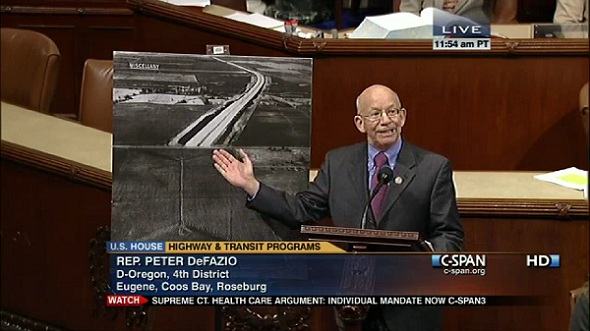
Yesterday, before taking off for a two-week recess, Congress passed a three-month extension of SAFETEA-LU, the ninth since it first expired on September 30, 2009. It now only needs the president’s signature sometime before midnight on Saturday to become law.
That means that on June 26, 2012, current transportation policy will have been operating under temporary extensions for 1,000 days. Four days later, it will be due to expire yet again.
One thousand days. Think about how much more could have been accomplished if in September of 2009, Congress had simply approved a 3-year, $150 billion extension rather than piecing one together three or six months at a time. Cities and transit agencies, for instance, would have had the funding guarantees to support investment in infrastructure while they ride out the recession.
The political dynamics at work are complex. But at the most basic level, no one in Washington has mustered the will to tell Americans the truth: “Transportation isn’t free.”
Take the Senate’s two-year bill. Its loudest critics complain that it doesn’t offer the funding guarantees of a five-year bill. And that’s true — even the bill’s supporters would agree. But the whole rationale behind the decision to cap the bill at two years was that the gas tax could just barely get them to the end of 2013.
At some point, Congress and the president will have to clear this hurdle. Whether by raising the gas tax and indexing it to inflation, implementing a mileage tax, or simply letting existing highways be tolled, the money has to come from somewhere.
You won’t hear anyone in Washington say that these days. Instead, the more conservative representatives will talk about how the federal government is exceeding its authority in paying for transit and bike lanes because they don’t cross state lines. Or the believers in private financing will say they need more time to develop “innovative” (read: magic) funding schemes that’ll saddle later generations — my generation — with the cost of the transportation fantasy they’ve sold to their constituents.
“The money just isn’t there!” cried House Majority Leader Eric Cantor this week, apparently forgetting the option of raising the gas tax. To which his (Republican!) colleague in the House Walter Jones responded, “Then why are we spending $10 billion a month in Afghanistan?” Because freedom isn’t free, as they say.

Streetsblog has migrated to a new comment system. New commenters can register directly in the comments section of any article. Returning commenters: your previous comments and display name have been preserved, but you'll need to reclaim your account by clicking "Forgot your password?" on the sign-in form, entering your email, and following the verification link to set a new password — this is required because passwords could not be carried over during the migration. For questions, contact tips@streetsblog.org.