Mixed-Use Development Delivers Huge Public Returns Compared to Sprawl
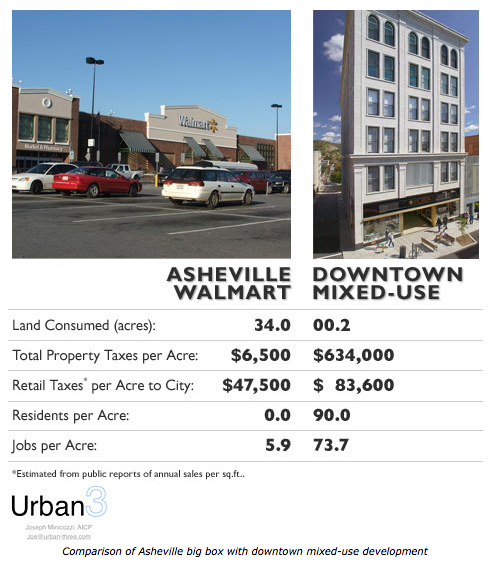
Walkable development pays — that’s the conclusion of a study recently outlined in Planetizen. For cities and towns facing tight budgets — just about everywhere in the United States right now — the smart way to boost tax revenue is to encourage mixed-use, walkable development, as the above graphic amply illustrates.
The for-profit development company Public Interest Projects (PIP) reports that urbanism produces much more tax revenue for localities than sprawl. Analyzing tax data around Asheville, North Carolina, the research team found that downtowns — places with the most places to shop per acre — often subsidize the more suburban parts of the community. In places like Asheville, mixed-use developments offered up to eight times (or more) the tax revenue per acre of a Super Walmart.
Former PIP employee Joseph Minicozzi, now a principal with for-profit development firm Urban3, tells Planetizen readers that many cities are approaching development from the wrong frame of mind (emphasis added):
Our mistake has been looking at the overall value of a development project rather than its per unit productivity. Especially relevant in these times of limited public means, every city should be thinking long and hard about encouraging, and not accidentally discouraging, the property tax bonus that comes with mixed-use urbanism. Put simply, density gets far more bang for its buck.
He concludes that public policies that encourage low-density development urgently need to be reformed:
Communities across the United States are going broke, and we can rightly look to our municipal finance systems and our failure to fully appreciate the payoff for density as a big part of the cause. Let’s all do the math so we can make some positive changes in the system because, in the end, downtown pays.
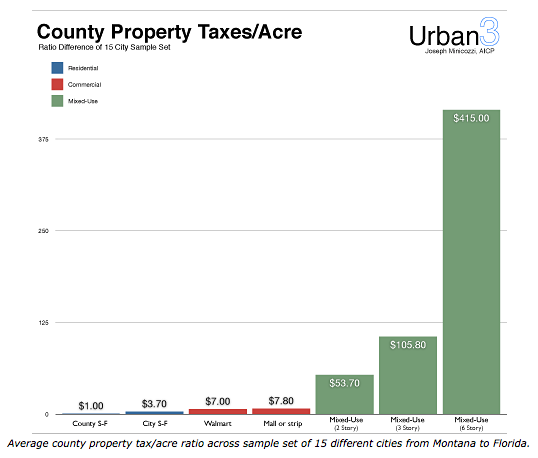
- Image: Planetizen

Read More:
Streetsblog has migrated to a new comment system. New commenters can register directly in the comments section of any article. Returning commenters: your previous comments and display name have been preserved, but you'll need to reclaim your account by clicking "Forgot your password?" on the sign-in form, entering your email, and following the verification link to set a new password — this is required because passwords could not be carried over during the migration. For questions, contact tips@streetsblog.org.