Are Cyclists “Elite Snobs”? It Depends on If They’re in Your Way
“Are Urban Bicyclists Just Elite Snobs?” asked Salon in a recent article. The question could have come from a game of Madlibs. Are [marginalized group of people] just [pejorative adjective] [insulting label]?
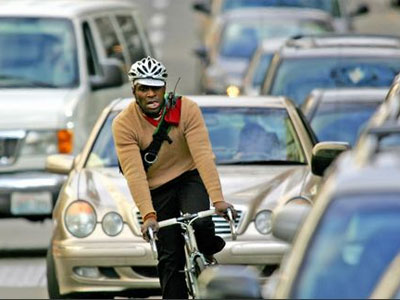
It’s hard to imagine another group receiving the same treatment. Are suburban drivers just insufferable jerks? Are transit riders just self-righteous cads? You get the idea.
The bulk of the Salon piece went on to mostly disprove the headline, before wrapping up with a fingerwagging admonition for cyclists to behave themselves. In a recent post at Network blog Rebuilding Place in the Urban Space, Richard Layman says that author Will Doig approached the cycling “image problem” from the wrong angle. It has less to do with cyclists’ behavior than the way biking disrupts what motorists have come to expect on the streets:
The problem with this article is that it looks at this issue as if it were just about bicyclists, when really the issue is the challenge that bicycling [and walking, and transit] makes to automobile-centric mobility paradigms.
Before the car, cities had been designed to optimize walking and that urban form also optimized bicycling and transit, but as the car became more widely deployed, the car instead was privileged at the expense of walking and biking–making roads wider, creating traffic signals, not giving pedestrians the right of way on the road, gradually increasing the legal speed limits on surface streets to speeds that kill pedestrians when accidents occur, etc.
The challenge to the primacy of the automobile is very uncomfortable for most people who are drivers, because it means for them a loss of privilege, as the past 90 years of transportation policy has privileged automobile use at the expense of walking, transit, and bicycling.
Plus there is the issue of anyone who doesn’t drive, in this case the bicyclist, as “the other”–people can understand and deride the poor as unable to drive because they can’t afford to buy a car, but people who choose not to drive challenge the system.

Read More:
Streetsblog has migrated to a new comment system. New commenters can register directly in the comments section of any article. Returning commenters: your previous comments and display name have been preserved, but you'll need to reclaim your account by clicking "Forgot your password?" on the sign-in form, entering your email, and following the verification link to set a new password — this is required because passwords could not be carried over during the migration. For questions, contact tips@streetsblog.org.