Is America’s ‘First Autonomous Transit System’ Really Dead?
What was supposed to be America’s first “autonomous” transit system is on pause in the midst of a fiscal crisis at the agency that built it — offering a cautionary tale about deprioritizing a tried-and-true transit solutions in favor of untested ideas.
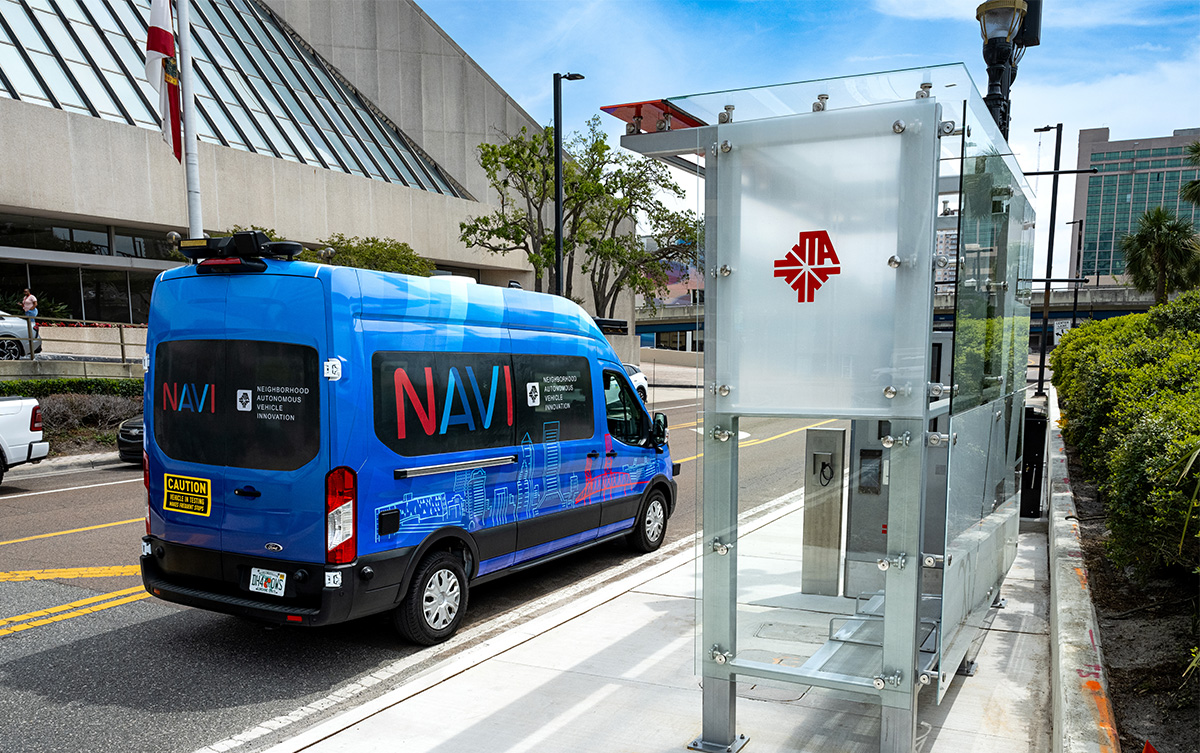
The Jacksonville Transit Authority recently announced that it would suspend operations on the Neighborhood Autonomous Vehicle Innovation system, known locally as NAVI, amidst a $39 million budget shortfall that also temporarily shuttered the Florida city’s eight-stop monorail system, Skyway, and resulted in the layoffs of nearly 200 people.
That shortfall eventually drew the attention of Florida Attorney General James Uthmeier, who subpoenaed the JTA last week for a range of financial documents — including statements on NAVI ridership that have implications for state funding. (Information on more colorful expenditures, like massages, was also requested.)
Some local advocates, though, argue that the problems with NAVI began long before the current fiscal crisis, and speak to larger issues with an agency with a history of chasing shiny new technology when residents without cars are struggling to get around.
“It all spiraled out of control,” said Marcus Nelson, a Jacksonville native and public transportation activist. “[NAVI] was originally supposed to be affordable — and then it became this expensive monstrosity, which I guess that might not happen at all now.”
‘A lot of promises’ — but not many results.
Nelson isn’t the only Jaxson who has doubts about NAVI.
Even when it first launched in June of 2025, the system drew criticism for its $65 million price tag — $39.5 million of which came from local funds. That’s larger than the current shortfall, and indeed, the entire operating budget of some transit agencies, like the Michigan capital of Lansing.
“If there was not this insistence to force this type of autonomous technology into the transit system and to be the first to do this, you’d have plenty of money within budget to maintain your core operations and keep the Skyway running — not lay people off,” Davis added.
Running a downtown route of just 3.5 miles, mostly along a single road — and with a fleet of just 14 Ford shuttle vans, each with a capacity of only nine passengers — NAVI has also faced pushback for not meaningfully expanding shared mobility access in America’s single largest major city by land mass outside Alaska.
Jacksonville measures a staggering 747.3 square miles in all, and was recently ranked in the top 10 most-sprawling large metro areas in the country, and critics say NAVI has little hope of scaling out to its farthest reaches.
In November 2025, though, local investigative journalists alleged that transit agency employees were being paid to spend hours on the autonomous vans to boost ridership and make NAVI appear more viable on paper. The agency denied this, and claimed employees were simply acting as “ambassadors to help riders become familiar with the service.”

Perhaps most outrageously, though, NAVI’s so-called “autonomous” transit system has never been truly autonomous, requiring a human “attendant” behind the wheel of each of its vehicles at all times.
And while there are federal restrictions outside JTA’s control on what type of cars are allowed to operate on local roads without drivers, some locals say the agency still fell short of its lofty promises. (The JTA did not respond to a request for comment on this story.)
“The technology is still risky,” said Ennis Davis, a local transpiration planner and co-founder of Jacksonville Magazine. “There are a lot of things beyond the city of Jacksonville’s control, beyond JTA’s control; there are federal regulations that have got to be dealt with. But still, a lot of the promises that JTA has made are not coming to fruition.”
‘Political poison’
In Davis’s view, though, perhaps the most damning aspect of NAVI was how it diverted attention and resources from the broader public transportation options Jacksonville sorely needs — which residents have demanded for years.
He traces that groundswell back to the 1970s, when Jacksonville first won its bid to build the Skyway automated monorail system with help from the federal Downtown People Mover program — though unlike the the NAVI, the Skyway is actually driverless.
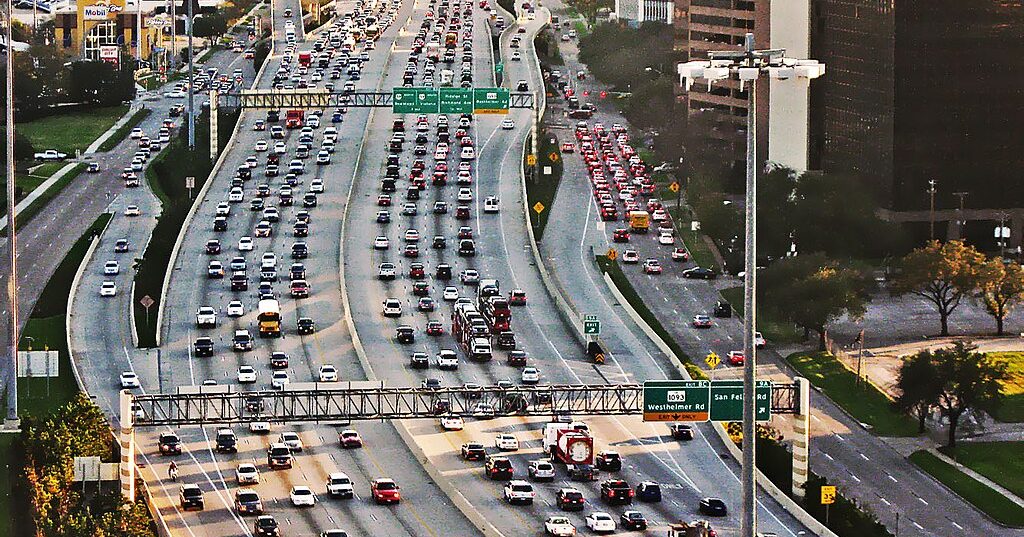
Originally conceived as the last-mile component of a larger shared mobility plan, Davis says that system’s ambitions were quickly undermined by policies that incentivized suburban sprawl — not to mention ever-more driving. Jacksonville recently ranked in the top 20 most-dangerous US metros for pedestrians.
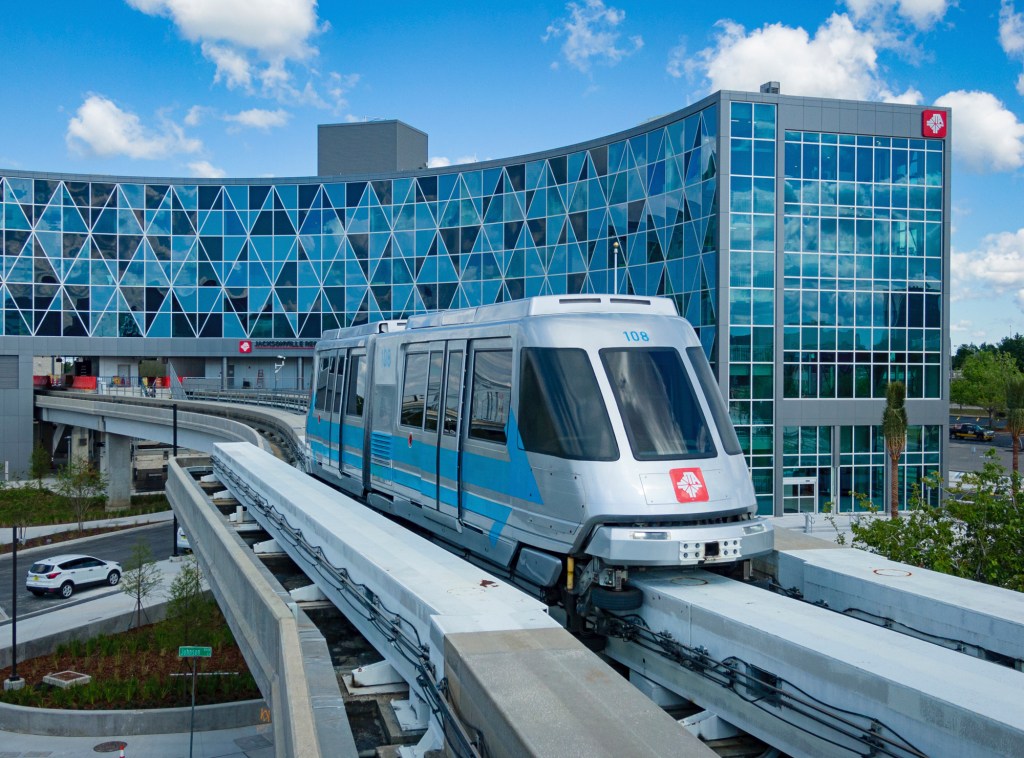
At its height in 2015, the Skyway logged just 5,000 riders a day in a city of more than a million. And since it was approaching the end of its useful life anyway, local officials were doubtful about its future.
“[Today, even the name] ‘Skyway’ is political poison,” Davis adds. “It’s associated with being a transit boondoggle; [the JTA] doesn’t want to use that term. So they decided, ‘we’re just gonna call it something new.'”
In acronym-happy Jacksonville, that rebranding and planning effort became known as “U2C,” short for the “Ultimate Urban Connector” program. Davis says, though, that despite past griping about the Skyway “boondoggle,” the process revealed that many residents actually wanted more public transportation options — and they even wanted to see the Skyway become a meaningful part of the larger shared network they’d been promised decades ago.
Rather than asking where Jaxsons wanted to go and determining the best mode to get them there, though, critics say agency officials over-focused on the next-gen transit options they wanted to provide. On JTA’s website today, U2C is referred to simply as “a program to introduce autonomous vehicles (AVs) into the JTA’s transportation system.”
“The community overwhelmingly recommended that the Skyway be modernized and expanded,” Davis counters. “Somewhere along the line, though, JTA took that ‘as we’re going to advance new technology’ — so, autonomous vehicles.”
Now, the agency is asking the public to weigh in on six alternatives for the future of the Skyway — which Davis says presents dubiously high estimates for rehabilitating the monorail, potentially steering respondents towards AV-centric options like converting the track into an elevated road exclusively for NAVIs.
‘Zombie agency’
Still, both Davis and Nelson acknowledge that Jacksonville’s experiments with new transportation technology are not entirely to blame for JTA’s budget crisis.
Like most US transit agencies, the agency has struggled in the wake of COVID, especially in a state that systemically underfunds public services and whose voters may soon force even steeper cuts. Even with the help of federal grants, which NAVI and the Skyway both received, both advocates say expanding transit service in such an autocentric city can be an uphill climb.
Nelson argues JTA officials should be held accountable for pushing the NAVI solution as hard as they have — if any of them are still around, that is. CEO Nat Ford announced he was leaving the agency in July when the impending NAVI shutdown was first rumored; he’s set to take the helm at the Dallas Area Rapid Transit later this month.
“Obviously, it’s a pretty bad look to have a large public agency very loudly and proudly chasing this dream to then have their financial position erode in front of them — and then the CEO in charge runs off to another state,” Nelson added. “Taxpayers feel like they’re being handed a bag … In a state where it’s challenging to bring in new local funding for transit, you’re going to be stuck with this zombie agency walking around with all this infrastructure that they can’t really afford to take advantage of.”
‘The pain is the first step’
Davis says he’s still hopeful that Jacksonville’s transit future can be resuscitated — if they get back to basics and stop chasing “national firsts.”
He cites Miami as an example, whose notorious Metromover circulator also won a Downtown People Mover grant, only to face struggling ridership much like the Skyway. Over time, though, he says the city changed its land use policy to encourage transit-oriented development around its stations, alongside improvements to the larger transit network of which it’s a part; Metromover reported a 54.5 percent year-over-year ridership jump last month, bolstered by the World Cup.
If Jacksonville can think holistically, too, he hopes it can replicate its downstate neighbor’s success – and that starts with looking at how well the entire transportation landscape is working for people, not just swapping a monorail for a fleet of glorified shuttle vans that can’t even drive themselves like they claim.
“We really need to have an honest conversation about transit in general in Jacksonville, and understand that there is no such thing as a one-size-fits-all solution,” he adds. “We’ve always tried to come up with the thing that no one else has ever done, and [we’ve always said,] ‘We’re going to be the first and greatest and best at this.’ [But you can wait to] see other cities touch the hot stove and burn themselves; you don’t need to touch the hot stove, too.”

In time, advocates are hopeful that the JTA can get its financial house in order and start expanding the network, even if service cuts and layoffs hurt for now.
Some of those needs might even be met by automated technologies, which Davis says he doesn’t oppose. But if they are, it should be because vehicles like NAVIs are truly the best fit for a specific mobility need, in a broader ecosystem of diverse mobility options — not because the agency wants to claim the title of “first in the nation.”
“I think it’s more of a cautionary tale of not bringing the community to the decision-making table of its future,” he added. “The pain we’re going through now is the first step. Some of these things that we’ve been trying to force people into just need to die.”

Read More:
Streetsblog has migrated to a new comment system. New commenters can register directly in the comments section of any article. Returning commenters: your previous comments and display name have been preserved, but you'll need to reclaim your account by clicking "Forgot your password?" on the sign-in form, entering your email, and following the verification link to set a new password — this is required because passwords could not be carried over during the migration. For questions, contact tips@streetsblog.org.