Pedestrian Fatalities Drop Again, But More Needs To Be Done, Says Governors Group
And this is supposed to be good news?
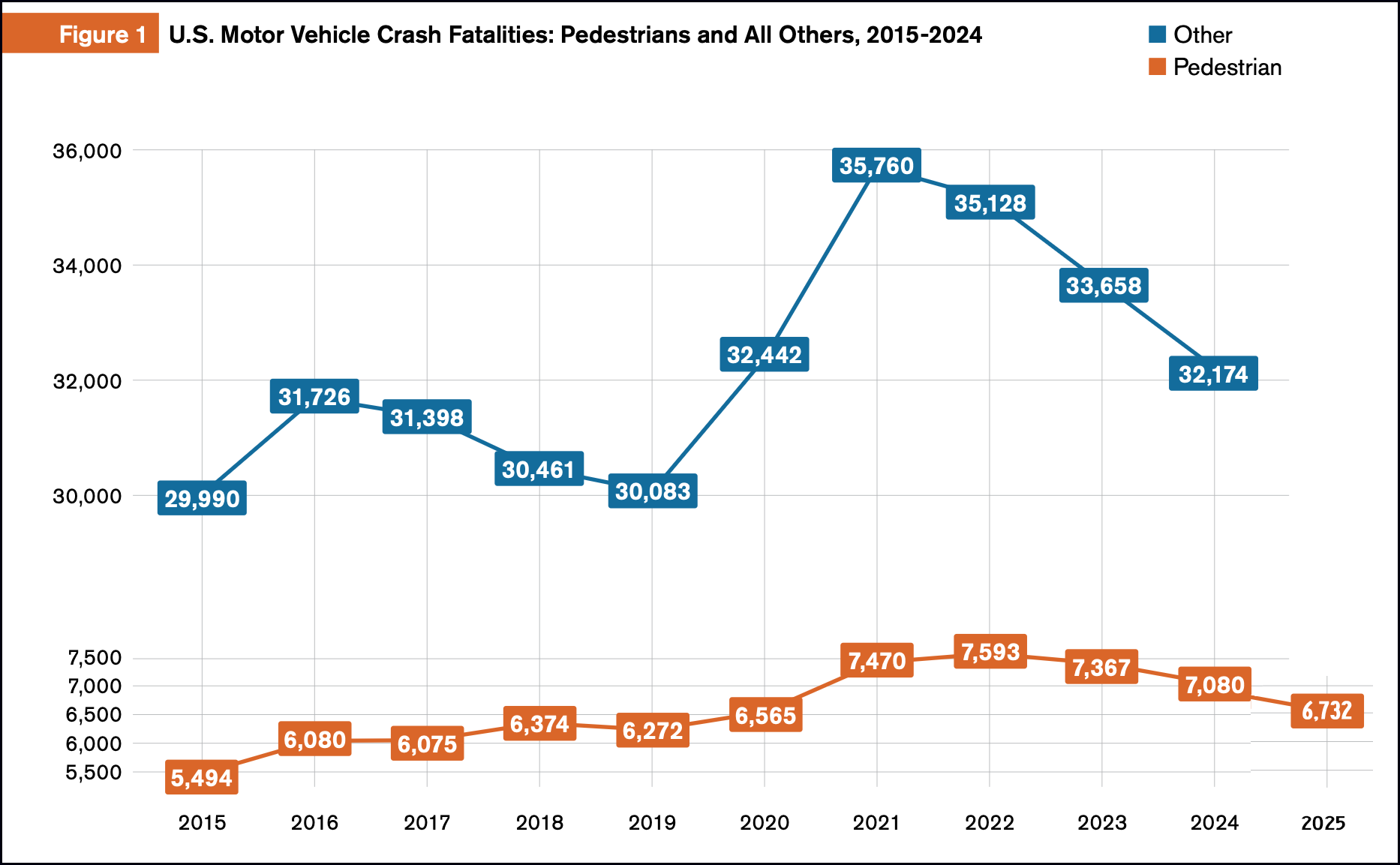
The number of pedestrians killed by drivers last year was down 7 percent from the previous year, according to a new report released on Tuesday — but those 6,732 fatally struck friends, neighbors and relatives represent 22.5 percent more pedestrians than were killed by car and truck drivers in 2015 and roughly 70 percent more than the number killed in 2009.
That’s the top-line finding from the annual carnage report put out by the Governors Highway Safety Association, which uses crash statistics sent by State Highway Safety Offices (which are slightly different from, and presented earlier than, federal data, though the trends are generally the same).
“It’s encouraging to see fewer pedestrian deaths for the third straight year,” GHSA Chief
Executive Officer Jonathan Adkins said in a statement. “Let’s keep this progress going until we reach zero deaths. We must stay vigilant and leverage proven countermeasures like traffic enforcement that focus on high-risk driving behavior, education and outreach initiatives, and infrastructure improvements.”
Indeed, more must be done, as other findings of the report offer plenty of bad news about the safety trend in these United States, a trend that helps bolster the Association’s support for “proven countermeasures, including infrastructure improvements, education and outreach initiatives and traffic enforcement that focuses on high-risk driving behavior.”
For instance:
- Since the recent peak of total fatalities — the 2021 pandemic year when drivers went on a speed rumspringa — the number of pedestrians killed is falling at a slower rate than the number of people inside of vehicles. The Governors Highway Safety Association offered a few possible reasons for this shift, all of which will be familiar to Streetsblog readers: “Vehicles are getting larger and heavier, and greater force means pedestrians are less likely to survive injuries. In addition to being heavier, these vehicles tend to have tall, blunt front ends which are associated with a 43.6-percent increase in pedestrian fatality risk when compared with low and sloped front ends.”
- Similarly, the portion of crashes that lead to a pedestrian fatality has reached double-digits for the first time since at least 2015, with 10.1 percent of crashes causing the death of someone outside the car. That’s up from just 4 percent in 2015 — a 152-percent increase that is closely linked to the increasing weight of the most-popular American vehicles.
- The total economic toll of pedestrian fatalities is roughly $90 billion, which includes medical costs, legal costs and lost wages, but also is mostly comprised of deprived quality of life.
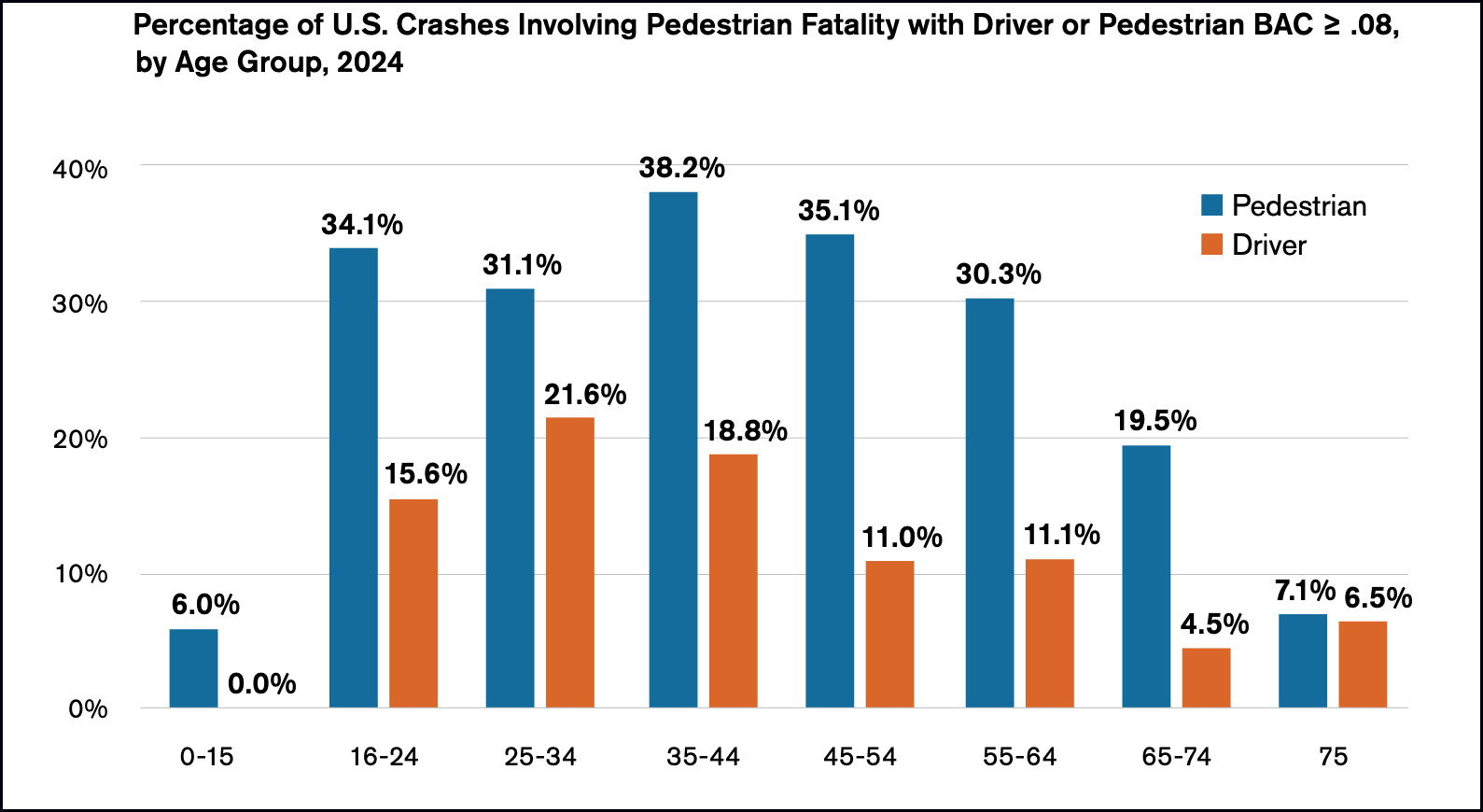
- Drunk drivers are more likely to kill a pedestrian than themselves:
- Distracted driving (and, to an indeterminate effect, walking) is on the rise, too. In 2019, roughly 15 percent of all crash fatalities, both pedestrian and drivers, were attributed to distracted driving or walking. By 2024, distraction was the stated cause of 39 percent of pedestrian fatalities and 22 percent of driver fatalities.
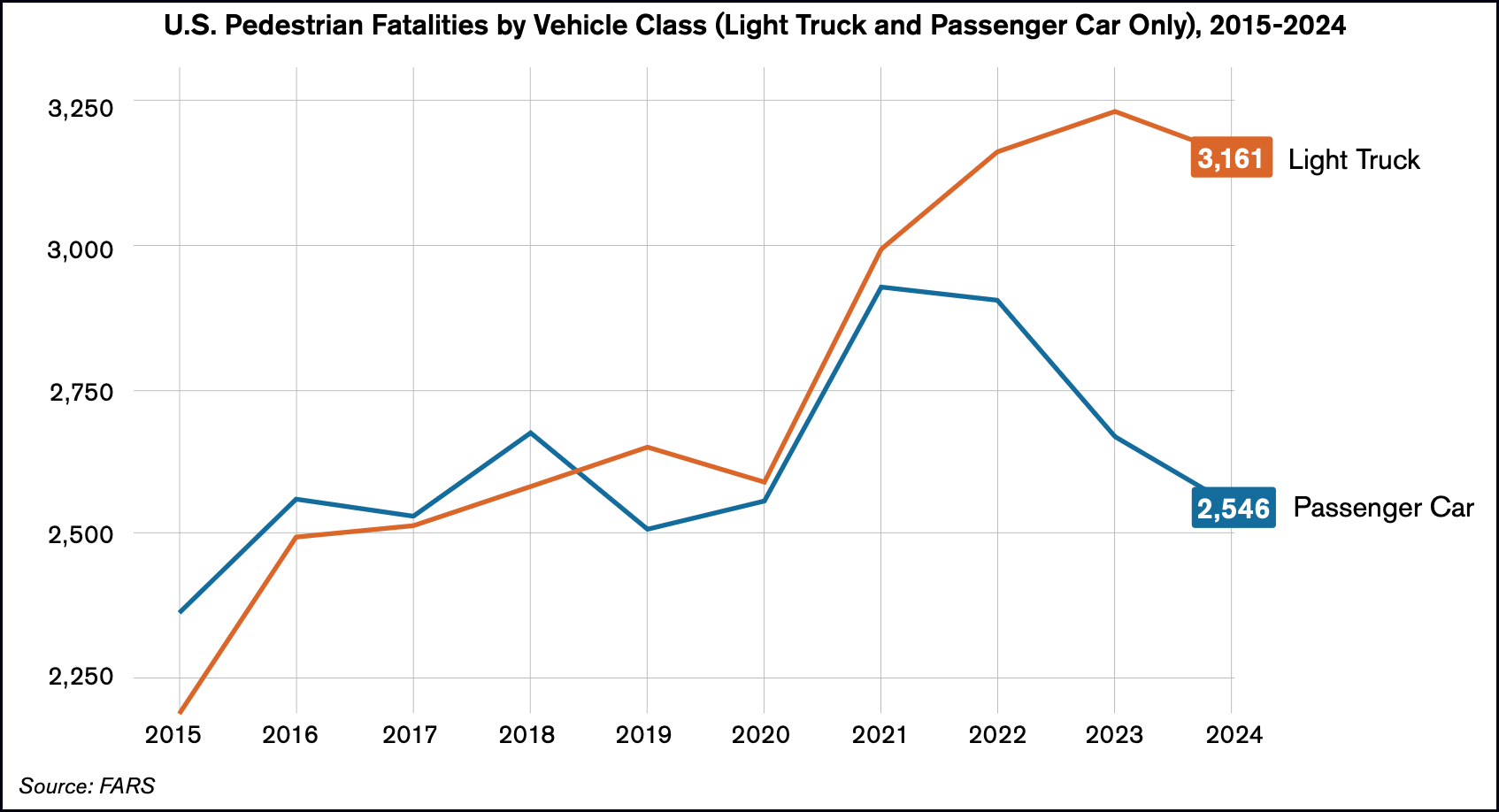
- The percentage of pedestrians killed by big SUVs is still huge, the result of decades of failure to rein in the size of vehicles churned out by Detroit. If there is any positive news in that gap is that in 2024, it narrowed ever so slightly:
- And, along the same lines, the percentage of crashes that end in a pedestrian death is much lower in urban areas than in rural areas — and the rural death toll is rising. In 2016, 10.4 percent of rural crashes ended in a pedestrian death. In 2024, that rate had risen to 15.1, an increase of 45 percent. The reason is not only the size of vehicles and the speed with which their drivers can pilot them. “Rural roadways tend to have higher speeds, fewer sidewalks and longer transport times with limited access to trauma centers,” the report stated.
- No solace here, though: the percentage of urban crashes that cause a pedestrian fatality was up to 9.2 percent in 2024, up from 5.1 percent in 2018. That’s mostly due to the size, shape and weight of these SUVs.
And, of course, there are positive trends among some states in the data.
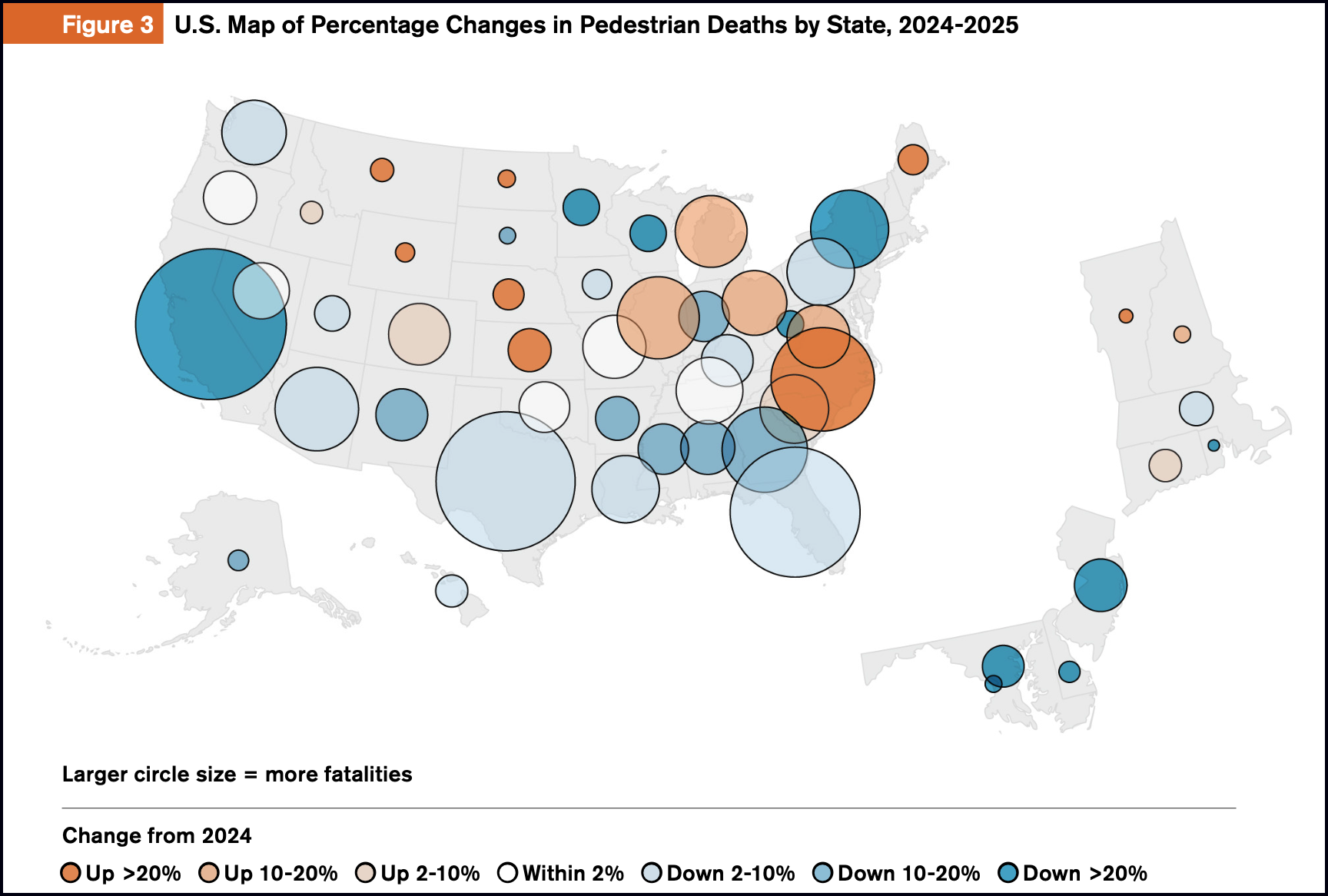
A plurality of states — 28 — is experiencing downward trends in pedestrian fatalities while 17 states had more pedestrians killed in 2025 than in 2024. The map shows the extent of the changes, with California having the best positive trend (ped deaths down 22.4 percent) and North Carolina going south (pedestrian deaths were up 32 percent). Because California is so big, that state’s drop in pedestrian deaths (239 fewer in 2025) accounted for more than half of the national decline last year):
What is California doing so well to make it such an outlier? The report offers a few specifics beyond the state’s general support for Vision Zero strategies:
- A program in Southern California “trained community members to conduct walking and bicycling assessments … and talk with local government officials about infrastructure changes that expand safe options for people outside of vehicles.”
- California allowed municipalities to reduce their speed limits.
- The Golden State (as well as Pennsylvania and Vermont) funded digital alert projects which send real-time, in-vehicle notifications to drivers via navigation apps or built-in vehicle systems, giving drivers advance notice to move over or slow down when approaching police, fire, ambulance or other emergency roadside personnel.
The Governors Highway Safety Association will hold a webinar on July 16, at 2 p.m. ET, to share an overview of the data and highlight unique approaches states are taking to pedestrian safety. Sign up here.

Streetsblog has migrated to a new comment system. New commenters can register directly in the comments section of any article. Returning commenters: your previous comments and display name have been preserved, but you'll need to reclaim your account by clicking "Forgot your password?" on the sign-in form, entering your email, and following the verification link to set a new password — this is required because passwords could not be carried over during the migration. For questions, contact tips@streetsblog.org.