“Why Do We Do This Bill?”: Preparing Congressional Staff for Surface Transportation Reauthorization

Editor’s note: The following article originally appeared on the T4America Blog and is republished with permission.
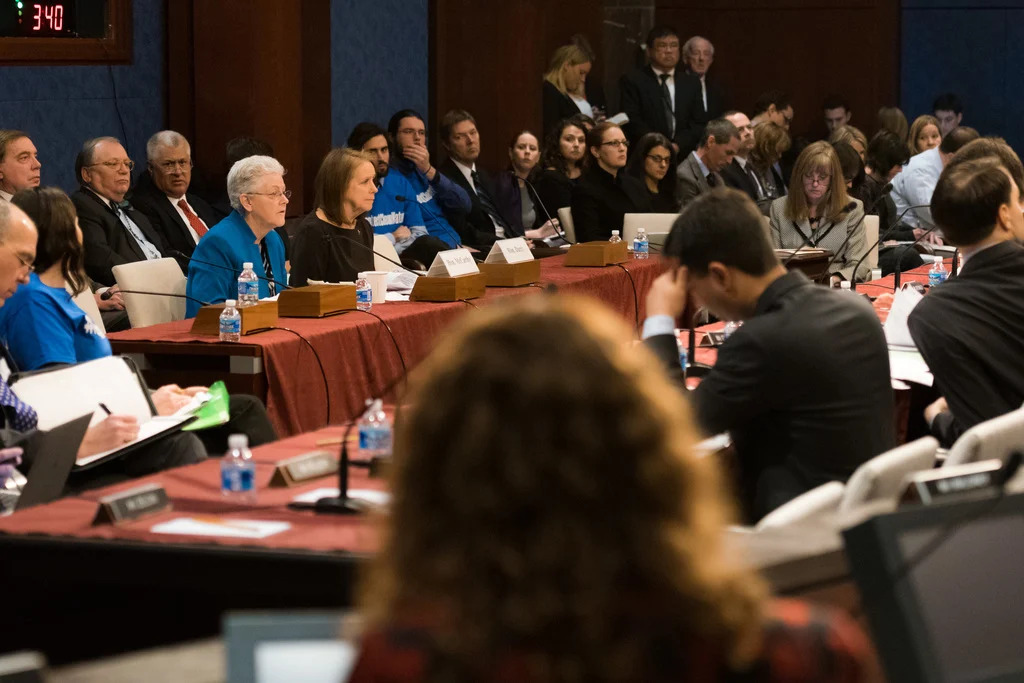
Over the past month, T4America organized briefings for Hill staffers (one each for the House and Senate) about the federal surface transportation reauthorization process to help them advance their members’ priorities, but also hopefully to encourage them to take a more skeptical look at a program producing marginal and diminishing returns for taxpayers at enormous expense.
When SGA president and CEO Beth Osborne asked the staffers present to raise their hands if they worked on developing the Infrastructure Investment and Jobs Act (IIJA) back in November 2021, maybe two total hands went up in either briefing. Ninety-five percent or more of the staff who showed up are knee-deep in their very first reauthorization cycle. This isn’t just because the briefings drew interns or newer, younger staffers. These were staffers who, in most cases, had worked on the Hill for years and were specifically responsible for transportation issues.
In T4America’s experience, this is pretty typical for most offices. The fact that reauthorization happens about every five years has one notable effect: There’s little institutional knowledge of the process or the policy within many congressional offices. Most members of Congress (and their staff) don’t think or do much about it during the 4-6 years between reauthorization cycles. (That said, there are certainly reams of institutional knowledge built up within the members who have served on key House or Senate committees for any length of time, as well as the staffers who work directly for those committees and might be, like T4America, working on their fourth transportation bill cycle.)
But this once-every-five-years cycle is one reason why the bipartisan status quo has so much inertia—there’s little reason to interrogate the overarching purpose of this program, to look back at how it has performed, or what everyone is getting for the money.
In both briefings, we wanted to try to get everyone to take a step back and think about the purposes of the federal transportation program. Why do we need this bill? Why does this program exist? We asked everyone in both briefings, and the answers started out largely the same:
- “To provide steady, predictable funding.”
- “To allocate transportation money to states.”
- “To make a better transportation system.”
Look carefully: These answers are not about measurable outcomes but are simply outputs. This underscores many of the structural problems and defines how most lawmakers tend to approach this program: How much money is in the bill overall, and how much is coming to my state? Many are also interested in things like “How much is going toward transit vs. highways, or is the small program I like getting more funding?” But very few members of Congress are asking harder, outcomes-oriented questions like “Are we making measurable progress on outcomes that matter with the hundreds of billions in general funds that we have been using to subsidize this program?”
Eventually, many of the staffers started answering with goals for the program more oriented around outcomes, including the performance measures specifically codified into the program back in 2012’s MAP-21:
- “To make a safer, faster, reliable, more predictable system.”
- “To reduce congestion.”
- “To finally fix our crumbling roads and bridges.
If these are truly core goals for the program (and they are!), how has the program performed? If we’re going to do what the big industry groups think we should do and borrow another $200 billion or more from our grandkids to do more of the same, we should ask some questions about the returns we’re going to get for that money.
Here’s what Beth had to say on safety, the state of repair of our roads and bridges, and congestion:
As we said last year, after spending over $1 trillion on transportation, our roads are still crumbling, unsafe, and congested. So we asked these staffers: Why should any member of Congress be lining up to support continuing this program without significant changes? And for those in the congressional minority, why should they be lining up to provide bipartisan support for a law where their priorities in the last bipartisan bill—the Infrastructure Investment and Jobs Act—have so often been meddled with, frozen, or eliminated outright by the White House? Especially while those with whom they forged the “bipartisan” agreement have largely stood on the sidelines and failed to defend what they collectively passed?
To that last point, as we’ve chronicled here, over the last year, billions of dollars in funding for community-led safety projects, electrification, transit, and passenger rail projects from the bipartisan-passed IIJA have been delayed, frozen, or outright cancelled by the administration’s USDOT. But it’s not just the administration: Congress rescinded and reprogrammed over $2.3 billion in IIJA appropriations in the FY26 spending bill and even more in the partisan reconciliation bill. And this year, the Trump administration canceled another $963 million for clean transportation projects, targeting communities in Minnesota, Colorado, Illinois, and California.
It’s time to focus on opportunities and outcomes
Surface transportation reauthorization is an opportunity to reorient federal policy to address the issues that matter most to Americans. Such as making our streets and roads far safer for everyone who uses them. Or holding every single entity spending federal money accountable for actually repairing what they’ve built first, before building new stuff. Or focusing not on how much money gets spent on 1950s measures like congestion, but instead on making things more affordable by improving accessibility—making it easier and cheaper to get to what we need each day. Or finding ways to get more homes built in the areas that already have great transportation and transit access.
During the rest of the time in these two briefings, we had tables organized around issues like transit, rail, or safety, where staffers could dig into those issues with policy experts from other organizations and learn how those priorities can be advanced in the reauthorization process.
More members of Congress (from both parties) should be more skeptically interrogating this program and asking: What are we getting for the huge price tag? Why should we deficit spend so much just to accomplish so little?
No more blank checks for unproductive infrastructure that makes life more unaffordable, produces terrible results on safety, and fails to actually improve the condition of our infrastructure. That’s the core message that we hope to continue communicating to these vital staffers and congressional offices who will be shaping what comes next after the IIJA.
Our sincere thanks to Senator Lisa Blunt Rochester (DE) for helping us to organize the Senate briefing, to the Congressional Progressive Caucus for helping to organize the House briefing, and to our many partners and advocates who came to help educate staff.

Streetsblog has migrated to a new comment system. New commenters can register directly in the comments section of any article. Returning commenters: your previous comments and display name have been preserved, but you'll need to reclaim your account by clicking "Forgot your password?" on the sign-in form, entering your email, and following the verification link to set a new password — this is required because passwords could not be carried over during the migration. For questions, contact tips@streetsblog.org.