How To Fix The Broken Gas Tax
America is vastly undercharging its drivers for the roads they use even as the cost to build and maintain highways soars, a new report confirms — and it would be better for everyone, including motorists themselves, if Congress pursued new strategies beyond just the gas tax to get drivers to pay their fair share and stop the mega-project madness that’s made our transportation system so expensive in the first place.
The federal gas tax has lost an astonishing 81 percent of its purchasing power since it was last increased in 1993 — and almost all (77 percent) of that erosion is because of the runaway cost of building highways, according to a new analysis from Consumer Reports. That’s nearly twice as fast as the rate of inflation, and has required massive infusions of cash from the general fund, which means it’s also paid by non-drivers who are responsible for little to no damage to the highway system.
That contradicts a common narrative among fossil fuel proponents that the rise of electric vehicles and more fuel-efficient cars has bankrupted the Highway Trust Fund, which the study found to have contributed just 2 and 15 percent to the reduction in revenues, respectively.
“We were surprised at how little they factored into it, and how significant increases in the cost of building and maintaining roads has been,” said Chris Harto, manager of sustainable and advocacy and co-author of the report. “EV sales continue to grow and become a more significant part of the vehicle mix, but they’re still an extremely small part of the story.”
Perhaps needless to say, cyclists and walkers had such a small impact on the gas tax’s plummeting purchasing power that they didn’t even merit a mention in the study.
Why the gas tax alone is not enough
With all of the nation’s core federal transportation policies and programs up for renewal in late September, including the mechanisms that control the Trust Fund, Harto joins the chorus of advocates that argues the time has come for lawmakers to rethink the fundamentals of how we fund our transportation system in the U.S — and explore a broader menu of strategies to make those funding streams more fair to consumers.
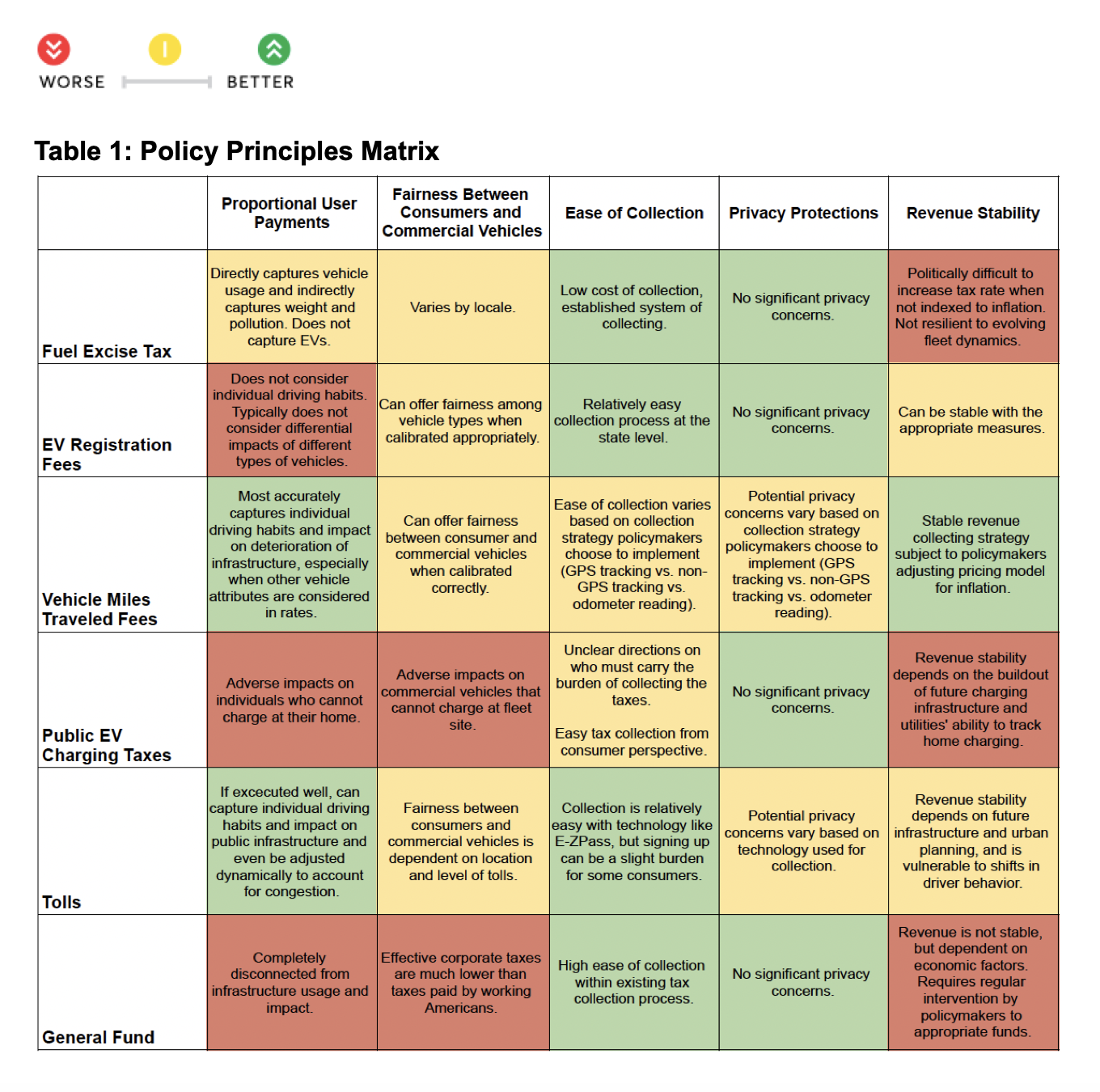
It won’t be easy. Of the six road-funding strategies the researchers explored, lawmakers have historically over-relied on just two — fuel excise taxes and transfers from the general fund — even though neither has provided a revenue stream stable enough to satiate America’s ravenous highway appetite without constant increases.
Meanwhile, the third strategy — electric vehicle registration fees — wouldn’t even come close to closing the funding gap, especially if the Trump administration continues to slash subsidies to encourage Americans to make the switch. And the other three — tolls, “vehicle miles traveled” fees, and taxes on public EV chargers — are either inadequate on their own, or face fierce political pushback anytime they’re proposed.
While the report stops short of recommending any specific mix of those six ideas, the Consumer Reports team encouraged Congress to explore a bold, multi-pronged approach, even though they’ll face resistance.
“If we want to build and maintain our transportation system, we are going to need more funding than an 18-cent-per-gallon gas tax can deliver,” Harto added. “Congress is going to need to wrestle with how to, essentially, charge everyone more for using the roads, which is not a popular thing. Nobody likes to see their taxes increased.”
Why we need to bring highway costs down, too
Harto also noted that it’s important to address the other side of America’s road-funding equation too: the overabundance of highways that we spend so much money to build.
“[Congress shouldn’t just be] focusing on raising revenue, but really digging in and figuring out what can be done to control costs,” he added. “Because the rate of inflation in the cost to build and maintain roads is out of control, and controlling that can go a long way to doing more with less as well.”
Some researchers have traced the exploding price tag on America’s highway system to understaffed state Departments of Transportation, which forces over-reliance on expensive consultants, as well as limited market competition for hefty government contracts.
Others argue, though, that America’s obsession with complicated, autocentric projects is itself driving costs up — and that we have to deprioritize ineffective, expensive strategies like massive spaghetti junction highway interchanges to cure congestion, and choose simpler, more effective ones like congestion pricing and bus lanes instead.
“If our goal is to use taxpayer resources wisely, and budget for transportation expenditures effectively, then it would stand to reason that transportation agencies would take every opportunity to prioritize truly high-value projects, ‘right-size’ those investments, and minimize unnecessary complexity,” wrote Tony Dutzik of the Frontier group in a recent article.
“Yet, in our review of highway projects around the country, state departments of transportation regularly do the opposite – opting for ‘supersized’ highway expansion projects when smaller, simpler projects could achieve the lion’s share of the benefits.”
What a ‘fair share’ really looks like
At the very least, Harto says that U.S. consumers deserve a system where the people who put the most wear and tear on our roads are the ones who pay the most money to fix them — and where those who do the least damage are rewarded.
Most of the strategies his report explores could and should be scaled to vehicle weight at the minimum — without exceptions for commercial vehicles, who “pay significantly more per mile than passenger vehicles, [but] still pay much less than their proportional impact on the system,” the report notes.
“We just want policymakers to be very cognizant of that, and make sure that we’re not all subsidizing Amazon, Walmart, and all the major trucking groups,” Harto added. “There’s no market force that’s driving [those companies] to pass on savings to consumers, versus just letting those savings fall to their bottom line.”
People who don’t or rarely drive, meanwhile, would actually be paying less for roads than they do right now if our road funding system were truly fair — and if more money were redirected to their travel needs, transportation would almost certainly work better for everyone.
“Somebody who takes a bus ride or a bike is taking cars off the road,” Harto underscores. “They’re reducing congestion. They’re minimizing impact on that system and allowing more person-miles to occur on that same set of transportation infrastructure than otherwise would have been possible if they were in a car as well.
“So I think policymakers should consider not just the impacts that certain transportation choices people make, but also the benefits of those positive choices that some people make,” he continues. “That can benefit the whole system.”

Read More:
Streetsblog has migrated to a new comment system. New commenters can register directly in the comments section of any article. Returning commenters: your previous comments and display name have been preserved, but you'll need to reclaim your account by clicking "Forgot your password?" on the sign-in form, entering your email, and following the verification link to set a new password — this is required because passwords could not be carried over during the migration. For questions, contact tips@streetsblog.org.