Are Roundabouts Just For Rich People?
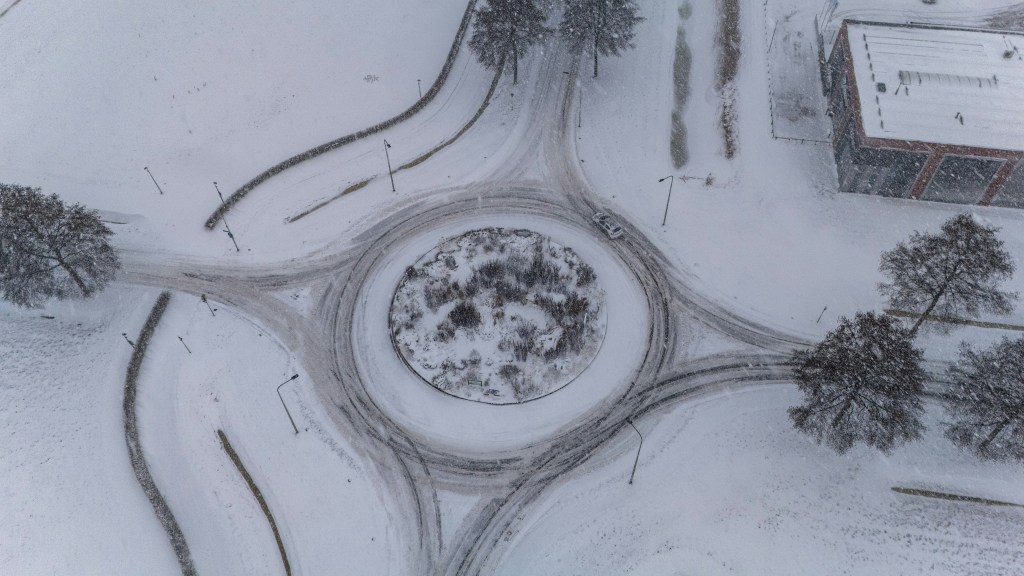
Life-saving “roundabout” road treatments are disproportionately located in rich neighborhoods and missing from poor ones, but transportation officials can change those patterns of inequity by being more proactive about safety city-wide, a North Carolina study concludes.
The UNC Chapel Hill analysis with the provocative title “Roundabouts Are For Rich People” recently found that the circular intersection design that reduces injury crashes by 80 percent was disproportionately sited in wealthy neighborhoods.
The racial makeup of a neighborhood was also predictive of whether a street received a roundabout or not, with Black neighborhoods receiving fewer than white ones, though it wasn’t as strongly associated as whether those neighbors had money.
Not to be confused with a traffic circle or a rotary, the first roundabout was built in the U.S. in the 1990s and quickly became a celebrated traffic safety tool, albeit with a few asterisks when they’re designed without bicyclist and pedestrians in mind, like the kind of internationally famous mega-roundabouts that have multiple lanes and few protected bike facilities.
But for study author Matthew Bhagat-Conway, the distribution of roundabouts is only an example of larger inequalities in transportation planning, albeit one that’s particularly easy to study in statewide databases – and it likely extends beyond the college-town streets that initially inspired the study.
“[It was a way of] zooming way out to look at the whole state, and asking, ‘Are we seeing patterns of inequity being reproduced by traffic control devices?'” he added. “And we found that particularly with roundabouts, you’d see a lot fewer of them in lower-income neighborhoods across the state. And that’s not just something that’s happening in cities like Durham.”
An assistant professor of City and Regional Planning at UNC Chapel Hill, Bhagat-Conway said that North Carolina’s roundabout distribution problem is largely a byproduct of how the state builds traffic-calming infrastructure. Like many communities across America, major safety projects in North Carolina tend to only happen when new roads are built, or when existing roads are expanded to accommodate more traffic as population increases — which still happens, even though expansion doesn’t fix congestion.
Both of those things are associated with influxes of wealthier residents who can afford the cost of living in the hot neighborhood in the middle of town, or the brand-new subdivision on the urban fringe.
“A lot of it comes down to funding and process,” Bhagat-Conway said. “More transportation dollars are available in wealthier places, particularly when you’re talking about things that may be driven by local investment. Then there are also places that are seeing more development even if they’re not newer neighborhoods — you’re more likely to see a roundabout going up in a place probably where there’s investment in the road system happening, just because that place is growing.”
Low-income residents, by contrast, often live in areas that are losing population, and they aren’t the target market for new neighborhoods full of sprawling McMansions, either. And since policymakers don’t always pay the same attention to the safety concerns from the very poor as they do to, say, rich campaign donors, low-income residents tend to remain stuck in aging neighborhoods with the same kind of traffic signals and signs they’ve always had, rather than cutting-edge safety initiatives like roundabouts — even though their neighborhoods tend to have the highest crash rates, particularly for pedestrians.
“We ultimately think that has to do with traffic signals being a tool that prioritize traffic flow rather than safety,” Bhagat-Conway added. “And so in places where you have high traffic volumes — and maybe there’s less political less political power concentrated in those communities — there’s more focus on moving vehicles through those communities.”
The other way that streets get traffic-calmed, of course, is if they meet what the Manual of Uniform Traffic Control Devices calls a “warrant,” such as a certain number of pedestrians crossing in an average hour that “warrants” a crosswalk to make them more visible to drivers.
Bhagat-Conway argues that reactive approach is selling low-income neighborhoods short, and recommends that cities expand upon a framework called “Intersection Control Evaluation,” which calls on cities to systematically and regularly assess the safety of every major intersection, and prioritize changes based on need — even if no one’s planning to widen the most dangerous roads anytime soon.
“We just need to do this a lot more,” he adds. “We need to not only do this at big, new intersections — we need to be doing this periodically, at every intersection with a major street. And we need to do a better job of working with smaller streets, too.”
At the end of the day, Bhagat-Conway says being proactive about safety isn’t just about roundabouts, because doing it will lead to all kinds of traffic-calming infrastructure. And while it would almost certainly steer much-needed investments to poorer neighborhoods, it’s not just about equity, either.
“We come at [these ideas] from an equity lens, and we think we should implement these things because of equity,” he added. “But they’re also just good ideas.”

Read More:
Streetsblog has migrated to a new comment system. New commenters can register directly in the comments section of any article. Returning commenters: your previous comments and display name have been preserved, but you'll need to reclaim your account by clicking "Forgot your password?" on the sign-in form, entering your email, and following the verification link to set a new password — this is required because passwords could not be carried over during the migration. For questions, contact tips@streetsblog.org.