When The Suburbs Want To Opt Out of Funding Regional Transit
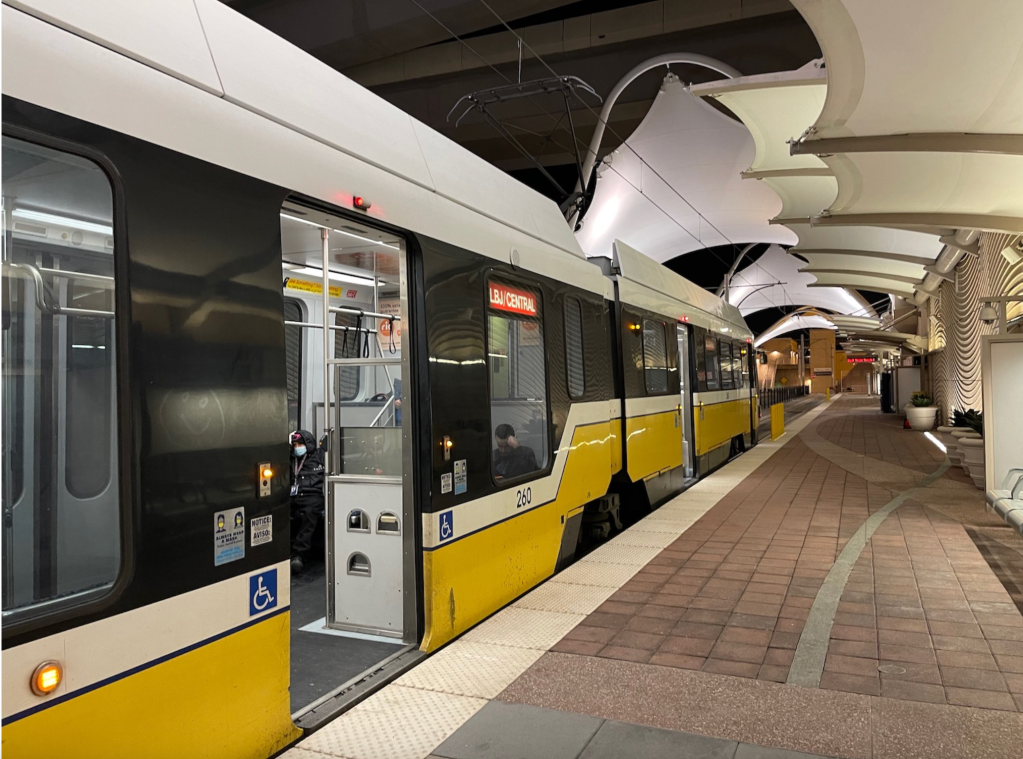
A vote six years in the making that would decimate the Dallas Area Rapid Transit system might soon be called off, potentially averting a major funding crisis for the agency — though advocates say there’s more work to be done to make sure every DFW resident has the mass mobility options they deserve.
Since the beginning of the decade, a handful of wealthy, sprawling suburban cities in the greater Dallas metro have been fighting for an exemption to a one percent sales tax that funds the area transit agency. The mayors of those cities – Irving, Plano, Farmers Branch, Addison, University Park and Highland Park – have argued that they pay far more into the system than they get back, according to a 2024 study that only analyzed one fiscal year’s worth of data.
By state law, local governments are only allowed to levy a total of two percent of sales taxes, including the allocation for DART. That cap, city leaders have said, is preventing them from investing in other services such as economic development corporations that are allowed to provide incentives for businesses or developers.
Tensions came to a head earlier this year when the six cities announced they would each hold referendum votes in May, asking voters to leave the transit system altogether. And if voters agreed, DART would lose over $200 million — a slashing that would immediately end bus services, paratransit and other transit options for more than 600,000 residents in the area.
To replace those services, local leaders proposed implementing microtransit – essentially, city-subsidized ride shares, operated by private companies such as Uber, Lyft, or Via.
“It would be like starting from scratch in some ways, but we’re willing to take the risk that we can do a better job,” said the mayor of Irving, Rick Stopfer in early February.
As part of larger budget cuts at the agency, DART has already cut two major bus routes that serve his city – an unpopular move that impacts hundreds of low-income residents. Stopfer, who also serves on DART’s board of directors, said that decision is just one example of a larger frustration that local leaders have when it comes to negotiating with DART. He argued that voters should be allowed to decide whether the agency deserves their money.
“It’s in the hands of the residents,” he said. “If they vote to stay in, well, then it isn’t [the city’s] problem; it’s DART’s problem. If you’re in a van for hours for an appointment, if they didn’t pick you up and you lost your job – it’s not my problem.”
“Positive things are happening”
Last week, though, the City of Dallas and the DART board itself made major concessions to the suburbs, hoping to keep the system intact.
Just before the deadline to call off the withdrawal referendum, Dallas City Council agreed to restructure DART’s 14 member board, and give up one of its seven seats to other cities. DART also agreed to refund .05 cents of every penny it collects to member cities – nearly $42 million annually across thirteen cities.
Those changes will still have to be approved by the state legislature, which doesn’t meet until 2027. But it was enough for the mayors of Irving, Plano, and Addison to signal to local media that they would support calling off the withdrawal elections. (DART and the mayors of Plano, Farmers Branch, Addison, University Park and Highland Park did not return a request for comment; Stopfer did not return a request for comment after the announcements.)
The North Central Texas Council of Governments — a regional agency that coordinates infrastructure and planning across the metroplex — has agreed to fill in $75 million of DART’s budget for the next five years, said Michael Morris, who leads the Regional Transportation Council. He’s overseen the development of Transit 2.0, a new vision for a larger, more functional transit system that can serve the needs of some 12 million people who are expected to call the Dallas area home by 2050.
“That work was going on, positive things were happening – then we discovered we needed to bring this over to the DART side of things that we weren’t currently working on, and solve this financial crisis,” he said.
That funding, Morris explained, will come from unallocated federal block grants for congestion mitigation and air quality improvement. NCTCOG also announced it would create a new, regional rail authority that will oversee transit across the metroplex from Fort Worth to Denton, opening the door for further transit enhancements.
To truly create a public transit system that can function across 13 counties, though, there’s a growing recognition that Texas needs to start funding its metropolitan transit authorities, not just its cities – a responsibility that the state has shrugged off for decades.
Even the state’s department of transportation — which has a history of pushing through unpopular highway expansion projects — released a draft study in November saying that the state won’t be able to build its way out of congestion forever.
“Texas is probably the largest state that doesn’t fund transit directly,” Morris said, explaining that most of the Department of Transportation’s budget goes towards building roads and highways. Of some $41 million available in state funding for transit, TxDOT doesn’t send any of that money to the state’s biggest cities.
In other words, rural and smaller urban areas qualify for state transportation funds, but large metro areas like Dallas-Fort Worth, Houston, Austin and San Antonio don’t. And while NCTCOG is working on legislative proposals that could finally allow funding for regional rail, they haven’t passed yet.
“The state of Maryland could fit inside the Dallas-Forth Worth region,” Morris said. “And what does Maryland do? The state funds regional rail between their cities.”
Even if the vote is formally called off, the suburban cities that threatened to leave DART will still have to rebuild their relationship with the agency and other regional transportation authorities, Morris said. In previous years, for example, the City of Plano even tried to pass a bill at the state legislature that would have nullified DART’s ability to collect sales tax at all.
The bill didn’t pass, but Plano’s leaders have said they would continue to reintroduce it in subsequent sessions.
“It feels like a marriage where two people have said, okay we’re not going to leave each other – but those issues haven’t disappeared,” Morris said.
Rebuilding trust with residents will take effort, too — because ultimately, the decisions to restructure DART’s board, refund a portion of sales tax, and create the new rail authority were all made behind closed doors. And local transit advocates, in particular, aren’t all happy with those moves.
“These decisions were made without a ridership perspective,” said Tyler Wright, the vice president of a local transit riders advocacy group called Dallas Area Transit Alliance. “We inserted ourselves into the process, because of course we had to – but we need to be invited to the table.”
In Wright’s view, DART’s troubles reflect a broader trend in Texas of privatizing public services. Allowing the withdrawal votes to go through and proving that citizens supported public transit services could have been its own win, he said.
“It’s so attractive to be a fiscal hawk and talk about slashing taxes,” he said. “There’s a lack of understanding and empathy.”
While Wright remains cautiously optimistic for the future, he says other members of the Alliance feel more uncertain about what could come next.
“In the past, [sales tax diversions] meant service cuts,” said Wright. “Adding more cuts to more cities, to me, means more service cuts. We want to know who has to be fired, whose routes will be sacrificed, for cities to get these handouts that they’ve been complaining about [not getting].”

Read More:
Streetsblog has migrated to a new comment system. New commenters can register directly in the comments section of any article. Returning commenters: your previous comments and display name have been preserved, but you'll need to reclaim your account by clicking "Forgot your password?" on the sign-in form, entering your email, and following the verification link to set a new password — this is required because passwords could not be carried over during the migration. For questions, contact tips@streetsblog.org.