Aisle Be Damned: Dems and GOP Unite in Oregon In Bid To Legalize Kei Trucks
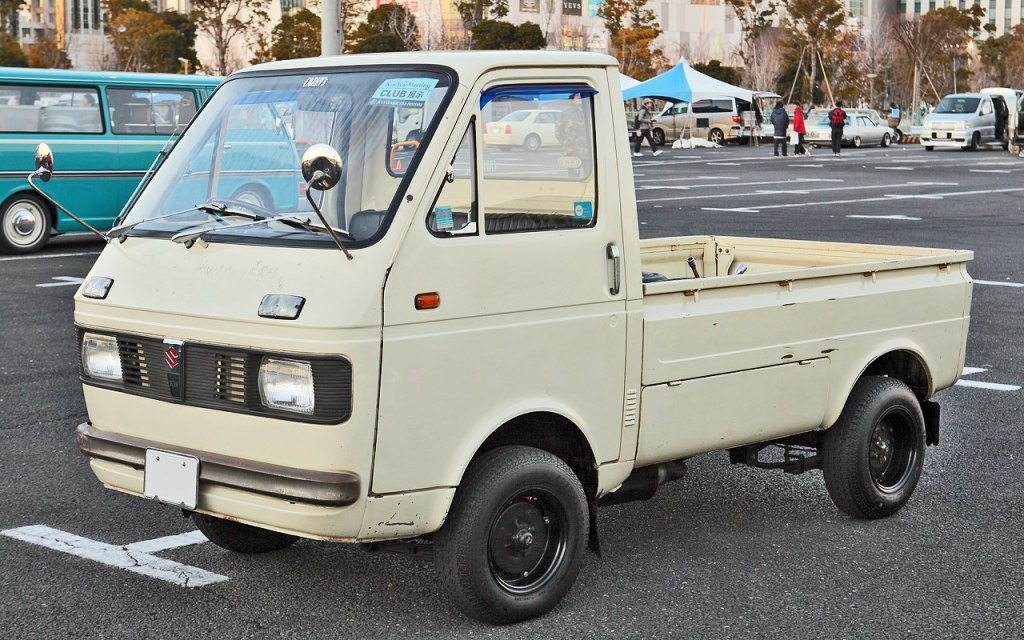
A bipartisan bill would allow finally make small-format “kei” trucks street legal in Oregon — and offer other U.S. communities one model for how to increase safety, save money, and remove unnecessarily huge, polluting vehicles from the roads.
Initially popularized in Japan where the term “keitora” literally translates to “light truck,” mini-trucks currently can’t be registered in the Beaver State, in part because its vehicle code doesn’t have clear parameters defining their maximum size, engine capacity, and age. This legislation will correct that, finally enabling Oregonians to legally use a smaller vehicle when it’s the right tool for the job — or at least save them the hassle of crossing state lines to buy and register one in neighboring Washington, where they’re already legal.
State Sen. Anthony Broadman said the bill was inspired partly by a brewery owner in his district who wanted to use kei trucks to deliver kegs to restaurants down narrow city alleys, only to find that state laws essentially forced him to use a large delivery truck instead.
But the bill has attracted particular interest from rural, Republican communities whose residents would prefer an easier way to haul things like hay around a farm. It’s also won praise from people of all political backgrounds who are struggling with the swelling costs of car ownership, which have grown to more than $12,000 a year as the average vehicle has grown substantially larger.
“My whole reason for being in Salem is to fight for affordability, growing our economy, and safety,” said Broadman. “Those aren’t really partisan issues. This just happens to be one of those issues that rural Democrats, urban Democrats, rural Republicans and urban Republicans all agree on. We just want more affordable options for people to do business and get around.”
Broadman says this is his third attempt to bring kei cars to Oregon — but with more bipartisan support, he hopes this time, it will stick. The bill has even attracted two Republican co-sponsors in Virgle Osborne and Alex Skarlatos, the latter of whom has been celebrated by President Trump for thwarting a terrorist attack on board a Paris train, an incident which was later turned into a Clint Eastwood movie.
Notably, Trump himself has praised kei cars as “smaller, more affordable … fuel efficient” and “really cute,” and called on regulators in December to make it easier for U.S. automakers to produce them — though he stopped short of loosening strict rules that prevent the import of foreign vehicles less than 25 years old.
The Oregon bill won’t address those supply issues, never mind the other structural reasons why so many Americans are rightly afraid to travel in anything besides a large automobile — especially as so many other cars on the road continue to get bigger and more lethal.
Still, he hopes that by taking this first step, Oregon can at least start shifting the balance away from mega-cars for every single trip, by allowing residents the freedom to choose smaller, slower vehicles that often better suit their actual travel needs. And in time, that could open up a conversation about how to make kei trucks an everyday site on U.S. roads.
“‘I’m open to all options when it comes to micro mobility and giving people more options for how to get around,” Broadman added. “If there are efforts that we can take at the state level to help the federal government [put more kei trucks on the road] — and those are good faith, actual proposals — then I’m all for it.”
Short of a full kei-car revolution, though, Broadman argues that legalizing micro-trucks carries big safety benefits for communities, especially since many of them can’t travel at high speeds that are more lethal to pedestrians — and wouldn’t even be legally allowed to travel on highways with speed limits over 65 miles per hour under the new legislation.
And since used mini-trucks retail for between $6,000 and $12,000 and are considerably more fuel efficient than maxi-trucks, they’d also save people who absolutely have to drive a lot of money, while making streets less dangerous for people who don’t.
“Transportation is a huge chunk of people’s take home pay,” Broadman adds. “To the extent we can lower costs with more affordable vehicles for small businesses and households, we need to do everything we can to fight for folks who are struggling right now. I think this is one small part of doing that — and it has the added benefit of being safer, and potentially more environmentally friendly when we’re using used vehicles, because we’re not needing to build new ones.”
Broadman acknowledged that kei trucks are far from a silver-bullet answer to America’s transportation affordability crisis, which is rooted in the inherently high costs of car ownership itself and can only be addressed by providing more U.S. residents with a greater range of mobility options besides driving — and more access to dense, amenity-rich neighborhoods to match.
He also doesn’t argue that kei cars will meet every mobility need in mixed urban and rural communities like his, which don’t exemplify that walkable, transit-rich ideal – or that he’s likely to give up his minivan or his Husqvarna motorcycle anytime soon.
Still, he encourages residents of other states where kei-trucks are not yet legal to follow Oregon’s lead, and try to welcome more vehicles into the “traffic option spectrum” — because they might be surprised by who gets on board.
“If it can work in Central Oregon, then it can work anywhere in our country,” he said.

Read More:
Streetsblog has migrated to a new comment system. New commenters can register directly in the comments section of any article. Returning commenters: your previous comments and display name have been preserved, but you'll need to reclaim your account by clicking "Forgot your password?" on the sign-in form, entering your email, and following the verification link to set a new password — this is required because passwords could not be carried over during the migration. For questions, contact tips@streetsblog.org.