Environmental Groups File Suit Against I-80 Highway Expansion
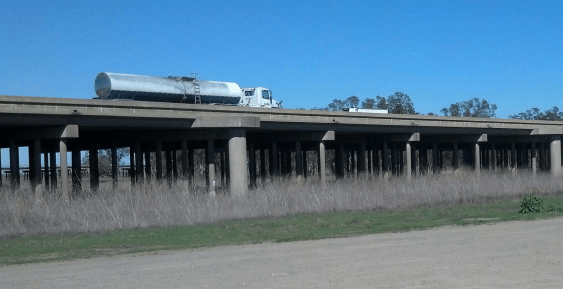
The Natural Resources Defense Council, the Planning and Conservation League, and the Center for Biological Diversity have filed a lawsuit asking the court to reject Caltrans’ environmental impact report for a highway expansion project in Northern California.
The I-80 Yolo Causeway project has stirred up controversy on many fronts, including a charge from a former Caltrans official that it was improperly using funding restricted to repairs for widening the freeway. The California Transportation Commission (CTC) just approved an environmental impact report with a “statement of overriding considerations” that basically states that widening the highway is more important than the health and climate impacts that will result from the expansion.
The lawsuit charges that Caltrans improperly chopped the project into separate pieces to obscure its environmental impacts. The first project is using S.B. 1 highway maintenance funds to strengthen the roadbed along the causeway between Davis and Sacramento. Because Caltrans is calling it a “maintenance” project, no environmental review was conducted. But the second part of the project will take advantage of that new roadbed to restripe the highway with a new lane, expanding capacity.
This second project did produce an Environmental Impact Report, which is the subject of the lawsuit. “The project will impede the state’s climate objectives, worsen air pollution in vulnerable communities, and degrade valuable habitats—without ultimately achieving its goals for reducing traffic congestion,” says the suit. “Caltrans unlawfully failed to adequately analyze, publicly disclose, or mitigate these impacts in its EIR, in violation of the California Environmental Quality Act and the [its] implementing guidelines.”
The lawsuit accuses Caltrans of significantly overstating the congestion reduction benefits of adding a new lane. It further alleges that the traffic models it used are flawed and inconsistent, severely undercounting induced vehicle miles traveled, traffic impacts, greenhouse gas emissions, air quality impacts, and energy use impacts. The EIR did not even address the project’s impacts on wildlife in the Yolo Bypass Wildlife Area, which is on a key migratory path for birds.
Various groups and individuals have raised these concerns throughout the project planning process. But Caltrans has a deadline to get it under construction by fall or lose federal funding, and the questions raised were ignored or inadequately answered by planners and decision makers at both Caltrans and the CTC.
The project is one of the first large ones being planned under new S.B. 743 rules that require Caltrans to account and mitigate for new vehicle miles traveled that would result from the expansion. But Caltrans plans to only mitigate about half of the new induced vehicle miles traveled. The EIR concludes that “the project would have significant and unavoidable impacts on transportation, specifically, vehicle miles traveled (VMT),” but that “the proposed project benefits outweigh the unavoidable VMT adverse impact.”
Presumably those project benefits are the congestion reductions, which an understanding of induced demand would say are a fantasy.
The California Air Resources Board and others have raised concerns about the modeling used by Caltrans in this and other projects. Caltrans itself has acknowledged that because S.B. 743 doesn’t require it to measure induced freight traffic, it is not included in the VMT estimates. That’s contradictory, since the CTC and Caltrans also tout the benefits to freight trucks from the supposed congestion reductions that a new lane would bring. But easier travel will bring more freight traffic, thus erasing any gains while increasing pollution and greenhouse gas emissions.
Similar concerns – faulty VMT calculations and inadequate mitigations for what will be increased climate-damaging emissions – have arisen in numerous other highway expansion plans throughout the state, including the I-15 in the Inland Empire, Highway 1 in Santa Cruz, and Highway 99 in the Central Valley, among others.
California has to stop expanding highways if it’s going to meet its own climate mandates. But regardless of opinion on that score, these projects show that for Caltrans, the practice of not adequately accounting for the impacts of its projects will continue as status quo unless it is stopped.
The post Environmental Groups File Suit Against I-80 Highway Expansion appeared first on Streetsblog California.

Streetsblog has migrated to a new comment system. New commenters can register directly in the comments section of any article. Returning commenters: your previous comments and display name have been preserved, but you'll need to reclaim your account by clicking "Forgot your password?" on the sign-in form, entering your email, and following the verification link to set a new password — this is required because passwords could not be carried over during the migration. For questions, contact tips@streetsblog.org.