UPDATE: Awful Highway Expansions in Denver and Portland are Facing New Hurdles
Updated | Two state transportation agencies are scrambling after freeway-widening projects in Denver and Portland faced new hurdles about the projects’ costs or destructive effects on the environment.
On May 16, the Colorado Department of Transportation abandoned plans to enlarge a stretch of Interstate 25 through central Denver after acknowledging the project had become too expensive, the Colorado Sun reported.
Then on Monday, Oregon’s DOT declined to defend its environmental review of its plan to expand a swath of Interstate 5 through Portland’s east side after three community groups sued the agency for submitting a slipshod assessment.
The Colorado project is indefinitely delayed, though Oregon claims its project remains still on a 2023-construction timeline, but advocates declared victory after leading campaigns against the boondoggles.
“Community 2, ODOT 0,” said Chris Smith, a co-founder of No More Freeways and one of the plaintiffs who sued ODOT. “We will continue to use the tools at our disposal to demonstrate how ODOT’s proposed freeway expansions are legally incompatible with any coherent, desirable vision of a region with cleaner air, reduced traffic congestion and fewer carbon emissions.”
Denver advocates hailed the state’s decision as an additional step toward eventually removing the freeway altogether.
“In order to make the shift we need to with our transportation funding, we’ll continue calling on CDOT, the Denver Regional Council of Governments, and the city and county of Denver to invest money in public transit projects, not just other highway expansion projects,” said Molly McKinley, policy director of Denver Streets Partnership.
State departments of transportation nationwide have been pouring billions of dollars into highway-widening projects for years after being incentivized to spend federal funds on new projects.
Three years ago, Colorado officials proposed overhauling a 4.5-mile stretch of I-25 between Santa Fe Drive and 20th Street by adding a lane in both directions, arguing it would ease traffic congestion in a corridor that carried 200,000 vehicles a day (Mile High officials did not appear to understand the concept of induced demand).
The state budgeted $60 million to start, part of a $1.6-billion trove of funding for road work across the state. But costs began to escalate and the agency realized it did not have the money to complete the project. And community groups pressured state officials to back off locating highway projects in communities of color that have dealt with air and noise pollution for generations.
Instead, CDOT said it would partner with the Federal Railroad Administration to study how to move rail lines adjacent to the highway and redevelop a rail yard to build a multimodal transit system connecting communities separated by the highway.
The agency didn’t say it would completely abandon the interstate project, but advocates are urging CDOT to remove I-25 from the state’s 10-year plan entirely.
“I do think scrutiny is increasing and advocates are gaining some traction,” said Martha Roskowski, a principal with Further Strategies, a Colorado-based consulting firm. “Most of the victories to date are modest – we succeed in delaying them but not killing them outright.”
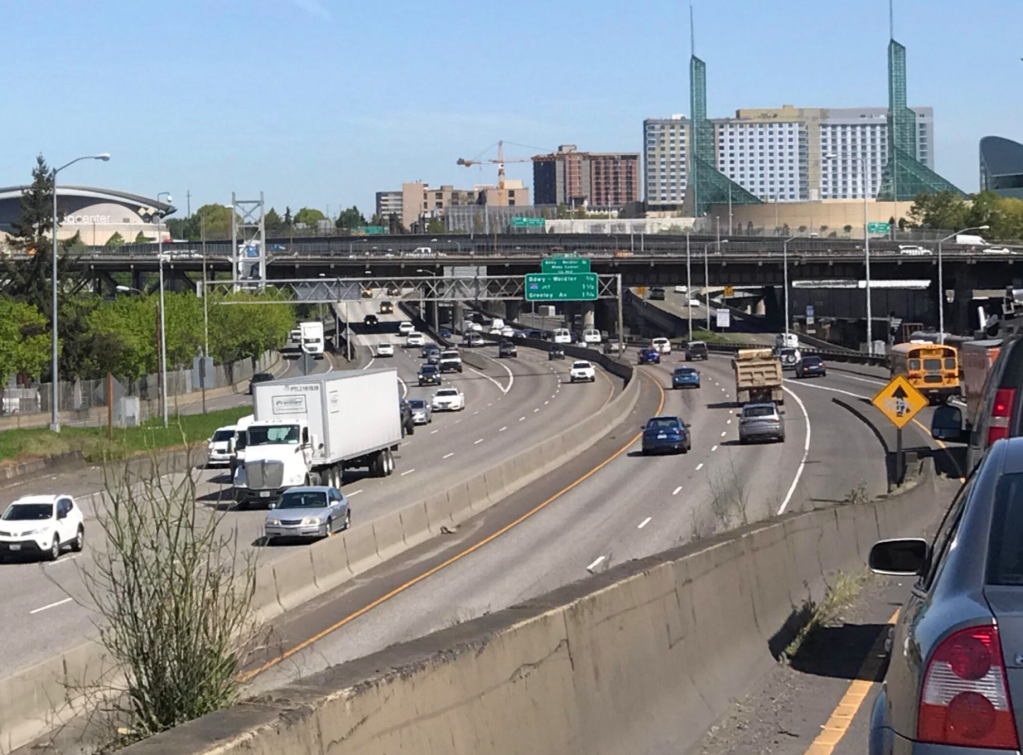
The Portland highway expansion has also been controversial and short of funds. In 2017, the state legislature approved a $450 million plan to widen Interstate 5 through Portland’s Albina neighborhood, a historically Black community obliterated by the highway’s construction in the 1960s. Four years later, the Oregon Transportation Commission approved the plan even as its cost estimate grew to $800 million and then past $1 billion. By January, Oregon transportation officials said the state was half a billion dollars short of the $1.2 billion it needed to build the project.
Soon they ran into another problem when the Federal Highway Administration announced the same month it would rescind an initial environmental approval of the project and require the ODOT to provide an updated assessment of the highway’s effect on the surrounding community.
Several of Portland’s advocacy groups had accused ODOT of ignoring the freeway’s impact on neighborhood air quality, local traffic, and street safety as well as the longstanding devastation to Albina’s Black community in a 2021 lawsuit.
Now that ODOT failed to defend its environmental assessment in court a second time, advocates want to see the state prioritize bicycle and pedestrian infrastructure as well as transit instead of dangerous roadways.
“It’s an outdated albatross of a project that is indicative of state DOTs nationally. We need a managed decline of freeway industrial complex,” Aaron Brown, co-founder of No More Freeways, said. “We have to stop this current iteration to study what the other alternatives are. We’re pointing out that with inflation and cost overruns, these projects will cost billions of dollars that we don’t have and we should be funding other things.”
Story was updated after ODOT claimed its project is not delayed.

Read More:
Streetsblog has migrated to a new comment system. New commenters can register directly in the comments section of any article. Returning commenters: your previous comments and display name have been preserved, but you'll need to reclaim your account by clicking "Forgot your password?" on the sign-in form, entering your email, and following the verification link to set a new password — this is required because passwords could not be carried over during the migration. For questions, contact tips@streetsblog.org.