

America’s Stunted National Debate About Infrastructure
If there’s one message about infrastructure that Americans have had drilled into their heads, it’s this: We need to spend more on it. That’s what the American Society of Civil Engineers keeps saying, and what infrastructure coverage in general interest media keeps repeating.
The White House itself referred to ASCE’s infrastructure report card — hardly the product of a disinterested third party — in announcing its “infrastructure plan” last week.
The Trump claim of investing $1.5 trillion in infrastructure was easily proven a sham. It calls for $200 billion in federal funding over 10 years, with cuts in his budget proposal offsetting the new infrastructure spending the White House laid out. Despite some cringe-inducing headlines, most reporters figured this out.
But when the national debate about infrastructure is limited to the question of whether we’re spending enough, we’re not talking about the infrastructure issues that really matter.
We haven’t delved into fundamental questions like: What should we repair? What should we build? How well are our current investments serving us? Given available resources and the results of past spending, what’s the best way to allocate infrastructure funding?
As Adie Tomer put it at Brookings, the Trump plan “is mostly a vehicle to indiscriminately boost spending” instead of “establishing a clear long-term vision for the country’s infrastructure that supports a more competitive and inclusive economy.”
Put another way, the White House has proposed a method to divide spoils, not to address the nation’s infrastructure needs.
About a quarter of the spending would be reserved for rural areas, guaranteeing a cut for Trump’s base.
About half would go to a discretionary grant program emphasizing private investment. The program would be administered by the White House, giving the Trump team a large pool of funds to dole out as patronage. The type of transportation project this program would favor — privately-financed roads — would both feed sprawl and create new risks for taxpayers.
Meanwhile, the Trump budget calls for cutting off funds to existing transit improvement programs like New Starts, one of the reasons it has accurately been described as an attack on cities.
Nor does the plan address the issue of poor maintenance and “crumbling” transportation infrastructure. America wouldn’t have a problem with decrepit roads and bridges if states focused on fixing existing infrastructure instead of building sprawl-inducing highway expansions. And yet, nothing in Trump’s proposal mandates investment in maintenance, reports Transportation for America.
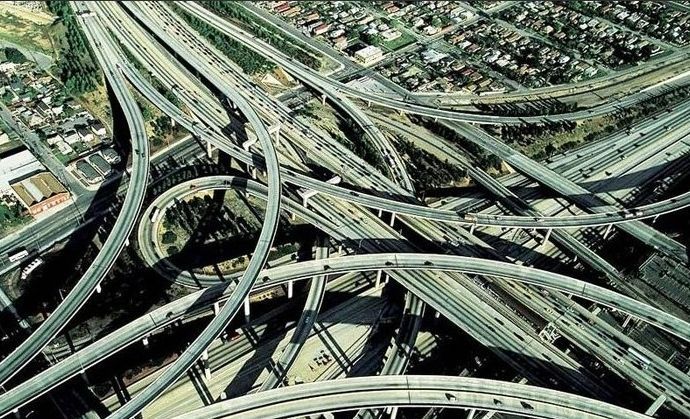
The highway network that began under Eisenhower was essentially completed a long time ago. For years it’s been apparent that road expansion is an increasingly poor fit for cities that are choking on cars, hollowed out by sprawl, or both. But American infrastructure spending continues on autopilot.
Kentucky and Indiana have poured $2.6 billion into two gigantic highway bridges out of all proportion to what Louisville needs. Georgia DOT is building a $1 billion interchange in Atlanta that will make the city’s car dependence problem worse. Colorado is moving ahead with a $1.2 billion highway expansion cutting through asthma-plagued north Denver neighborhoods. The list goes on.
On the local level, there’s clearly a political appetite for a different way of doing things. Voters approve most transit ballot measures, and there’s a trend toward decoupling these local funding packages from road expansion. The emphasis is increasingly on transit, biking, and walking, instead of splitting the baby.
Translating this momentum to the arena of national partisan politics will be challenging, to say the least. When one of the two political parties is institutionally hostile to cities and the people who live in them, filibuster-proof support for changing federal infrastructure policy will be hard to muster.
First, though, we need to talk about what we want federal infrastructure policy to achieve. And right now, we aren’t even having that debate.










Comments Are Temporarily Disabled
Streetsblog is in the process of migrating our commenting system. During this transition, commenting is temporarily unavailable.
Once the migration is complete, you will be able to log back in and will have full access to your comment history. We appreciate your patience and look forward to having you back in the conversation soon.