Big Cuts in Store for Seattle Transit After Voters Reject Ballot Measure
It looks like Seattle’s Prop 1, the ballot measure that could have fended off major cuts for Seattle transit, did not win a majority of the votes in yesterday’s election.
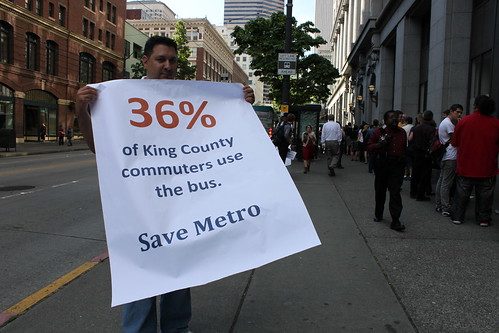
Counting will likely go on for a while now, but early returns show Prop 1 failing by about 10 points. Passage would have prevented Seattle Metro from cutting 17 percent of its service, secured through an additional annual $40 car registration fee and a 0.1 percent sales tax hike.
As Martin Duke at Seattle Transit Blog put it, “The impact will be most severe on the transit-dependent, but commuters of all modes, businesses in dense areas, clean air and water, and public health are all losers.”
Shane Phillips at Better Institutions says state leaders are at fault for deliberately structuring the tax to undermine transit:
The ultimate blame for this failure lies with the state legislature, with it’s Republican-led house, which denied the County the right to adopt more progressive (and more popular) revenue measures. As a result of their failure of leadership, King County had no choice but to propose a regressive, unpopular car tab fee paired with a sales tax increase, and here we are.
Meanwhile, Duke says public officials have to make the most of a bad hand:
It is always imperative that Metro spend its dollars wisely. The King County Executive and Council must exercise real political courage to overcome the forces that resist reform of our route structure. In an expanding service environment, it would be possible to rationalize the system and take care of the scattered losers from any restructure, but today Metro must focus on the serving the most people it can, and the casualties are regrettable but inevitable.
One effect of the cuts will to be consolidate desirable service into a few trunk lines. It is more important than ever that these lines function effectively to avoid the total collapse of the system. In these corridors, cities must ignore complaints from other stakeholders and remove parking or general-purpose lanes to ensure these buses are not stuck in traffic. Moreover, future city transportation levies must invest in priority treatments for buses. The returns from these projects are often astronomical, and if anything the case for them has improved.
In these struggles, we look forward to the support of the many Proposition 1 opponents who were concerned that Metro was not spending its dollars effectively.
Elsewhere on the Network today: NRDC’s Switchboard blog explains how Agenda 21 conspiracy theorists continue to have an outsized impact on policy around the United States. And Bike Portland dishes about the first major speech from the city’s new transportation director, Leah Treat.

Read More:
Streetsblog has migrated to a new comment system. New commenters can register directly in the comments section of any article. Returning commenters: your previous comments and display name have been preserved, but you'll need to reclaim your account by clicking "Forgot your password?" on the sign-in form, entering your email, and following the verification link to set a new password — this is required because passwords could not be carried over during the migration. For questions, contact tips@streetsblog.org.