In Push For Jobs Bill, Obama Picks the Wrong Bridge to Highlight

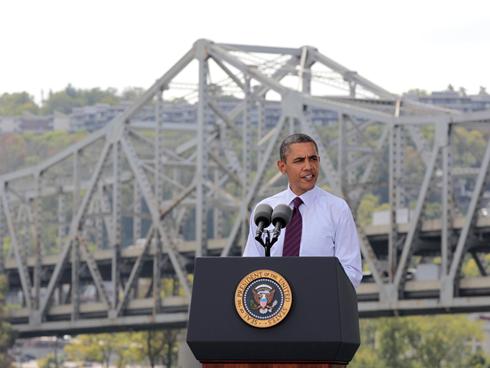
President Obama chose the home turf of two of his principal political opponents to highlight the need for more infrastructure investment in the U.S. Standing beneath the Brent Spence Bridge, which connects Cincinnati (the home city of House Speaker John Boehner) with Kentucky (the home state of Senate Republican Leader Mitch McConnell), Obama made his demand of Congress: “Rebuild this bridge!”
The president was making a push for his $447 billion jobs bill, which could create an estimated 1.9 million jobs.
The Brent Spence Bridge is considered “functionally obsolete.” “It’s safe to drive on, but it was not designed to accommodate today’s traffic, which can stretch for a mile,” Obama said.
Many transportation reformers would rather see transportation agencies attend to “structurally deficient” infrastructure — which is not safe to drive on, despite the fact that thousands of people do it every day — instead of widening safe, existing roads. This particular bridge project, which local smart growth advocates have been warning about for years, would add more lanes and induce sprawl.
In a post earlier this summer, Jake Mecklenbourg of UrbanCincy criticized the bridge widening project and refuted the claim that the project is of national importance because it lies on a primary trucking route. “The Brent Spence Bridge, like most urban interstate bridges, primarily serves local commuters and delivery trucks,” he wrote. “For fifteen years after its construction it was the region’s only interstate highway crossing. But between 1977 and 1979, three other interstate highway bridges opened nearby, providing numerous alternative routes through the Cincinnati area for long-distance travelers.”
Transportation reform groups have long opposed a bias toward lane widening, as opposed to repairing structurally deficient bridges. “While the road builders have long reaped higher profits by lobbying for new roads and more lanes, we cannot afford to waste scarce taxpayer dollars on new capacity before we fix what we already have,” said U.S. PIRG Tax and Budget Associate Dan Smith.
U.S. PIRG supports the infrastructure proposal contained in the president’s jobs bill. Regardless of the particular bridge Obama chose as the setting for his speech, Smith said the president was on the right track by pushing for repairs and maintenance of existing infrastructure — especially if the goal is job creation. “Road and bridge repair projects have been shown to create 16 percent more jobs than building new roads, and there are over a million construction workers looking for a job,” Smith said. “We should put them to work making our roads safer.”

Read More:
Streetsblog has migrated to a new comment system. New commenters can register directly in the comments section of any article. Returning commenters: your previous comments and display name have been preserved, but you'll need to reclaim your account by clicking "Forgot your password?" on the sign-in form, entering your email, and following the verification link to set a new password — this is required because passwords could not be carried over during the migration. For questions, contact tips@streetsblog.org.