Does It Make Sense for Transit Agencies to Pay for “Last Mile” Uber Trips?
Should transit agencies subsidize short “last-mile” Uber trips to expand transit access for people who live outside comfortable walking distance of a train station?
Columbus, Ohio, has proposed something along these lines as part of its application for U.S. DOT’s Smart City Challenge. The city is one of seven finalists competing for a $50 million federal grant.
New technologies associated with ride-hailing services like Uber and Lyft make such a program more feasible, but is it a good idea? In a new report, the Center for American Progress explores how such a program might work for low-income residents of Atlanta.
CAP’s Kevin DeGood and Andrew Schwartz don’t reach a firm conclusion about the merits of such a program, but their report suggests it would have very limited impact.
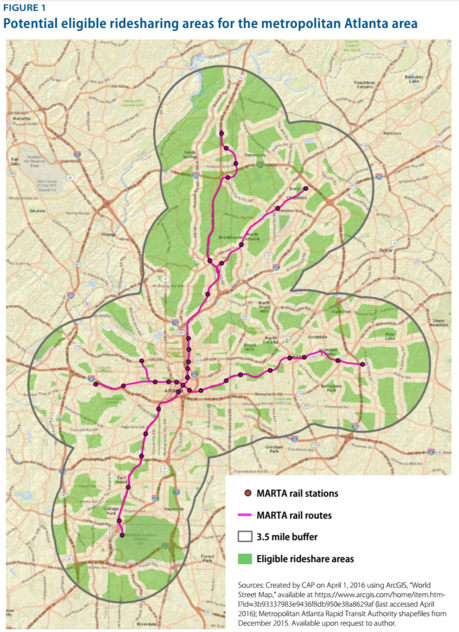
They start by defining who would be eligible for the subsidized ride-hailing program, mapping out a radius of 3.5 miles from MARTA stations while excluding areas closer than half a mile away from a MARTA rail station or a quarter mile away from bus lines that connect to rail.
In one of their scenarios, any commuter living in that zone who doesn’t own a car would be eligible for a $3 ride-hailing subsidy for each trip to or from work. That would reach an estimated 8,300 people and cost $12 million per year.
In the other scenario, the same subsidy would be available for workers in households below the poverty line with three or more children, regardless of car ownership. CAP estimates this would encompass 3,300 people and cost $5 million per year.
Participating commuters would pay for the remainder of each ride-hailing trip, which is no small sum over the course of a year. On average, DeGood and Schwartz estimate it would cost each commuter $2,150 annually. That doesn’t include the cost of MARTA fares, and it assumes no surge pricing.
Low-income households spend about $2,000 per year to own a vehicle, according to CAP, so even with the subsidies, participants would on average pay more for the ride-hail portion of their commutes each year than they would to own a car. This strongly suggests that the number of people who participate would be much smaller than the number of people eligible for the subsidy. CAP does note, however, that vehicle costs for low-income households tend to be highly variable, because older cars break down and need expensive repairs, so the costs of a ride-hail-plus-transit commute would be more predictable.
But would this be a worthwhile way for MARTA to spend its money? Using federal transit funds for this purpose would require a change in current law, and even if MARTA could do it, right now the agency doesn’t have any federal funds to spare. DeGood and Schwartz note that “by almost any account,” current federal funds “are insufficient to meet the true ongoing capital needs of MARTA.”
What about MARTA’s operating funds? DeGood and Schwartz say such a program might be preferable to using the money to increase bus service:
Subsidizing ridesharing would expand access to people who are largely excluded and would provide a major improvement in their ability to access employment and other essential services — a change that could prove transformational to a qualified individual or family.
But it’s not clear that ride-hail subsidies would increase opportunity and access to jobs for more low-income households than spending the same amount on more frequent bus service.
While it’s interesting to see some analysis of how ride-hail-to-transit subsidies for commuters might work, it’s still hard to discern a concrete benefit compared to plain old bus and train service.

Streetsblog has migrated to a new comment system. New commenters can register directly in the comments section of any article. Returning commenters: your previous comments and display name have been preserved, but you'll need to reclaim your account by clicking "Forgot your password?" on the sign-in form, entering your email, and following the verification link to set a new password — this is required because passwords could not be carried over during the migration. For questions, contact tips@streetsblog.org.