Our Best Bet To Confront Climate Change in the Trump Era? Build More Apartments

In politics, it’s often said that ‘perceptions are reality.’ Less noted is the inverse: what’s not perceived in politics may as well not exist.
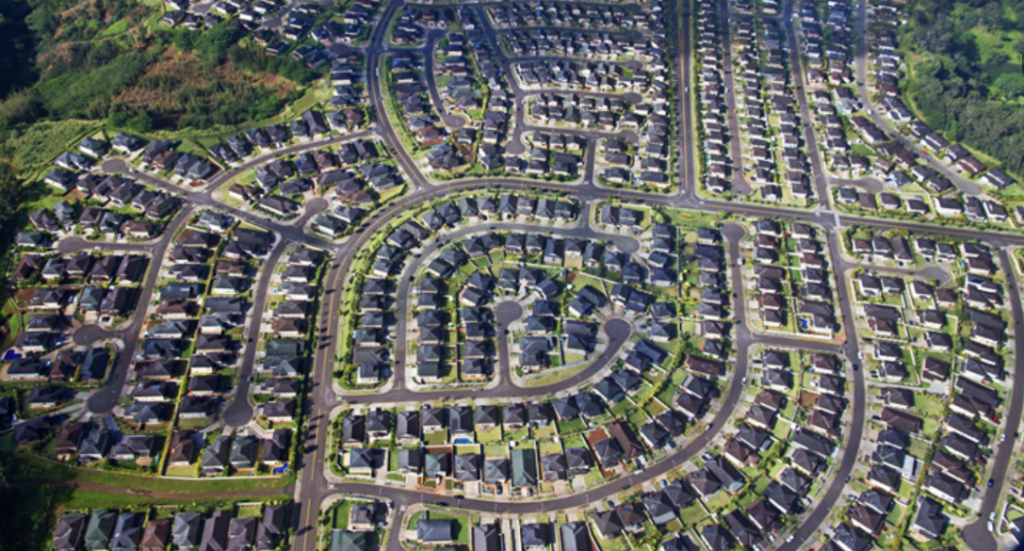
This corollary is a surprise blessing for the climate during the Trump era, because few even perceive one of the biggest fixes to global warming. Apartments are a stealth climate solution that slash pollution on an epic scale. Emissions-wise, they are to detached houses what Chevy Bolts are to Cadillac Escalades — climate heroes hidden in plain sight.
They are also currently illegal, by dint of local zoning, on more than 95 percent of America’s residential land.
Allowing apartments in more places would unleash the private construction of millions of new flats in American cities, suburbs, and towns. And doing so is now politically possible, thanks to the budding pro-homes or Yes In My Back Yard (YIMBY) movement.
More than a quarter of US residences are apartments, and their share is growing. Apartments use less energy, land, and materials than houses. They concentrate in the walkable centers of cities and towns, where proximity lets apartment dwellers drive less than house dwellers.
Apartments are also ahead in the race to electrify. The power grid is quickly greening, so electric heat pumps, water heaters, and induction cookers are keys to decarbonizing homes. More than 75 percent of new apartments heat their space and water with electricity, while only about half of new houses do.
The climate upside of less driving, land, materials, and natural gas compound. Living in urban high-rises typically causes one-third the climate damage of living in detached suburban houses. Living in low-rise apartments usually causes half as much.
In many cities, allowing more homes in built-up neighborhoods is the single most impactful emissions strategy that’s fully under local control, and new research shows liberalizing in-town homebuilding can bring climate benefits quickly.
This climate case for apartments is unfamiliar, though — which is good news for nature, considering that the climate movement has been clotheslined by right-wing populism since November 2024.
Almost anything that counts as climate action is getting purged in the dragnet of the Trump administration’s hostility to the word “climate.” Same goes for the 23 states run by Republican trifectas and the 12 states with divided governments. Even in the 15 Democrat-run blue trifecta states, climate action is often hamstrung by federal opposition.
So it’s a good thing that many more Americans would choose apartments were they available — and that more apartments would actually be available if zoning codes did not ban them from all but a tiny sliver of residential land. Moreover, housing is a top-tier priority across the partisan spectrum for entirely unrelated reasons.
With a housing shortage estimated at 5 million missing dwellings, cut-throat competition has spiked housing costs and helped make “affordability” the word of the year in US politics. Expensive housing leads polls for political concerns in many cities, and it’s entangled with homelessness and public disorder, other poll-topping concerns that it worsens.
It’s an especially good thing that across North America, the pro-homes movement has been winning with bipartisan support—everyone from property-rights Republicans to social-justice Democrats. This fact makes housing reforms winnable at times when other priorities are not.
Pro-homes advocates have already won statewide reforms to allow more apartments close to transit stations in California, Colorado, Massachusetts, and Washington. They won reforms welcoming apartments in commercial zones across Montana, Texas, and Washington. And in a recent win in Oregon, they pioneered a promising new strategy for apartment legalization in large sections of every city. The movement even found bipartisan support in the most polarized legislature on the continent: the 119th Congress.
To date, the pro-homes movement’s record of success has come surprisingly cheap, spending only about $40 million a year. That’s just one percent of the $4 billion that the climate movement spends annually in the United States.
Notably, though, the housing movement is the one with room to run. Even shifting one percent of US climate funding to apartment legalization would more than double the latter’s support.
That added support could let the pro-homes movement unleash construction of millions of homes in all-electric, walkable, low-carbon buildings in blue and red states. These apartments can house grateful Americans, lower rents, and chip away at homelessness. They can also keep megatons of carbon dioxide out of the atmosphere — a reality that will slow climate change, regardless of perceptions.

Alan Durning is founder and executive director of Sightline Institute, a nonpartisan, nonprofit research organization in Seattle, and author of the report Apartments Are the Climate Solution Hiding in Plain Sight.
Read More:
Streetsblog has migrated to a new comment system. New commenters can register directly in the comments section of any article. Returning commenters: your previous comments and display name have been preserved, but you'll need to reclaim your account by clicking "Forgot your password?" on the sign-in form, entering your email, and following the verification link to set a new password — this is required because passwords could not be carried over during the migration. For questions, contact tips@streetsblog.org.