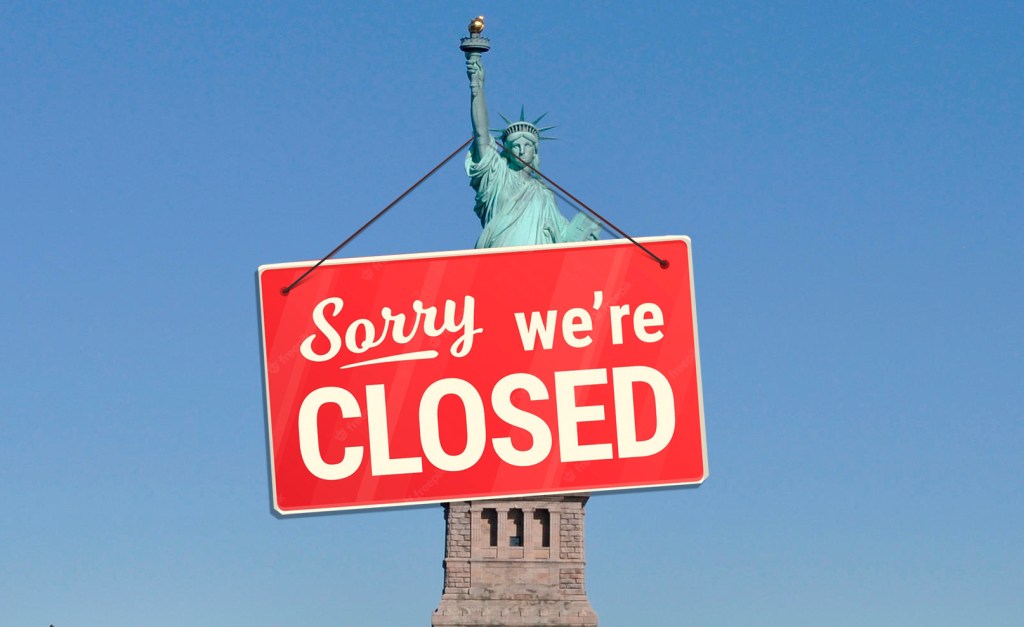
Democrats Push For High-Speed Rail Investment Amid GOP Highway Feeding Frenzy
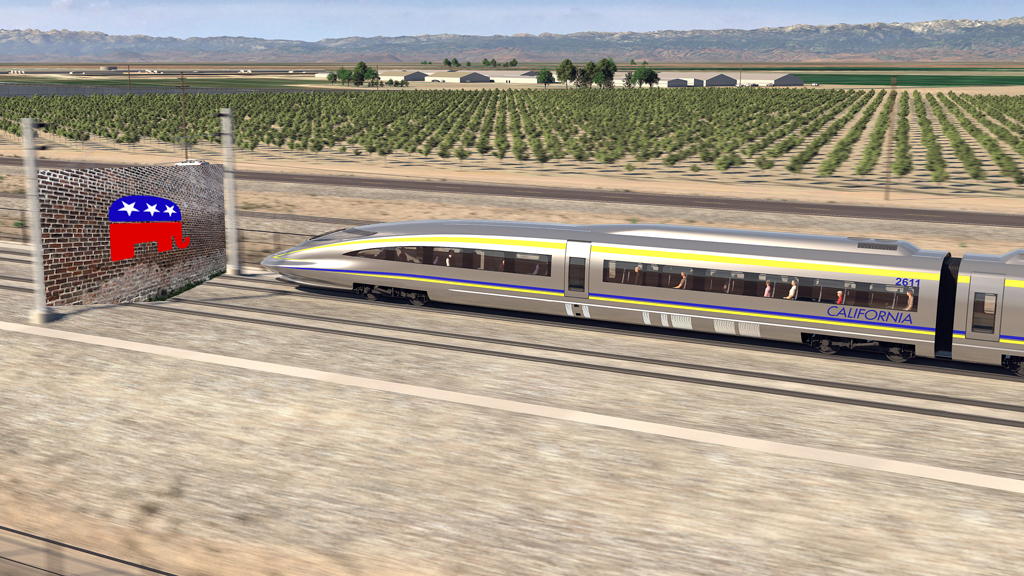
The federal government would be required to set aside a portion of future transportation funding for high-speed rail under a new Congressional bill aimed at countering a Republican-led bid to just keep building highways.
Rep. Seth Moulton (D-Mass.) has re-introduced the American High-Speed Rail Act, which authorizes $205 billion over five years to boost high-speed rail and, most important, would make funding for high-speed rail development automatic rather than subject to normal annual appropriations.
“America deserves the same world-class high-speed rail system that other countries have had now for decades,” said Moulton. “This isn’t just about improving convenience, it’s about creating smart, business-driven investment that will create millions of good-paying jobs, connect communities big and small, fight climate change, and ensure America leads the way in the infrastructure of the future.”
The bill puts an emphasis on transit-oriented development, expanding incentives to ensure that new rail hubs catalyze affordable housing and commercial growth in surrounding areas. It also has provisions that would encourage private investment through grants and loan eligibility and increase funding flexibility for the timing and sources of the non-federal costs.
“This legislation marks a transformative step toward creating a more connected, sustainable, and prosperous future for all Americans,” said Rep. Suzan DelBene (D-Wash.), a co-sponsor. “By investing in a national high-speed rail network, we are not only alleviating strain on our highways and airports and creating safer communities, but we are also strengthening productivity and lowering carbon emissions.”
The bill would be a necessary counterweight to the BUILD America 250 Act currently making its way through negotiations.
As Streetsblog USA has reported, the House’s proposed infrastructure legislation would be uniquely bad for passenger rail. Unlike Moulton’s proposal, it does not fund any specific funding beyond what’s secured by the Highway Trust Fund.. The proposed bill also contrasts the robust Biden-era Bipartisan Infrastructure Law, expiring on Sept. 30, that secured record amounts of funding for rail projects.
Crucially, roughly $475 billion of the $580 billion that the BUILD American 250 bill would allocate over its five years is automatically set aside for highway funding without requiring annual appropriations. Meanwhile, the remaining $106 billion for transit will be subject to the give-and-take of the annual appropriation process, which, as NACTO put it in a statement, “makes it more challenging for local agencies to plan and build transit projects, as funding is not guaranteed.”
Never a better time
The guaranteed high-speed rail funding would come as crucial high-speed rail projects — such as the California High-speed rail project between San Francisco and Los Angeles and another between Chicago and St. Louis — are struggling to get off the ground.
The latter proposal, in particular, could use the funding guarantee after commissioners of the Illinois High Speed Rail Commission objected to the most recent cost and ridership projections.
The Commission has focused on the route that has the highest projected ridership of the options and is uniquely well-positioned for development because it’s wholly contained in Illinois. The line is projected to see over 2.8 million riders annually, almost five times the current annual ridership. The journey would be two and a half hours, a dramatic improvement from the four-and-a-half-hour car ride and the five-hour Amtrak offering.
Questionably, the projections did not account for any future transit-oriented development, underestimating the broader effects of the project. Their projections also don’t consider positive effects on the greater Midwest region.
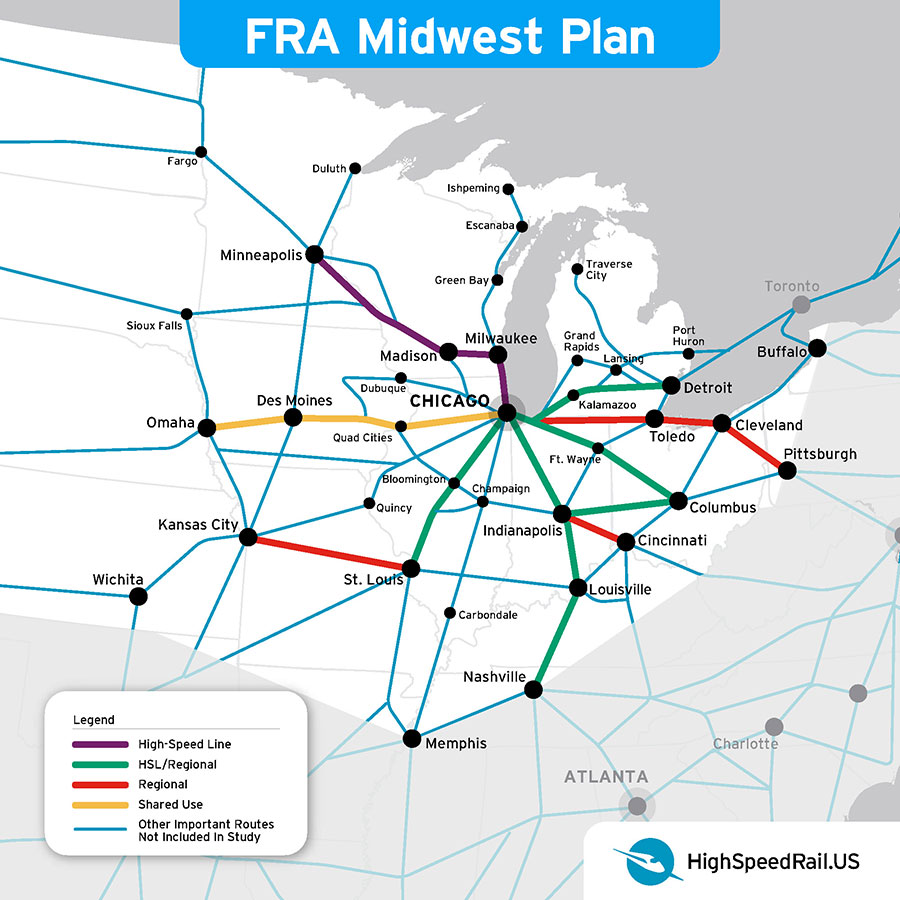
The High Speed Rail Alliance’s vision for a network in the Midwest hinges on Chicago as a core driver of intercity ridership in the network, with lines branching out to other midwestern hubs like Minneapolis-St. Paul, Indianapolis, and Cincinnati.
Also overlooked in the projections is induced demand — the principle that increasing the supply or quality of something makes consumers want more. It’s often applied to “one more lane” highway expansion that leads to something like the 26-lane Katy Freeway in Houston.
The same logic applies to high-speed rail. Building it will make taking the train more attractive — it will then be faster, cheaper, and more convenient — leading to higher ridership.
For example, the Amtrak Borealis line between St. Paul and Chicago debuted in May 2024 and it beat projected ridership by nearly 60 percent even though it is just regular passenger rail service,.
The line’s success shows that demand for safe, reliable transportation options for Americans is there and is often underestimated. A frequent and reliable high-speed option would only make the offering that much sweeter for passengers.
Americans are ready for a high-speed rail network.
In a survey conducted for the U.S High Speed Rail Association, 72 percent of registered voters say that they support creating a nationwide high-speed rail network.
The survey tells us that Americans are tired of lackluster rail options.
Rail investment in the most-densely populated regions in the country is a no-brainer. High-speed rail connections in cities like Chicago and San Francisco that already have robust public transit networks would eliminate many car trips and lead some residents to abandon the costs and hassles of car ownership entirely.
For more information, visit the High Speed Rail Alliance.

Streetsblog has migrated to a new comment system. New commenters can register directly in the comments section of any article. Returning commenters: your previous comments and display name have been preserved, but you'll need to reclaim your account by clicking "Forgot your password?" on the sign-in form, entering your email, and following the verification link to set a new password — this is required because passwords could not be carried over during the migration. For questions, contact tips@streetsblog.org.