Urban Truth Collective: Straight Talk About The Joy Of Cities In An Age Of Disinformation
Fifteen-minute cities are open air prisons. There’s a war on cars. Homelessness has nothing to do with housing. Wider, faster roads and highways are an improvement.
When it comes to cities, we’re inundated with lies like these.
But it makes no sense that we should be afraid of places where people can get most of what we need, closer by. Maybe our kids can even walk to the store! No walls, no guards – just convenient options that don’t need a car every time. It’s just a normal, “common sense” place to live — as most cities used to be, before we mandated car dependency.
It makes no sense to claim that there’s a war on cars and motorists, when if anything, there’s been a war on walking. Over the last 70 years, human settlements have become less dense through the deliberate subsiding of driving, including land-use laws that promote sprawl, and decisions that make walking, cycling, and public transportation more difficult by design. This is not some “lefty propaganda hyperbole” — The American Conservative goes so far as to use the term “asphalt socialism” to refer to this relentless prioritization of driving far above everything else.
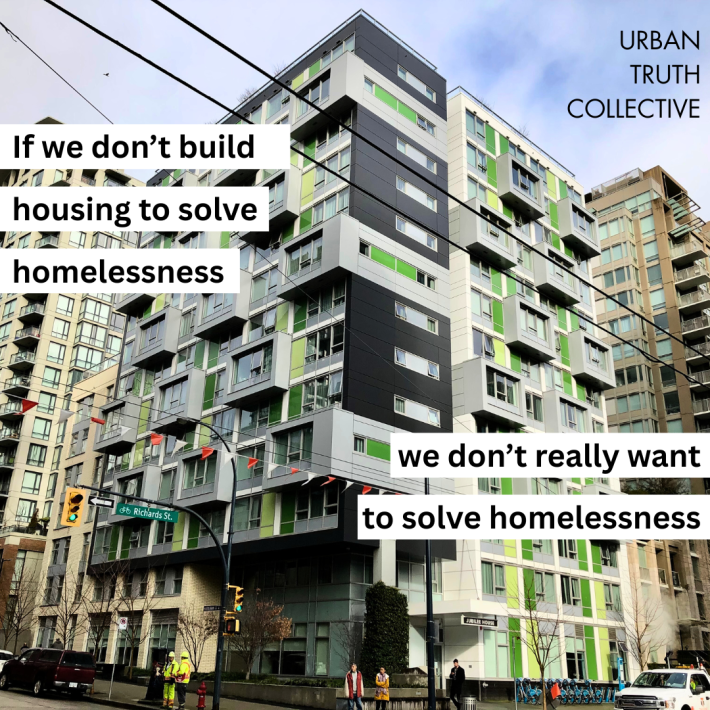
It makes no sense to say that solving homelessness doesn’t start with, and is entirely dependent on, actually building homes for the unhoused, and the amount of available housing. Eighty-five percent of San Francisco is zoned so that it’s illegal to build apartments. How could anyone fail to connect a crisis of homelessness with an absence of homes? Plus we know that housing the unhoused actually saves public money.
It makes no sense to deny that wider roads incentivize faster speeds, and lead to more road crashes, injuries, and deaths. Yet countries and cities around the world are still legitimizing road widening and even new highway-building inside cities, and still have the nerve to claim they’ll improve congestion (they won’t, they’ll induce more driving/traffic) and reduce emissions/pollution (they’ll do the opposite – we’ll have more cars in the same or worse congestion emitting a lot more). Orwell is rolling in his grave.
This week, to combat this constant stream of lies and disinformation that undermines our progress toward better city-building, we launched the Urban Truth Collective – a collaboration to bring together better city-building ideas and knowledge, with better communication, marketing and branding. The collective is led by the three of us: one, a well-known global city planning practitioner and urbanist; another, a marketing expert who used to work for car companies and now markets better streets and cities; and the third, a respected researcher and author (read “Dark PR: How Corporate Disinformation Undermines our Health and the Environment”). We three friends launched this, but it’s designed to grow, with the kind of diverse perspectives and ideas that reflect what make cities great.
Along with our many like-minded allies and collaborators in professional city-building practice, media, communications, marketing, politics, advocacy/activism, research etc, we will work to be more clear and persuasive. Not just when it comes to debunking what isn’t true and doesn’t work — but also championing more effectively what does.
We know that disinformation isn’t limited to electoral politics, space lasers, microchips, lizard people, or tin foil hats. It’s been landing hard in the cities we live in and love.
Collectively, we’re going to share the truth persuasively, create campaigns and brands that break through the noise and support better decisions, and go straight at the liars and the lying campaigns. We’ve let the lies be far too successful, and that’s significantly hurt our cities. No more.
We’ve seen in the past that better ways can work. As a “small” but important example, the work of Transportation Alternatives and others to change the narrative around collisions from “accident” to “crash” within the professional community, and increasingly among journalists at large, has been successful and badly needed. They identified the lie, created a counter-campaign, and fought hard to change the narrative. And they’re succeeding, despite it not being easy.
Once we change the conversations and narratives, it doesn’t end there. Ultimately, it’s about the decisions we make, especially the collective decisions. We need to build on the momentum of cities that have made real change, like Minneapolis who have rezoned much of its land for higher density living, significantly mitigating housing price increases. Or the great many cities around the world that have rethought harmful parking minimums, even turning them into parking maximums. Or Paris, which rapidly transformed its streets for pedestrians and cyclists, to be more green and better people-places, inspiring cities all over the world to do better, faster.
Unfortunately, as was seen in the case of the “15-minute cities” concept, disinformation campaigns against better urban environments can be strong and successful, even if they make no sense. Some urbanists claim that particular manufactured controversy has “died down,” but the truth is that in many ways, the disinformation achieved its goal. Many cities now avoid using the term at all, and are even careful about talking about having more things close-by in other ways, lest they be accused of “pushing that 15-minute city agenda”!
That’s a shame, as in cities like Paris where civil society and Mayor Anne Hidalgo were able to push through the lies, the benefits have been truly remarkable. Air pollution is at record lows. Road deaths are decreasing. Children play on the streets again. Any city that can overcome the lies and disinformation — and enjoy the results.
Our soft launch of the Collective has already created a lot of buzz, and quite a bit of expectation (which to be honest makes us both excited and quite nervous, since we’re busy people doing this off the sides of our desks). But it’s been a great start. Now the real work begins, for all of us. The graphics in this article are our first three simple ads – we’ll be doing a lot of those, plus some much more ambitious media.
We’re exploring how to grow and to collaborate most effectively, but we’re deliberately already “flying the plane while we build it.” We’re talking to publications, podcasters and video-makers, and organizations discussing collaborations. We’ll be writing op-eds and doing interviews to keep getting the word out about the truth about cities, and how we’re doing it.
Please keep reaching out to us with your ideas, and your enthusiasm. Check out our website, urbantruthcollective.com. Follow us on social media (we’re on Bluesky, Instagram and LinkedIn) and please help us share our content widely. And share with us your OWN great, persuasive content that calls out the lies and tells the truth more persuasively.
As the top of our website says, a better world requires great cities, communities, streets, and places, and the path to get there starts with the truth.

Brent Toderian is an influential city planner and urbanist who advises cities all over the world, the former Chief Planner for Vancouver, Canada, and a popular writer and speaker on cities.


Read More:
Streetsblog has migrated to a new comment system. New commenters can register directly in the comments section of any article. Returning commenters: your previous comments and display name have been preserved, but you'll need to reclaim your account by clicking "Forgot your password?" on the sign-in form, entering your email, and following the verification link to set a new password — this is required because passwords could not be carried over during the migration. For questions, contact tips@streetsblog.org.